

anyword
Anyword · Writing
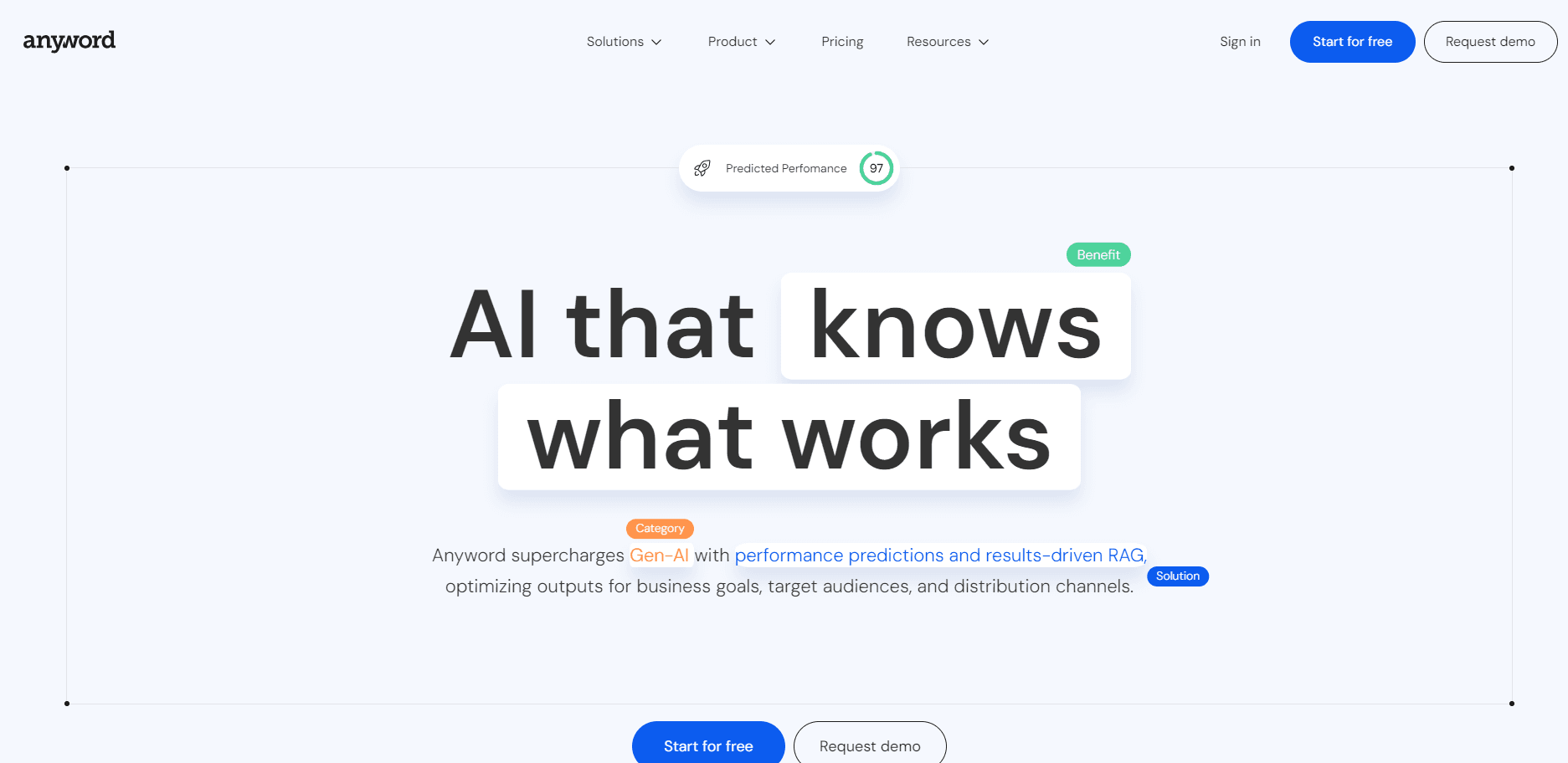
Anyword is an AI content platform that predicts how marketing copy performs, so growth teams publish higher-converting text.
About anyword
What Is Anyword
Anyword is a performance-driven AI writing tool built for go-to-market teams, meaning the people who run marketing, growth, and brand campaigns. The pitch is simple. Instead of just generating text, it scores that text and predicts which version will earn more clicks, conversions, or engagement. Anyword says its model picks the right choice about 82% of the time, and it points out that a plain model like GPT-5 gets it right only about 52% of the time. That gap is the whole product. Numbers like that are easy to market and hard to verify.
The platform leans on a large library of A/B test data from real marketing campaigns. Paste a headline or ad into the Data-driven Editor, and Anyword compares it against that library and flags the variants most likely to win. If your team already lives inside ChatGPT, Notion, or Gemini, Anyword plugs in as an add-on that carries its predictions and brand rules straight into the tools you open every morning.
The catch is the audience. Anyword is a marketing and content operations tool, not a general writing assistant for essays or fiction.
The most useful features, like custom integrations, a private language model, and the API, sit on the higher tiers, which means a small team often has to pay for an enterprise plan just to reach the workflow automation it actually needs.
Anyword's editorial team has spent years collecting A/B test results from real marketing campaigns, and that private dataset is the reason its predictions beat what you'd get by asking a general-purpose chatbot to guess which headline wins.
Getting Started
- Create an account on the Anyword site, ideally with a work email so your brand content stays in one workspace.
- Set up a brand voice by adding your tone of voice, target audience, and any messaging guidelines you want the AI to follow.
- Pick a template or open the Data-driven Editor, then paste a draft or generate fresh copy from a short prompt.
- Review the performance score on each variation and use the top pick, or export a CSV to generate copy in bulk.
- Install the Chrome extension or connect the API if you want predictions inside other tools and workflows.
Product Information
A quick look at anyword's pricing, supported platforms, and performance.
Best for
The users, tasks, and scenarios where this tool fits best.
Users
- Marketing and growth teams
- Content managers overseeing brand voice
- Paid ads and demand gen specialists
Tasks
- AI copywriting and ad ranking
- Drafting blog posts and landing pages
- Improving existing content
- Bulk copy generation
Scenarios
- Preparing a product launch
- Stretching an email program
- Running paid campaigns on a fixed budget
Key features
Performance Prediction
This is the feature everything else supports. Anyword scores each piece of copy and predicts which variation will perform better for a given audience, goal, and channel. According to the company, the model is about 82% accurate at picking the winner. A general-purpose model lands near 52%. For a growth team, that means fewer published guesses. Predictive copywriting, in practice, replaces a lot of gut feeling.
Data-driven Editor
The editor analyzes your draft as you write and highlights the phrasing most likely to convert. You don't need a live test to choose a version. It's the most direct way to use Anyword if you already have copy. Just paste it in and see which line to keep.
Brand Voice Controls
You set the tone, audience, vocabulary, and messaging rules once, and the AI applies them across every draft. This matters for teams where several writers touch the same campaigns. It keeps output on-brand without a human reviewing every line. The number of brand voices you can store depends on your plan.
Works With Your Existing Tools
Anyword connects to tools teams already use, including ChatGPT, Notion, and Google Gemini. Rather than replacing them, it adds its predictions and brand context on top. Like your current writing app? This is the least disruptive way to bring performance data into it.
API and Integrations
Higher-tier plans expose an API, so developers can pull performance predictions and brand context into their own applications. Custom integrations and a private language model are also reserved for enterprise pricing. This is the main reason a larger company would upgrade.
Content Intelligence
Content Intelligence compares your published content against Anyword's industry-specific test data and surfaces where you're leaving performance on the table. It works on pages you've already shipped, not just new drafts. It's an audit that keeps running. Small detail, big payoff.
Multi-language Support
This AI marketing content generator handles more than 30 languages, which helps teams localize campaigns without rewriting them from scratch. The prediction data is strongest for English. Treat scores in other languages as directional, not final. Don't bet a campaign on them.
Pros and cons
Pros
- Predicts copy performance before publishing, which cuts how many live A/B tests a team needs to run.
- Deep brand voice controls keep tone and messaging consistent across many writers and channels.
- Plugs into ChatGPT, Notion, and Gemini, so it adds to tools you already use instead of replacing them.
- Supports over 30 languages and offers an API on higher tiers for custom workflows.
- Meets enterprise security standards, including SOC 2, ISO, GDPR, and HIPAA, with SSO and role-based permissions available.
Cons
- It's aimed at marketing teams. General-interest writers will find it overpriced for what they need.
- Pricing is per seat, and extra seats cost $59/mo monthly or $49/mo yearly, which gets expensive as a team grows.
- The strongest features, like the API and a private language model, sit on enterprise plans with custom pricing.
- Prediction accuracy outside English is less clear, so non-English scores are harder to trust.
Frequently asked questions
Anyword is used to generate and score marketing copy. Teams write ads, landing pages, emails, and blog posts, then use Anyword's performance scores to pick the version most likely to convert.
Related content
Explore related tools, skills, and articles for anyword.
anyword Alternatives

Google EmbeddingGemma 2
Google DeepMind · Writing · Image · CodingGoogle EmbeddingGemma 2 is a 740M-parameter open model that turns text, code, images, audio, and video frames into vectors in one 768-dimension space, running on phones and laptops.

MePersona
MePersona, Inc. · Writing · Productivity · MarketingMePersona is an AI unified inbox for creators. It learns your voice, drafts replies to fan messages from 12 platforms, and sends only what you approve.

Fluence
Yay Software (Yannick Huchard) · Writing · Voice & Language · ProductivityFluence is an Android app that reads PDFs, EPUBs, Word files and web articles aloud, follows each sentence as it speaks, and answers questions about the text on the phone itself.