

Apex.AI
Apex.AI, Inc. · Other
Apex.AI builds Apex.OS, a safety-certified software foundation that helps automotive and robotics teams move ROS 2 prototypes into production vehicles and machines.
About Apex.AI
What Is Apex.AI
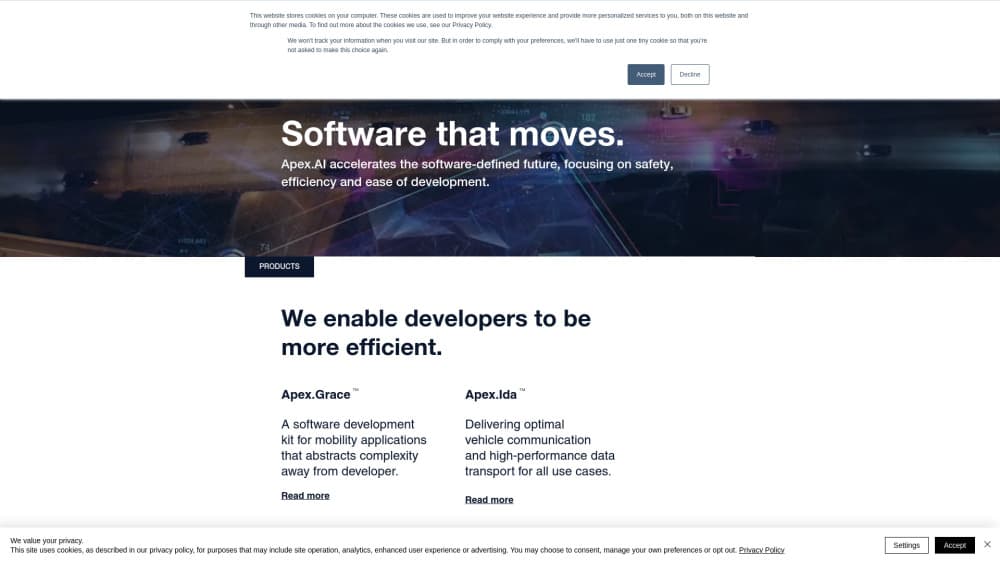
Apex.AI is a software company founded in 2017 by Jan Becker and Dejan Pangercic, headquartered in Palo Alto with engineering offices in Munich, Stuttgart, Tokyo and Pangyo. It sells safety-certified software for mobility systems, and its flagship product is Apex.OS, a bundle of two parts: Apex.Grace, the application runtime, and Apex.Ida, the communication middleware.
The problem it addresses is well known to anyone who has shipped a robot. ROS 2 is excellent for prototyping, but the open-source stack was never built to satisfy ISO 26262. Teams that validate an algorithm on a research vehicle usually rewrite it from scratch for production, which costs years and throws away tested code. Apex.AI forks proven open-source components, adds functional safety, determinism and tooling, then certifies the result. Apex.Grace reached ISO 26262 ASIL D, the highest automotive safety level, and the company reports more than $75 million raised from investors including Toyota Ventures, Volvo Group Venture Capital, ZF, Continental and LG Electronics.
The main limitation is access. Apex.AI sells to OEMs, Tier 1 suppliers, semiconductor vendors and robotics firms through direct contracts. There is no self-serve signup, no public price list and no free tier, so an individual developer cannot evaluate the SDK without going through a sales conversation. Support is tied to specific operating systems and hardware boards, which means your target ECU has to be on the qualified list before you commit.
Getting Started
- Contact the Apex.AI team through the website and describe your platform, your target safety level and your timeline. Evaluation access, NDAs and quotes all run through that conversation.
- Install the Apex.Grace SDK on a supported operating system, typically Linux for development and QNX or Linux with real-time patches for the target hardware.
- Port your ROS 2 nodes. The core APIs mirror ROS 2, so most packages compile with small changes to build files and quality-of-service settings.
- Configure Apex.Ida for data transport. Pick shared memory for on-board traffic, then add DDS, SOME/IP, CAN or MQTT connectors where the vehicle network needs them.
- Validate with record and replay, run your safety analysis, and hand the evidence package to your assessor.
Product Information
A quick look at Apex.AI's pricing, supported platforms, and performance.
Best for
The users, tasks, and scenarios where this tool fits best.
Users
- Automotive software teams at OEMs and Tier 1 suppliers
- Robotics and agriculture companies building certified machines
- Defense and UGV programs
Tasks
- Porting a ROS 2 autonomous driving software stack to production
- Consolidating sensor data on a single ECU
- Building a software-defined vehicle architecture
Scenarios
- Moving a research vehicle program toward a SOP date
- Running mixed-criticality workloads on one chip
- Recording and replaying large sensor logs
Key features
ROS 2 Compatibility Without a Rewrite
Apex.Grace keeps the ROS 2 publish and subscribe model, the request and reply pattern and the node lifecycle that most teams already know. Extensions cover real-time execution, system state management and fleet deployment. In practice your prototype code survives the jump to production, which is the whole reason teams pick this stack over AUTOSAR Adaptive.
ISO 26262 ASIL D Certification
The runtime is certified to ASIL D, the strictest level in the automotive functional safety standard, and the company states the assessment was done by TÜV NORD. That certificate is what lets an OEM put the software on a safety-critical path without rebuilding the framework from scratch. You still certify your own application, but you start from a qualified base.
Deterministic Executor
The executor lets integrators group work into single items, sequential chains or directed acyclic graphs, then run them on a thread pool. Thread priorities, core affinities and scheduling policies are all configurable. Separating application logic from execution policy means the same code can meet a hard real-time budget on one ECU and a softer one on another.
Zero-Copy Data Transport With Apex.Ida
Apex.Ida routes messages through shared memory and avoids the copies and context switches that eat latency in a normal DDS setup. Apex.AI reports throughput in the hundreds of gigabits per second for embedded targets, with low jitter under load. For a perception pipeline pushing multi-megabyte camera frames, that difference shows up as stable timing instead of spikes.
Protocol Bridges for Real Vehicles
A single application-facing API sits in front of DDS, SOME/IP, MQTT, CAN and WebRTC. The middleware picks the transport from configuration, so a radar signal from CAN and a camera frame from shared memory look the same to your code. This is what makes the automotive middleware usable in a vehicle that mixes old and new networks.
Apex.Autonomy for Unmanned Ground Vehicles
Apex.Autonomy is an autonomy stack built on Apex.OS for UGVs. It covers autonomous navigation, follow-me mode, convoy operations, evacuation routing, and object and drone detection. Because it runs on the same foundation, autonomy features can be updated without replacing the vehicle platform.
Tooling for Build, Test and Validation
Apex.Alan handles integration, build, test and delivery pipelines, and the V&V package records and replays very large data streams with time alignment. Teams use it to reproduce field failures on a bench. The tooling matters as much as the runtime, because safety evidence is mostly a documentation problem.
Pros and cons
Pros
- Certified to ISO 26262 ASIL D, which is rare among ROS 2 based runtimes and removes the biggest blocker for series production.
- Keeps ROS 2 APIs, so prototype code and developer habits carry over instead of being thrown away.
- Zero-copy transport in Apex.Ida keeps latency flat as message size grows, which matters for camera and lidar pipelines.
- One middleware covers DDS, SOME/IP, CAN, MQTT and WebRTC, so mixed network architectures do not need custom glue code.
Cons
- No public pricing and no free tier. Budget approval and evaluation both require a sales process, which rules the product out for hobbyists and small startups.
- Support depends on qualified operating systems and boards. An unusual ECU or a new chip can add months before the platform is ready.
- The stack targets safety-critical mobility work. Teams building a web service or a consumer app will find nothing here they can use.
Frequently asked questions
Apex.AI sells Apex.OS, a commercial software platform made of Apex.Grace for application execution and Apex.Ida for data transport. Add-on products cover autonomy for ground vehicles, build and test tooling, and validation support.
Related content
Explore related tools, skills, and articles for Apex.AI.
Apex.AI Alternatives

Odyssey 3
Odyssey · OtherOdyssey-3 is Odyssey's foundation world model. It simulates physics in real time, turns a prompt into an interactive environment, and adapts to robots, cars and games.

JarvisCore
Prescott Data · Coding · Productivity · OtherJarvisCore is an open source Python runtime where AI agents work as equal peers on an agent mesh, claim tasks from a shared ledger, and reach external services through a zero-trust broker.
Clef
Cloudflare · Business · OtherClef is Cloudflare's open-source decision model for Workers AI. It returns calibrated probabilities for typed questions, not generated text, so agents can classify, route, and act fast.