

Appen
Appen Limited · Coding · Business
Appen is an AI training data company that supplies human-labeled datasets for machine learning, covering RLHF, speech, computer vision, robotics, and model evaluation.
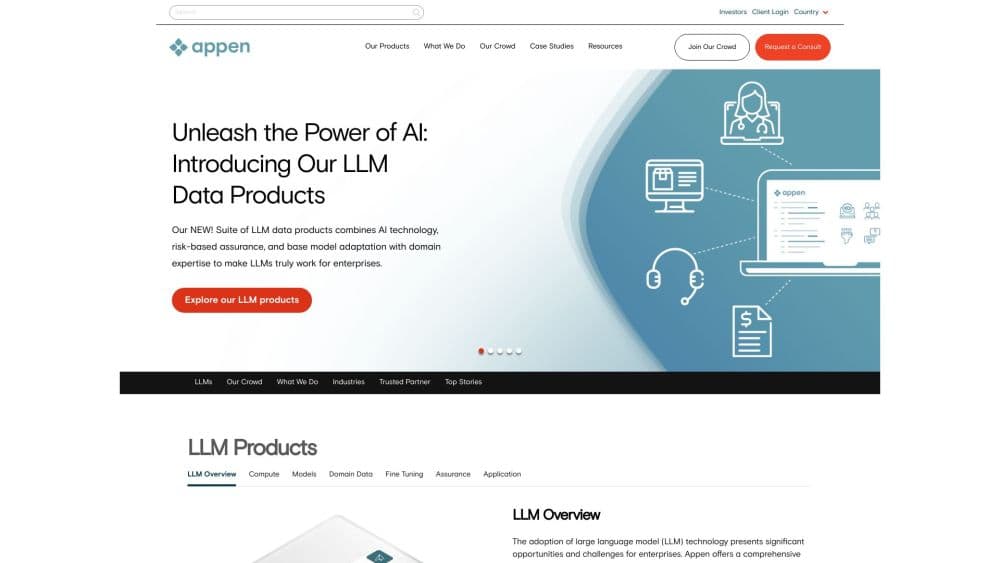
About Appen
What Is Appen
Appen is an Australian company that has collected and labeled data for AI systems since 1996. It works with the teams building large language models, speech assistants, self-driving software, and computer vision tools, and it supplies the human-generated data those systems learn from. Instead of selling a single app, Appen runs projects: you describe what your model needs, and Appen sources contributors, collects or annotates the data, and hands back a finished dataset.
The company solved a problem that most AI teams run into. Models need people, not just scraped text, to learn nuance, context, and physical reality. Appen organizes a global crowd and a network of specialists to do that work at scale, which is why teams turn to it as a data annotation services partner. Its catalog now lists hundreds of off-the-shelf datasets, alongside custom collection programs that gather data to a specific brief. Recent work spans reinforcement learning from human feedback, agentic AI trajectories, LiDAR point clouds, and independent model evaluation.
The main limitation is that Appen is built for organizations, not individuals. There is no self-serve signup for the data side, pricing is quoted per project, the data catalog is gated behind a sales conversation, and it does not operate as a general crowdsourcing platform for buyers. Contributors who want paid annotation work go through a separate platform called CrowdGen. If you are an individual researcher or hobbyist, Appen is usually the wrong fit.
Getting Started
- Go to appen.com and describe your project to the sales team. Tell them the model type, the languages, and the data volume you need.
- Agree on a scope, delivery format, and timeline; off-the-shelf catalog datasets can ship in days, while custom collection takes longer.
- Appen recruits and vets contributors, then collects or annotates the data under your agreed protocol.
- Review delivered samples, confirm quality thresholds, and move into full production.
- Receive the finished dataset in formats like WAV, JSONL, or COCO and start training.
Product Information
A quick look at Appen's pricing, supported platforms, and performance.
Best for
The users, tasks, and scenarios where this tool fits best.
Users
- AI and ML teams
- Speech and voice teams
- Robotics and autonomous vehicle teams
Tasks
- Training and aligning large language models
- Collecting speech datasets
- Annotating images and video
- Evaluating models
Scenarios
- Launching a voice assistant in a new language
- Building a coding agent
- Filling gaps in an existing dataset
Key features
Custom Data Collection
Appen builds datasets to your specification, whether you need a niche demographic, a controlled recording environment, or a domain only a few specialists understand. The team designs the collection protocol, recruits contributors, and manages consent and licensing as part of the process. This is the option to pick when a catalog dataset does not match your use case.
Off-the-Shelf Data Catalog
The catalog holds hundreds of pre-collected, pre-licensed datasets across categories like speech, code, and reinforcement learning tasks. Each one ships with a spec sheet covering source, annotation method, and known limitations, so legal and compliance reviewers can check provenance. You can license a set and start using it in days instead of commissioning a new collection.
RLHF and Model Alignment
Appen runs the human feedback work that teaches a model which answers are better. That includes reward-model training, supervised demonstrations, and the chain-of-thought reasoning traces that improve how a model explains itself. Teams use this to tune tone, safety, and accuracy before a model goes public. It is one of the company's busiest lines of work.
Speech and Multimodal AI
For systems that listen and speak, Appen collects multilingual speech corpora and runs text-to-speech annotation and voice-agent evaluation. On the visual side, it handles image and video labeling, and its teams also tag action recognition and point clouds for robotics and autonomous driving. Coverage spans more than 500 locales, which matters when a product has to work outside English.
Model Evaluation and Integrity
Beyond gathering data, Appen runs independent evaluation, including hallucination benchmarking, bias detection, and regulatory audits. The goal is to give teams outside evidence about whether a model is trustworthy, not just their own test results. This suits companies facing compliance reviews or planning a launch that regulators will scrutinize.
Research Services
Appen offers research support such as context engineering, synthetic data generation, and custom benchmarking with LLM-as-a-judge setups. The service exists for teams that have a working model but need extra hands to push a project forward. It leans on the same contributor network used for data collection, so the results come back as structured, reviewable output.
Pros and cons
Pros
- Covers the full data pipeline, from collection and annotation to evaluation, under one managed service.
- Proven track record across three decades, including RLHF work that shaped early conversational AI models.
- Global contributor network spans 500+ locales, which saves building a linguistics team for each new market.
- Standards are documented: SOC 2 Type II, ISO 27001, GDPR and CCPA handling, plus EU AI Act paperwork.
- Off-the-shelf datasets ship with provenance records that legal teams can review.
Cons
- There is no self-serve data product, so individuals and small teams cannot sign up and start on their own.
- Pricing is quoted per project, which makes budgets hard to predict before a sales call.
- The data catalog sits behind a sales process, so you cannot browse full specs without contacting Appen.
- Delivery depends on Appen's contributor availability, which can stretch timelines for rare languages or demographics.
Frequently asked questions
Appen collects, labels, and evaluates data that AI models train on. That covers human feedback for chatbots, speech recordings for voice assistants, image and sensor annotation for computer vision, and independent model testing.
Related content
Explore related tools, skills, and articles for Appen.
Appen Alternatives

Base Code
Base44 (Wix) · Coding · ProductivityBase Code is a shared cloud development environment from Base44. Teammates describe changes to an existing GitHub codebase in chat, preview them live and send them back as pull requests.

Google EmbeddingGemma 2
Google DeepMind · Writing · Image · CodingGoogle EmbeddingGemma 2 is a 740M-parameter open model that turns text, code, images, audio, and video frames into vectors in one 768-dimension space, running on phones and laptops.

GitGlow
GitGlow · Coding · ProductivityGitGlow is a local-first desktop Git client that lets independent developers review their own code and their AI agents' changes in one place before shipping.