

Applicant AI
Applicant AI · Business
Applicant AI is an AI applicant tracking system that scores job applications against your job description and works as a standalone ATS or as a pre-screen in front of tools like Greenhouse and Lever.
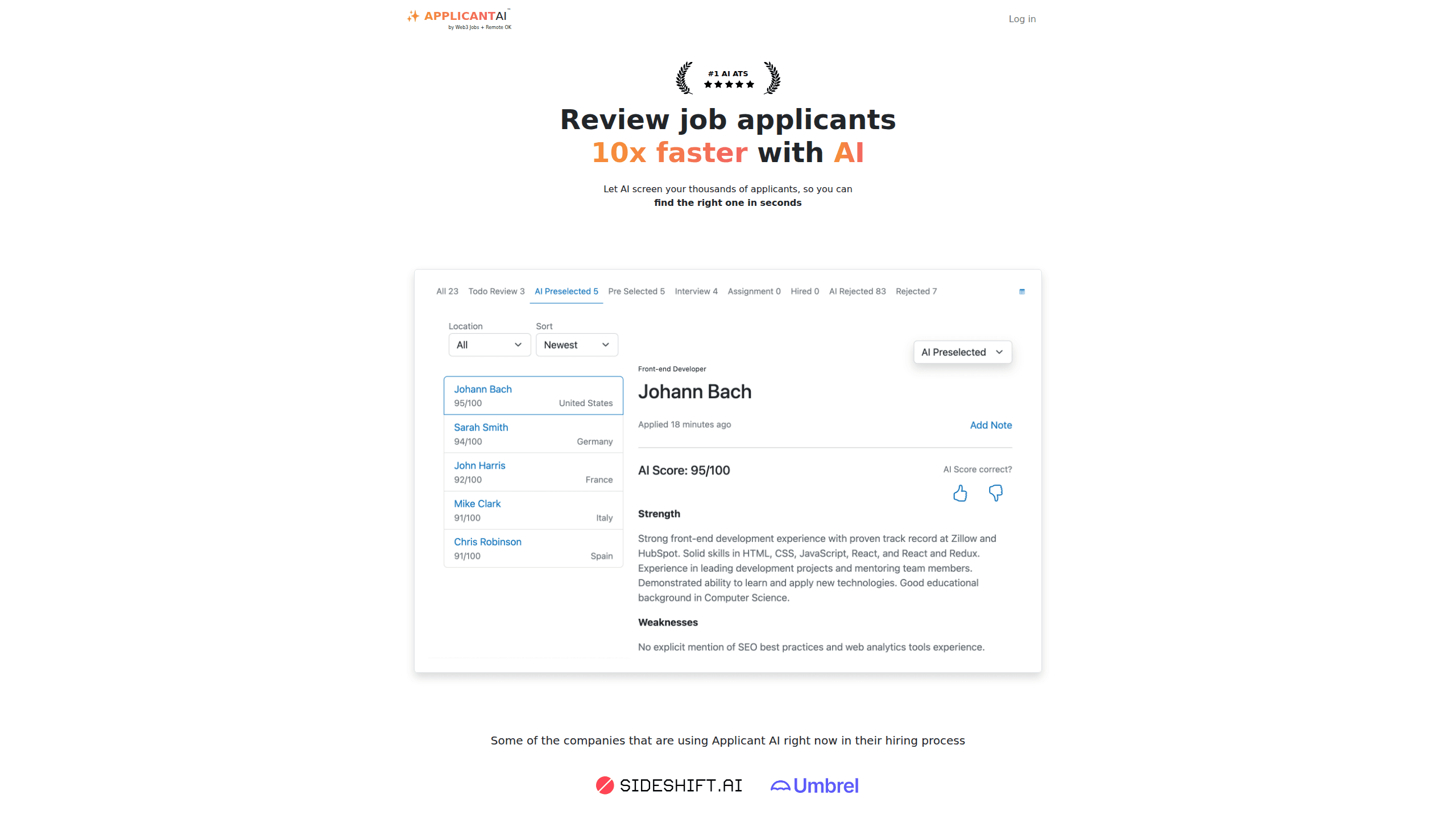
About Applicant AI
What Is Applicant AI
Applicant AI is an AI applicant tracking system built for one job: sorting a pile of job applications before a human opens any of them. Recruiters describe a role, and the software scores each resume and cover letter against that description, then ranks the strongest matches at the top. You still make the hiring call. The tool just clears the noise first.
The problem it targets is specific. Most applications and cover letters now look alike because applicants use AI to generate them, so screening by eye no longer separates people who fit from those who do not. Applicant AI treats that as a detection problem and uses AI resume screening to flag generic submissions while surfacing candidates whose materials actually line up with the role.
You can run it as a full ATS with a branded career page and a hiring pipeline, or keep your current system and use Applicant AI to pre-screen applicants. In that second setup, applicants answer a few questions on a custom link, get scored, and only the ones who clear the bar land in your existing ATS. This is AI recruitment software aimed at teams that hire regularly rather than one-off users: Applicant AI pricing starts at $99 a month, and the free tier covers the core ATS but not the AI screening workloads.
Getting Started
- Create an account at applicantai.com and pick a plan that matches how many open jobs you review with AI.
- Add a job and paste in the job description, plus any private instructions you use to weigh candidates.
- Share the application link or connect your existing ATS so pre-screened applicants flow in.
- Let Applicant AI score each applicant and sort the list by fit strength.
- Review the ranked list, then move candidates through stages such as pre-select, assessment, or interview.
Product Information
A quick look at Applicant AI's pricing, supported platforms, and performance.
Best for
The users, tasks, and scenarios where this tool fits best.
Users
- Recruiters handling high application volume
- Small teams without a dedicated screener
- Teams already on Greenhouse, Lever, or Workable
- HR leads worried about fairness rules
Tasks
- Screening applicants against a job description
- Catching AI-generated applications
- Running a branded career page
- Moving candidates through stages
- Pre-screening before your main ATS
Scenarios
- A viral job posting that floods your inbox
- A lean hiring sprint with no recruiter
- Keeping an existing pipeline uncluttered
Key features
AI Resume and Cover Letter Scoring
Applicant AI reads each resume and cover letter and grades how well it matches your job description, then sorts applicants by that score. The ranking is the point: instead of opening applications one by one, you start at the top and stop when the quality drops off. Scores update as new applications arrive, so the list stays current.
Filtering Out Low-Quality and AI-Generated Applications
The software is built to spot the sameness that AI writing has introduced into job applications. It flags generic cover letters and near-duplicate submissions, so mass-applied, low-effort entries sink to the bottom. For recruiters who used to reject most of a stack by hand, this is the feature that saves the most time.
Works as a Standalone ATS or a Pre-Filter
You can use Applicant AI as your full applicant tracking system, or keep Greenhouse, Lever, or Workable and let it pre-screen first. In pre-filter mode, applicants complete a form through a custom link, get scored, and only those above your threshold pass into your main ATS. You still see everyone who applied, including the ones who did not make it.
Built-In ATS with a Branded Career Page
The free ATS covers the basics a small team needs: unlimited jobs, a company career page with your branding, clarification questions on each posting, and an application form. You can move applicants between pipeline stages such as reject, pre-select, assessment, and interview, and send automatic rejection emails from a template you customize.
Custom Private Screening Instructions
You can give the AI your own evaluation rules, including criteria you would rather not publish on the job ad. That lets you weight the things your team actually cares about, such as specific experience or portfolio quality, without telling every applicant exactly what you screen for.
Compliance-Oriented Design
Applicant AI is positioned as a tool that assists human decision-making rather than replacing it, prioritizing candidates based on how their materials match the job description. That framing lines up with the EU AI Act, which treats hiring AI as high-risk and expects it to support, not overrule, human judgment.
Pros and cons
Pros
- Ranking applicants by fit turns a huge pile of applications into a shortlist you can work through in minutes rather than hours.
- It plugs into Greenhouse, Lever, and Workable, so you do not have to abandon an ATS your team already knows.
- Flagging AI-generated and near-identical submissions targets the exact problem that made manual screening stop working.
- Private screening instructions let you apply criteria you would not put on the public job ad.
- The free ATS tier includes unlimited jobs and a branded career page, which is enough for a small team to start.
Cons
- AI screening plans start at $99 a month and jump to $299, which is steep for a company that hires only a few times a year.
- The $99 Pro plan caps AI review at two open jobs, so a busy recruiting team will likely need the $299 tier.
- No public API is documented, so wiring Applicant AI into a custom system means working around it rather than building on it.
- Scoring quality depends on how well you write your job description and instructions, so vague postings get vaguer rankings.
Frequently asked questions
Applicant AI is an AI applicant tracking system that screens job applications for you. It reads each resume and cover letter, scores how well it matches your job description, and ranks applicants so you can review the strongest matches first. It also flags low-quality and AI-generated submissions that look alike.
Related content
Explore related tools, skills, and articles for Applicant AI.
Applicant AI Alternatives

Knocket
Knocket (Tencent RTC team) · Productivity · Business · ChatbotKnocket is a free live chat and contact page tool that lets visitors message you from your website, app, or a shareable link, with every reply handled from Telegram or one inbox.

shippedit.me
Krawlup · Marketing · Businessshippedit.me now redirects to Krawlup, a web platform that audits SEO, AEO and page speed every week, then hands the fixes to AI coding agents over MCP.

Ayven
Alknoma · Productivity · BusinessAyven is an AI control centre by Alknoma that turns a plain-language goal into a dated plan, hands the work to your people and AI agents, and asks for your approval only when the call is yours.