

Aptori
Aptori · Coding
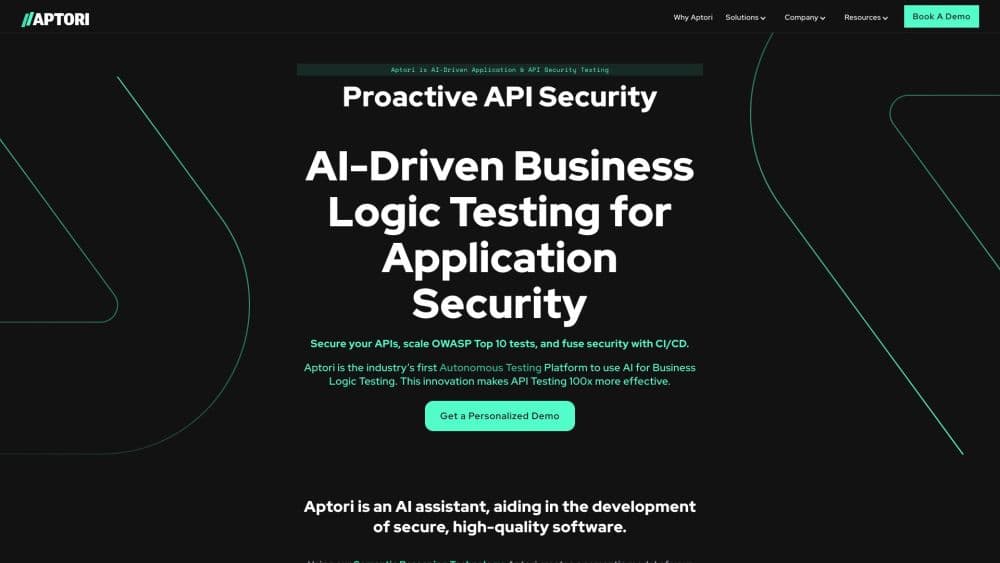
Aptori is an AI application security platform that tests code, APIs, and live app behavior, proves which findings are exploitable, and verifies fixes before closure.
About Aptori
What Is Aptori
Aptori is an application security platform for teams that ship software faster than they can review it. It covers three stages in one product: source code and dependencies, CI/CD releases, and the runtime behavior of APIs and applications. The company started in 2021, works out of San Jose, California, and sells to enterprises rather than individual developers.
The pitch is narrower than "find everything." Aptori ties each finding to an Application Context Graph that maps code, services, APIs, identities, and runtime paths, then checks whether an attacker could actually reach and exploit it. The vendor calls that runtime step Semantic Runtime Validation. What comes out is a shorter list of issues with a route to a fix and a retest, which is the part most security teams lack.
Access is the catch. For any of this to work, Aptori needs your repositories, API definitions, and recorded authentication flows. Without them, coverage falls back to surface scanning that tells you little more than a standard tool. Pricing isn't published, there's no self-serve signup, and every engagement starts with a demo or a scoped assessment. We haven't run the platform, so the claims here come from Aptori's own documentation.
Getting Started
- Book a demo or the free API security risk assessment. Both routes go through the sales team, and the assessment is scoped to a sample of your APIs.
- Connect source control and delivery tools. GitHub, GitLab, Jira, ServiceNow, and SSO or OIDC appear in the docs, and the platform reads repos and pipelines from there.
- Onboard the applications that matter. Point Aptori at an OpenAPI definition or a running target, then record the login flow so tests can replay a real user session. Aptori Desktop, available for macOS and Windows, handles the recording step when a browser flow is involved.
- Run a baseline pass across code, dependencies, containers, IaC, and APIs. Expect the first run to report more than later ones, because the context graph fills in as the platform learns the application.
- Work the queue: confirm which findings are real, push fixes as pull requests through Auto Code Fix, then retest to close each item with evidence attached.
Product Information
A quick look at Aptori's pricing, supported platforms, and performance.
Best for
The users, tasks, and scenarios where this tool fits best.
Users
- Application security engineers sitting on a large API estate
- Teams shipping AI-generated code
- Security and compliance leads working against EU CRA or UK TSA deadlines
Tasks
- Testing object-level authorization
- Filling gaps between scheduled pentests
- Clearing a scanner backlog
- Proving a fix held after release
Scenarios
- A release train where new endpoints ship every week and nobody has time to pen test each one.
- A regulated or air-gapped environment where sending source code to a vendor cloud isn't allowed, so the platform has to run inside your own infrastructure.
- A repository where coding agents commit faster than reviewers can read, and the security team needs a machine-speed first pass before a human looks.
Key features
Application Context Graph
The graph connects source code, dependencies, API endpoints, identities, workflows, runtime paths, and ownership into one model of the application. Every other engine reads from it, so a finding arrives with the component, the reachable path, and the team that owns it. That link is what separates a ranked list from a raw scanner dump.
Semantic Runtime Validation
This is the step where Aptori tries to prove a finding instead of assuming it. The platform models how identities, objects, and workflows are supposed to behave, then checks the running application against that model to see whether a control actually fails. Findings that can't be reproduced at runtime get deprioritized, which is where most of the noise reduction comes from.
Autonomous Penetration Testing
Controlled agents explore the application, chain requests, switch identities, and abuse workflows the way a tester would, with scope rules set by your team. They work continuously rather than in a scheduled window, and they retest after a fix lands. Think of it as coverage between human engagements, not a replacement for the judgment a skilled tester brings to a novel attack chain.
Code, Dependency, and Infrastructure Scanning
Aptori scans source code for control flow and data flow problems, checks dependencies and SBOMs for supply chain risk, and reviews containers, IaC, Kubernetes configuration, and exposed secrets. All of it feeds the same graph, so a vulnerable library shows up next to the endpoint that actually calls it. That beats a flat list of CVEs sorted by CVSS score.
Auto Code Fix With Pull Requests
Validated issues come with root cause context and a suggested change, and Aptori can open a pull request for review instead of filing another ticket. Developers see the fix in the language and framework they already use. Nothing merges without a human approving it, which keeps the workflow honest.
Verified Closure and Retesting
After a patch ships, the platform reruns the path that produced the finding and records the result. Items stay open until the retest confirms the risk is gone, and the evidence is kept for compliance reporting. For teams that need to show vulnerability remediation as an ongoing record rather than a quarterly snapshot, that loop is the whole point.
Pros and cons
Pros
- Runtime evidence trims the queue to issues someone can actually exploit, which saves triage hours every week.
- Code, dependency, API, and pentest coverage sit in one platform, so you stop stitching four tools together.
- Agentic testing runs between scheduled pentests instead of waiting for the next engagement.
- Deployment options include self-hosted, private cloud, and air-gapped installs, which matters for regulated teams.
- The fix path ends in a pull request and a retest record, not a ticket that disappears into a backlog.
Cons
- No self-serve trial and no published pricing, so you can't evaluate it without talking to sales first.
- Setup depends on real access to repositories, API specs, and auth flows, and thin onboarding limits what the platform can prove.
- There's no public REST API reference in the documentation, so automation leans on the Sift CLI and CI plugins.
- Autonomous testing on live targets needs tight scope rules and human sign-off, or a wrong request can hit production data.
Frequently asked questions
Aptori is an enterprise application security platform that combines code and dependency scanning, API security testing, and autonomous penetration testing. It validates findings against a model of how the application actually runs, then helps teams fix and retest them.
Related content
Explore related tools, skills, and articles for Aptori.
Aptori Alternatives

Base Code
Base44 (Wix) · Coding · ProductivityBase Code is a shared cloud development environment from Base44. Teammates describe changes to an existing GitHub codebase in chat, preview them live and send them back as pull requests.

Google EmbeddingGemma 2
Google DeepMind · Writing · Image · CodingGoogle EmbeddingGemma 2 is a 740M-parameter open model that turns text, code, images, audio, and video frames into vectors in one 768-dimension space, running on phones and laptops.

GitGlow
GitGlow · Coding · ProductivityGitGlow is a local-first desktop Git client that lets independent developers review their own code and their AI agents' changes in one place before shipping.