

ApyHub : The All in one API Platform
ApyHub · Coding
ApyHub is an all-in-one API platform that puts 1,500+ ready-made endpoints behind one subscription and one key. It covers file conversion, OCR, finance and more.
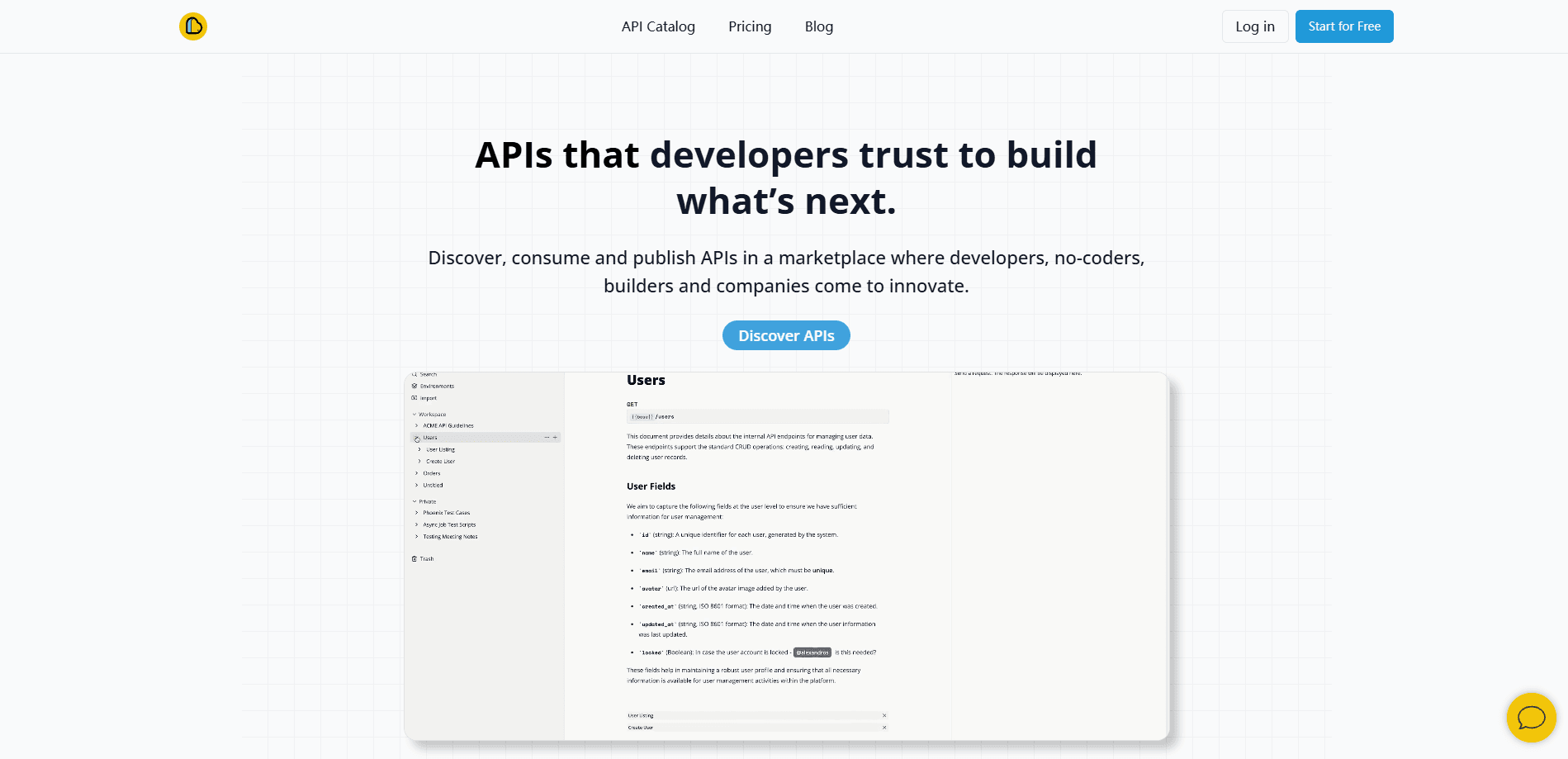
About ApyHub : The All in one API Platform
What Is ApyHub
ApyHub is an API marketplace built around one idea: developers shouldn't have to manage a separate subscription for every single-purpose API. Instead of buying a PDF plan from one vendor, a currency plan from another and an OCR plan from a third, you get all three from one catalog behind one key. The catalog lists 466 services across 20 categories, and the company describes the whole thing as more than 1,500 endpoints.
The problem it solves is a stack of renewals. When every capability comes from a different vendor, headroom sits unused on one plan while you hit the ceiling on another, and the only fix is upgrading a plan that wasn't the bottleneck. ApyHub pools usage into one balance instead. One contract, one bill, one thing to audit.
There are two limits to know before you commit. Brand-new accounts run on a free tier capped at 3,000 atoms per month, which is fine for testing but not for production traffic. And because everything funnels through a single provider, a catalog gap is a gap you cannot fill without going back to a point vendor. The catalog is broad, but it won't cover absolutely everything.
Getting Started
- Sign up for a free account and generate a token, which needs no card for the first 3,000 atoms each month
- Browse the catalog, or point an MCP client at the ApyHub server URL to see every API as a callable tool
- Send a request with the same Authorization header across every endpoint, so there's no per-API auth to learn
- Watch your atoms balance in the dashboard and top up anytime, or move up a plan when steady volume starts to outgrow the free tier
Product Information
A quick look at ApyHub : The All in one API Platform's pricing, supported platforms, and performance.
Best for
The users, tasks, and scenarios where this tool fits best.
Users
- Backend and full-stack developers
- Startup teams shipping fast
- AI agent builders
- Automation and no-code users
Tasks
- File conversion
- Data validation
- Finance and geolocation
- Text and AI utilities
- Agent tool calling
Scenarios
- A product needs a PDF export button
- A form collects IBANs
- An agent needs extra tools
- Usage is spiky across features
- A small team has no ops capacity
Key features
One Subscription and One Key
Every plan includes access to the entire catalog, not a slice of it. The same Authorization header works across all endpoints, so there's no per-API signup, no separate dashboard and no second credit card. The pitch is simple: one vendor, one contract, one thing to audit. For teams that used to juggle five marketplace subscriptions, that consolidation is the main draw.
Atoms-Based Usage and Top-Ups
ApyHub meters usage in atoms, its smallest billing unit, and you spend them on any API in the catalog. Because headroom pools across the whole account, a quiet endpoint doesn't waste the balance a busy one needs. You can top up atoms anytime rather than upgrading a plan, which keeps a spiky month from forcing a bigger commitment. No per-API negotiations and no quote calls.
MCP Server for Agents
The platform ships an MCP server, so one URL turns the catalog into tools an agent can call. Point a client like Claude, Cursor or Claude Code at the server and it introspects the live catalog, meaning new APIs show up as tools the moment they ship. Agent calls draw from the same atoms balance as your app's direct API calls, so there's one key and one bill rather than a second integration budget.
File Conversion APIs
File conversion is one of the busiest categories, with endpoints for HTML to PDF, video to GIF, and Word to text. Each one is built once and shared across every customer, so you skip the code, the monitoring and the maintenance. The endpoints accept a job and return the result, which fits pipelines that need a conversion step without a service to own.
Data Validation and Extraction APIs
The catalog covers validation and extraction across dozens of endpoints. You can check IBAN, SWIFT/BIC and email addresses, and the responses give you the parts you need, not just a yes or no. Extraction endpoints pull text from Word files and parse resumes and CVs into structured JSON, which suits teams that store, search and filter candidate data.
AI and Finance Utilities
Beyond plumbing, the catalog carries AI-adjacent and finance endpoints. There's sentiment scoring, resume parsing and iCal generation alongside currency conversion and geolocation. That mix is deliberate: the company argues these are the endpoints every product needs and nobody wants to own. Calling them from one key keeps small utilities from turning into five separate accounts.
Enterprise Security and Certification
ApyHub states that every service is reviewed before it ships and certified against GDPR, SOC 2 and ISO 27001, and it advertises 99.99% uptime. The company also cites the recent compromise of 170+ npm packages to make its case: a reviewed catalog removes the supply-chain risk that comes with pulling every utility from a random package. For a team facing a security review, those certifications are the line item that matters.
Pros and cons
Pros
- One key and one bill cover the whole catalog, so there's no stack of per-API subscriptions to manage
- Atoms pool across every endpoint, which means quiet APIs don't waste the balance busy ones need
- The MCP server exposes hundreds of APIs as agent tools from a single config
- Endpoints are reviewed and certified against GDPR, SOC 2 and ISO 27001, which eases security reviews
- A free tier with 3,000 atoms a month lets you test the platform without a card
Cons
- The free tier caps at 3,000 atoms per month, so real production traffic needs a paid plan
- Relying on one provider means a catalog gap is a capability you cannot call without a separate vendor
- Atoms can be hard to budget for if you don't know how many calls each endpoint consumes per task
- Some advanced workflows still expect code, so it isn't a drop-in for a no-code-only team
Frequently asked questions
ApyHub is an all-in-one API platform that puts a large catalog of ready-made endpoints behind one subscription and one key. It lists 466 services and more than 1,500 endpoints across areas like file conversion, data extraction, finance, geolocation and AI utilities.
Related content
Explore related tools, skills, and articles for ApyHub : The All in one API Platform.
ApyHub : The All in one API Platform Alternatives

Base Code
Base44 (Wix) · Coding · ProductivityBase Code is a shared cloud development environment from Base44. Teammates describe changes to an existing GitHub codebase in chat, preview them live and send them back as pull requests.

Google EmbeddingGemma 2
Google DeepMind · Writing · Image · CodingGoogle EmbeddingGemma 2 is a 740M-parameter open model that turns text, code, images, audio, and video frames into vectors in one 768-dimension space, running on phones and laptops.

GitGlow
GitGlow · Coding · ProductivityGitGlow is a local-first desktop Git client that lets independent developers review their own code and their AI agents' changes in one place before shipping.