

Ardent
ArdentAI, Inc. · Coding
Ardent clones any production Postgres database in under six seconds, giving coding agents and developers an isolated copy to test migrations and risky data changes.
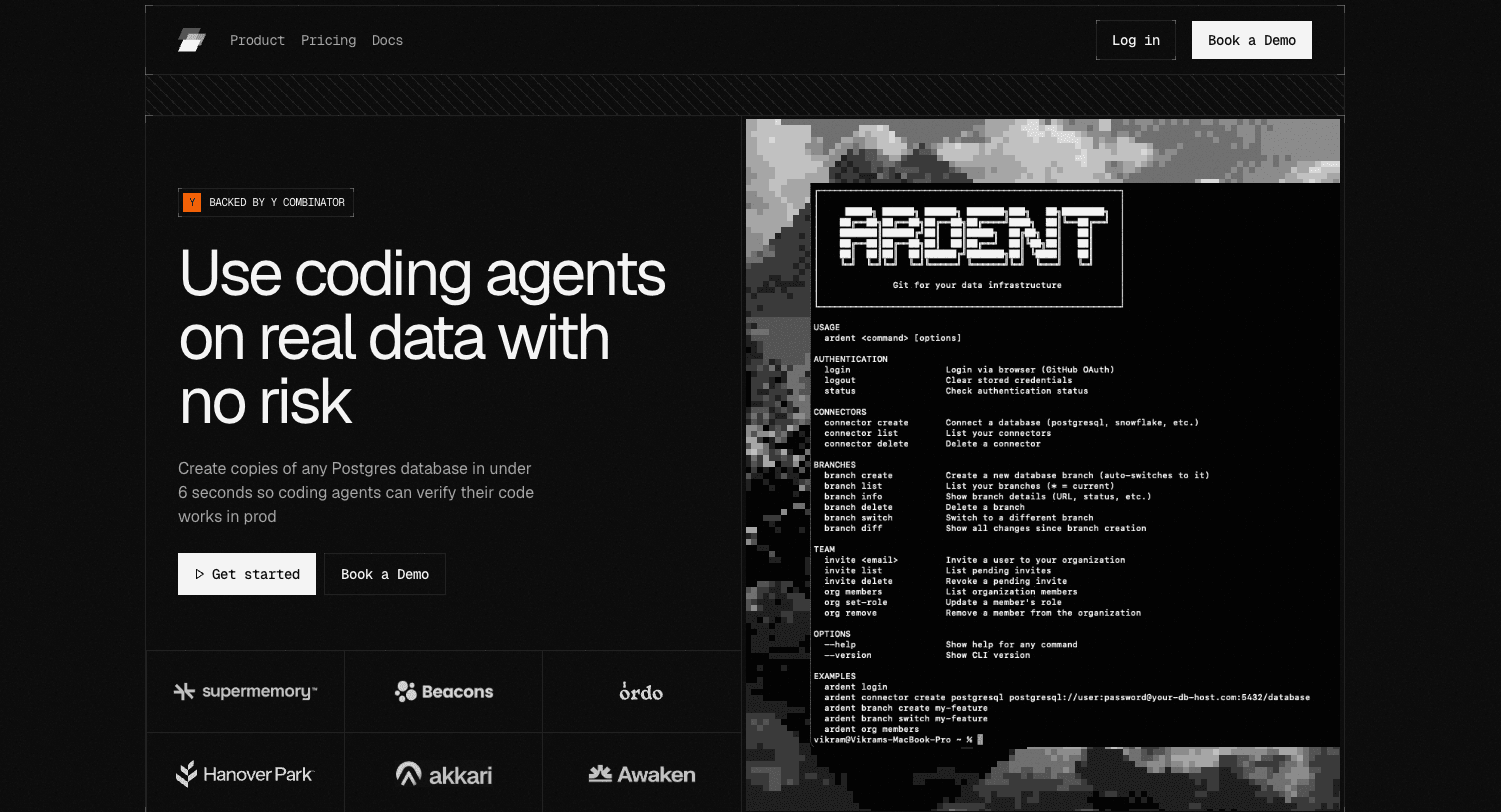
About Ardent
What Is Ardent
Ardent is database branching infrastructure for AI agents and the teams that run them, built by ArdentAI, Inc. It connects to an existing Postgres database, keeps a read replica fed by logical replication, and creates isolated branches from that replica. A branch is a full Postgres instance with your schema, data, grants, row-level security policies, functions and triggers.
The problem it targets is familiar to anyone who has pointed an automated coding agent at a database. Shared staging drifts from production, seed files miss edge cases, and one bad migration can take down the primary. Ardent gives each task its own connection URL. Agents can read, write, run migrations and break things, then the branch gets deleted. The pitch is a database sandbox for every task: the real schema, the real rows, none of the shared staging. Plenty of tools promise database branching for AI agents. Ardent's version does it without moving you to a new database provider.
The main limits are worth knowing up front. It handles Postgres only, branches are snapshots taken at creation, and large databases take a while during first connector setup.
Getting Started
- Install the CLI with
npm install -g ardent-cliand runardent login. - Export your connection string as
ARDENT_DB_URLand runardent connector preflight postgresql "$ARDENT_DB_URL". If preflight prints a grant script, run it on the source database first. - Create the connector with
ardent connector create postgresql "$ARDENT_DB_URL". Setup runs on Ardent's side and can take minutes to hours on large databases. - Run
ardent branch create my-feature, thenardent branch infoto get the branch connection URL. - Point your app or agent at that URL. Delete the branch with
ardent branch deletewhen the work is done.
Product Information
A quick look at Ardent's pricing, supported platforms, and performance.
Best for
The users, tasks, and scenarios where this tool fits best.
Users
- Platform and infrastructure teams running coding agents against production data
- Data engineers who test migrations and backfills before release
- Small teams watching costs
Tasks
- Testing a schema migration before it reaches production
- Rehearsing a backfill or data cleanup
- Giving an agent a scratch database per pull request
Scenarios
- Database changes in continuous integration
- Reproducing a production bug
- Onboarding a new engineer
Key features
Branches in under six seconds
Branch creation takes less than six seconds at any database size, according to Ardent. Branches are cloned from the read replica rather than the primary, so a burst of branch creation doesn't load production. That speed is what makes coding agent database testing practical: one branch per task, no queue behind other people's work.
Isolation at compute and storage
Each branch runs on its own compute with a copy-on-write view of storage. Writes stay on the branch, and its connection string has no route to your source database or its credentials. That matters once you start pasting URLs into an LLM prompt or a teammate's shell.
Copy-on-write branching
Copy-on-write branching keeps storage small: each Postgres clone shares the replica's storage and records only the blocks that change. Storage bills at $0.70 per GB-month for those changes, and Ardent places no cap on how many branches you keep.
Compute that scales to zero
Idle branches suspend after five minutes and wake on the next connection. Compute bills at $0.40 per CU-hour, where one CU is a vCPU and 4 GB of RAM, and it autoscales under load. You don't reserve capacity for agents that work in short bursts.
Postgres database branching on your current provider
Supabase, AWS RDS, PlanetScale and self-hosted Postgres 13 or newer connect through logical replication and DDL event triggers, with no provider migration and no schema rewrite. The source keeps its own replication slot and tracking metadata. For tables without a primary key, you pick a replica identity during setup.
CLI, REST API and team workflow
ardent branch create, switch, info and delete mirror git commands. The CLI emits JSON and stable exit codes for scripts and CI, while the REST API covers projects, connectors, branches and API keys with scoped tokens. Teammates share branches through an organization, with roles and per-key permissions.
Pros and cons
Pros
- Keeps your existing Postgres provider, so adoption doesn't mean a database migration.
- Branch time stays flat as data grows, which makes one branch per agent task affordable.
- Isolated credentials keep a leaked branch URL away from production.
- Copy-on-write storage and scale-to-zero compute keep idle and throwaway branches cheap.
Cons
- Postgres only. Teams on MySQL or MongoDB can't use it.
- A branch is a point-in-time snapshot, so production changes after creation never arrive and long-lived branches drift.
- First connector setup on a terabyte database can take hours, and tables without a primary key need an extra decision during setup.
Frequently asked questions
Ardent creates isolated copies of a Postgres database in under six seconds, so developers and coding agents can test code against real data without touching production.
Related content
Explore related tools, skills, and articles for Ardent.
Ardent Alternatives

Base Code
Base44 (Wix) · Coding · ProductivityBase Code is a shared cloud development environment from Base44. Teammates describe changes to an existing GitHub codebase in chat, preview them live and send them back as pull requests.

Google EmbeddingGemma 2
Google DeepMind · Writing · Image · CodingGoogle EmbeddingGemma 2 is a 740M-parameter open model that turns text, code, images, audio, and video frames into vectors in one 768-dimension space, running on phones and laptops.

GitGlow
GitGlow · Coding · ProductivityGitGlow is a local-first desktop Git client that lets independent developers review their own code and their AI agents' changes in one place before shipping.