

Ascend.io
Ascension Labs, Inc · Coding
Ascend.io is a data engineering platform that pulls ingestion, transformation and orchestration into a single workspace so teams can build and run pipelines without stitching together five different tools. The company pushed hard on automation, first with its DataAware engine that watches how data changes and only reprocesses what's actually affected, then with agents that help plan and maintain pipelines across the lifecycle. It's aimed at data engineers and platform teams. They'd rather describe what they want than hand-wire every dependency.
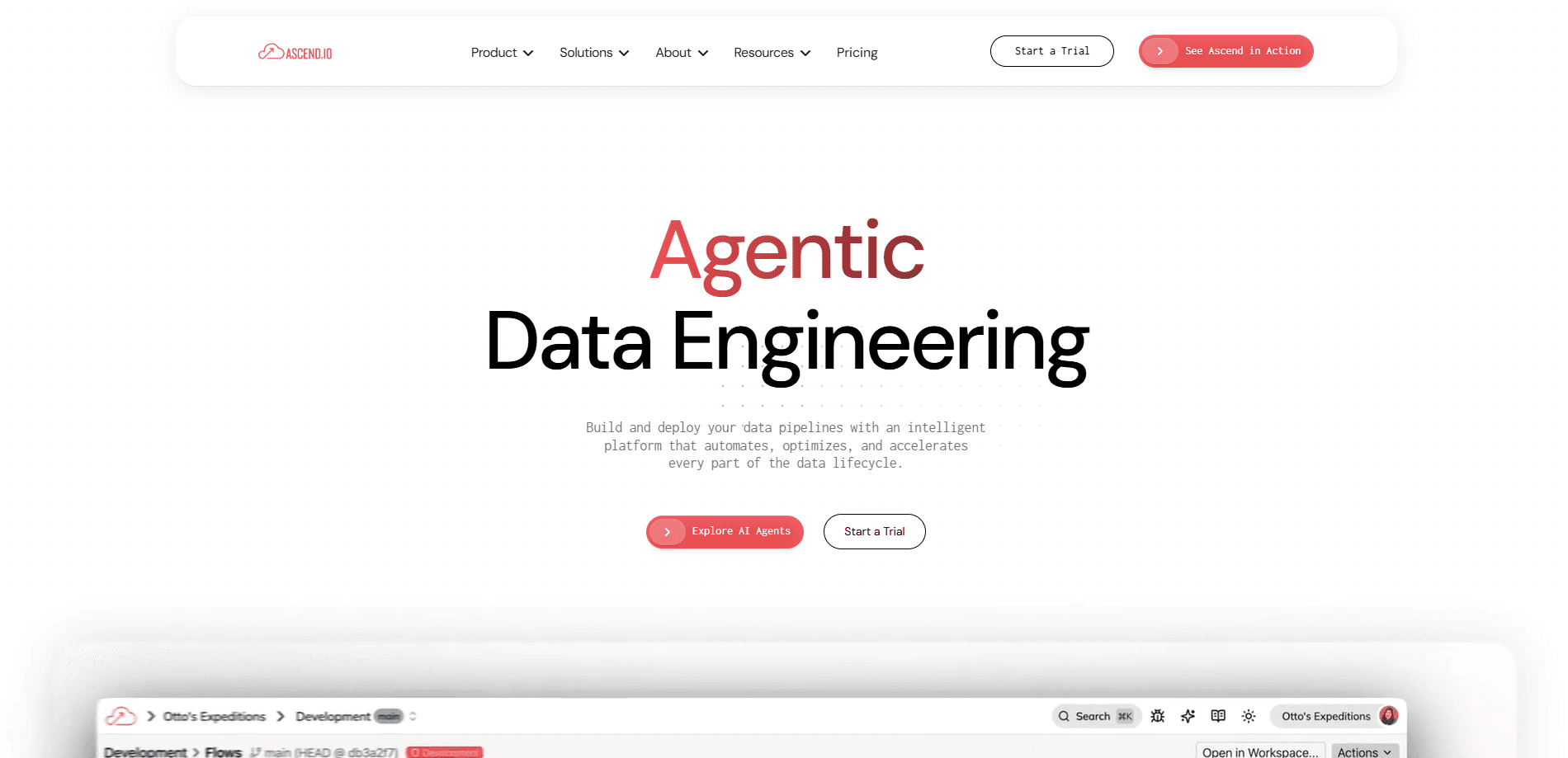
About Ascend.io
What Is Ascend.io
Ascend.io is a unified data pipeline platform built by Ascension Labs, Inc. It combines data ingestion, transformation, orchestration and observability in one place, which means a team can move a dataset from a source system through transformations to a destination without leaving the product. The pitch is speed. Less boilerplate, fewer moving parts, faster iteration on pipelines that keep working as data and requirements shift.
Getting Started
- Sign up on the Ascend website and connect your data sources and warehouse.
- Pick a source, then let the platform generate a baseline pipeline for ingestion and staging.
- Define transformations in the visual builder or in SQL and Python, and let the DataAware engine figure out which steps to run.
- Set schedules and triggers, then watch runs and data quality from the built-in observability views.
- Promote the pipeline to production and let agents flag or fix issues as underlying data changes.
Product Information
A quick look at Ascend.io's pricing, supported platforms, and performance.
Best for
The users, tasks, and scenarios where this tool fits best.
Users
- Data engineers who want fewer tools in the stack
- Analytics and platform teams at mid-size companies
Tasks
- Building and maintaining ETL and ELT pipelines
- Incremental processing of changing data
- Automating pipeline upkeep
Scenarios
- Standing up a new analytics dataset from a fresh source without writing a custom connector.
- Keeping production pipelines healthy when upstream tables change shape.
- Prototyping a workflow quickly, then promoting the same pipeline to production rather than rebuilding it.
Key features
Unified ingest, transform and orchestrate
Ascend folds ingestion, transformation and orchestration into a single platform instead of three separate tools. You connect a source, write or generate your transformations, and set the schedule in the same workspace. The upside is fewer integration points to break. There's also one place to debug when a run goes wrong.
DataAware incremental automation
The DataAware engine tracks changes in upstream data and figures out the minimum set of steps that need to rerun. That means a tweak to one table doesn't force a full pipeline rebuild. For teams working with large datasets, it cuts wasted compute. It also shortens the time between a source update and a fresh result.
Agentic data engineering
Ascend pushed into what it calls agentic data engineering, where AI agents work alongside engineers across the pipeline lifecycle. Agents can draft pipeline logic, suggest adjustments when data changes, and take on repetitive maintenance that usually eats an engineer's week. It's the part of the product that reflects where the company put its recent bets.
Declarative pipeline building
Instead of wiring every dependency by hand, you describe the pipeline and let the platform manage execution order. The company says it introduced the industry's first declarative data pipeline technology, and the model shows up throughout the product: less imperative code to maintain, more intent-driven configuration.
SQL and Python transformations
You can define transformations in the languages data teams already use, SQL for set-based work and Python for custom logic. That keeps the learning curve low. Engineers don't have to adopt a brand-new DSL just to move data around.
Built-in observability
Pipeline runs, data quality and lineage sit inside the same platform rather than in a separate monitoring add-on. When something breaks, you can trace it back through the steps in one view. That shortens the usual hunt. No more jumping across logs and dashboards.
API and developer tooling
Ascend exposes an API and developer documentation so teams can automate pipeline management or wire the platform into existing tooling. That matters if you want pipelines defined as code. It also helps if you trigger work from a broader orchestrator.
Pros and cons
Pros
- One platform for ingestion, transformation and orchestration cuts down on tool sprawl.
- DataAware incremental processing reduces unnecessary compute on large pipelines.
- Agents and declarative config lower the amount of hand-written plumbing.
- SQL and Python support means most data engineers can start without a new language.
- Observability is built in, so you don't buy and wire a separate monitoring product.
Cons
- No free plan, so there's no way to test the platform properly before committing.
- Pricing is custom, which makes it hard to estimate cost from the website alone.
- The company announced it's winding down operations, so new buyers should weigh long-term support carefully.
- Most value is in the managed platform, so there's little to adopt piecemeal.
Frequently asked questions
Ascend.io is used to build, run and maintain data pipelines, covering ingestion from source systems, transformation and orchestration in one platform. Teams use it to move data into warehouses and keep those pipelines running as data and requirements change.
Related content
Explore related tools, skills, and articles for Ascend.io.
Ascend.io Alternatives
Forefront
Forefront · CodingForefront is a web platform for building with open-source AI. It lets you fine-tune leading open-source language models on your own data, evaluate how they perform, and run them through an API or export them to host yourself. Developers who want the convenience of a closed-source platform but insist on owning their models and data are the target audience here.

Startkit
StartKit.AI · CodingStartkit is a boilerplate for building AI SaaS and AI wrapper products. Think of it as an AI startup boilerplate with the boring parts already wired up: authentication, Stripe and Lemon Squeezy payments, usage limits, transactional email, and an AI API starter that talks to OpenAI, Anthropic, Groq, or Llama. You clone the repo, set your price, and start on the part of your product that people actually pay for. It's Next.js under React and Tailwind, so most of the boilerplate code already feels familiar.
Testim
Tricentis · CodingTestim is an AI-powered test automation platform for building and running end-to-end tests across web, mobile, and Salesforce applications. It leans on machine learning to keep tests stable when an interface changes, so teams spend less time fixing broken selectors. Not bad for an automated testing tool you can start using today. You create tests by recording actions in a browser, then optionally add JavaScript when you need more control. It's a solid pick for busy QA teams.