

AssemblyAI
AssemblyAI · Writing · Voice & Language
AssemblyAI is a Voice AI platform that gives developers speech-to-text, real-time transcription, a Voice Agent API, and an LLM Gateway through one set of APIs.
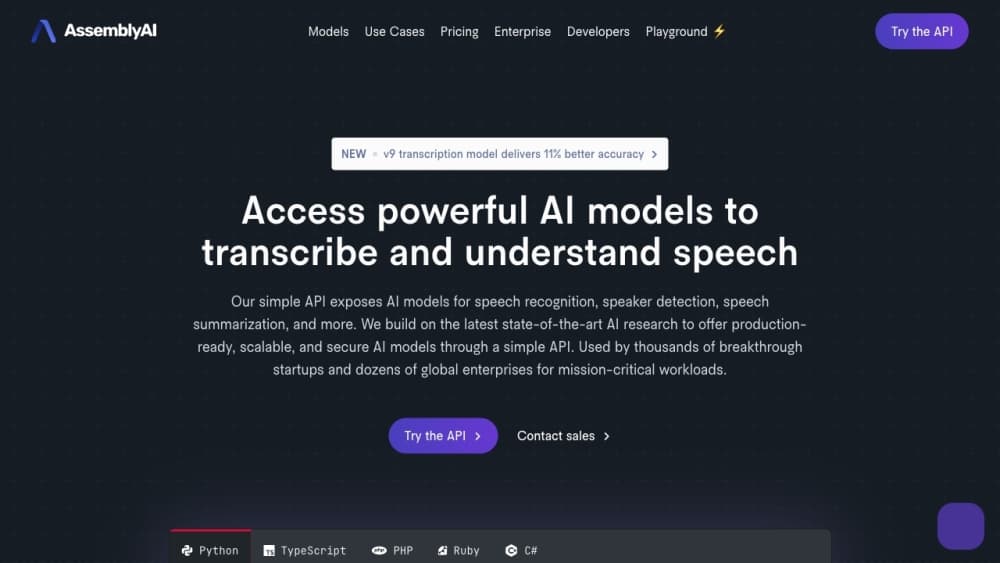
About AssemblyAI
What Is AssemblyAI
AssemblyAI is a Voice AI platform built for developers who need to turn speech into text, understand what was said, and run voice agents inside their own products. It covers transcription, speech understanding, guardrails, and language model access in one place, so a team doesn't have to wire up four separate vendors.
The company started in 2017 in San Francisco and is led by founder Dylan Fox. Its speech models sit behind products from teams like Granola, Dovetail, and LiveKit, and the platform is used by hundreds of thousands of developers. AssemblyAI positions its Universal models on accuracy: the company says Universal-3.5 Pro beats other market ASR models on entity accuracy and cuts hallucination 30% versus Whisper.
The main limit is audience. AssemblyAI is an API-first product, so there's no app to open and talk to. You also pay by usage, and streaming is billed on how long a connection stays open, not how much audio flows through it, which trips up teams that forget to close idle sockets.
Getting Started
- Create a free account in the AssemblyAI dashboard. New signups get $50 in credits with no credit card.
- Pick a model and endpoint: Universal-3.5 Pro for recorded files, Universal-3.6 Pro Realtime for live audio, or the Voice Agent API for full conversations.
- Grab your API key and send a first request from the docs, or test a file in the Playground before writing code.
- Wire the API into your app, then watch concurrency and usage on the dashboard so a busy month doesn't surprise you.
Product Information
A quick look at AssemblyAI's pricing, supported platforms, and performance.
Best for
The users, tasks, and scenarios where this tool fits best.
Users
- Developers building voice features
- Product teams at startups
- Regulated teams in finance or health
Tasks
- Transcribing recorded meetings
- Live call transcription
- Building voice agents
Scenarios
- Turning archived calls into notes
- Answering customer calls automatically
- Cleaning sensitive data from recordings
Key features
Universal Speech-to-Text Models
AssemblyAI's Universal-3.5 Pro is its most accurate model for recorded audio, and Universal-3.6 Pro Realtime is the flagship for live voice. The company says Universal-3.5 Pro leads on entity accuracy for things like card numbers and names, and streams at sub-200 millisecond latency for real-time use. It's the kind of transcription software you call from your own backend, not a desktop app. You pick a model per request, and the API reports which one ran.
Streaming Transcription at Low Latency
The streaming endpoint runs over a WebSocket and handles turn detection so a live transcript knows when a speaker stops. Universal-3.6 Pro Realtime supports 32 languages with native code switching, plus real-time speaker diarization that labels who spoke without post-processing. It suits captions, live coaching, and meeting assistants.
Voice Agent API
The Voice Agent API bundles speech-to-text, an LLM, and text-to-speech into one WebSocket connection. It runs end-of-turn detection and interruption handling server side, so the agent doesn't talk over the caller. You can swap the underlying LLM or voice, and AssemblyAI bills a single per-minute rate instead of separate component charges.
Speech Understanding Add-Ons
Beyond raw text, AssemblyAI offers speaker identification, entity detection, sentiment analysis, topic detection, and translation. These run as add-ons on top of the base rate, so you pay for only the ones you use. Translation covers over 100 target languages on recorded audio.
Guardrails for Sensitive Audio
Guardrails handle PII redaction, profanity filtering, and content moderation. You can strip card numbers from the transcript text, bleep them from the audio, or both, which matters for teams that record customer calls and have to store them safely.
LLM Gateway
The LLM Gateway is a single endpoint that serves 25 or more language models from five providers, authenticated with the same API key used for transcription. It adds automatic provider fallback and prompt caching, and it replaces the older summarization and auto-chapters features that AssemblyAI has retired.
Pros and cons
Pros
- Speech-to-text, speech understanding, guardrails, and a voice agent run under one API key, which removes the vendor stitching most voice projects start with.
- Swap the LLM or voice inside the Voice Agent API, so a model change doesn't force a rewrite of the whole pipeline.
- HIPAA, PCI, SOC 2, and EU data residency come without a premium, which helps regulated teams move faster.
- The $50 signup credit and per-hour billing let you test real audio before committing to a contract.
Cons
- There's no consumer app, so non-developers have nothing to open and use directly.
- Streaming bills on connection time, not audio length, so a forgotten open socket keeps costing money.
- Add-ons stack on the base rate, and a request using several of them can multiply the hourly cost.
- The cheapest streaming models cap language coverage and accuracy, so high-quality voice agents need the pricier tier.
Frequently asked questions
AssemblyAI is used to add speech recognition and voice features to software through a speech recognition API. Teams use it to transcribe calls and meetings, pull insights like speakers and sentiment, redact sensitive data, and run voice agents that answer questions in real time.
Related content
Explore related tools, skills, and articles for AssemblyAI.
AssemblyAI Alternatives

Google EmbeddingGemma 2
Google DeepMind · Writing · Image · CodingGoogle EmbeddingGemma 2 is a 740M-parameter open model that turns text, code, images, audio, and video frames into vectors in one 768-dimension space, running on phones and laptops.

MePersona
MePersona, Inc. · Writing · Productivity · MarketingMePersona is an AI unified inbox for creators. It learns your voice, drafts replies to fan messages from 12 platforms, and sends only what you approve.

Fluence
Yay Software (Yannick Huchard) · Writing · Voice & Language · ProductivityFluence is an Android app that reads PDFs, EPUBs, Word files and web articles aloud, follows each sentence as it speaks, and answers questions about the text on the phone itself.