

Assessment Systems
Assessment Systems Corporation · Coding · Business
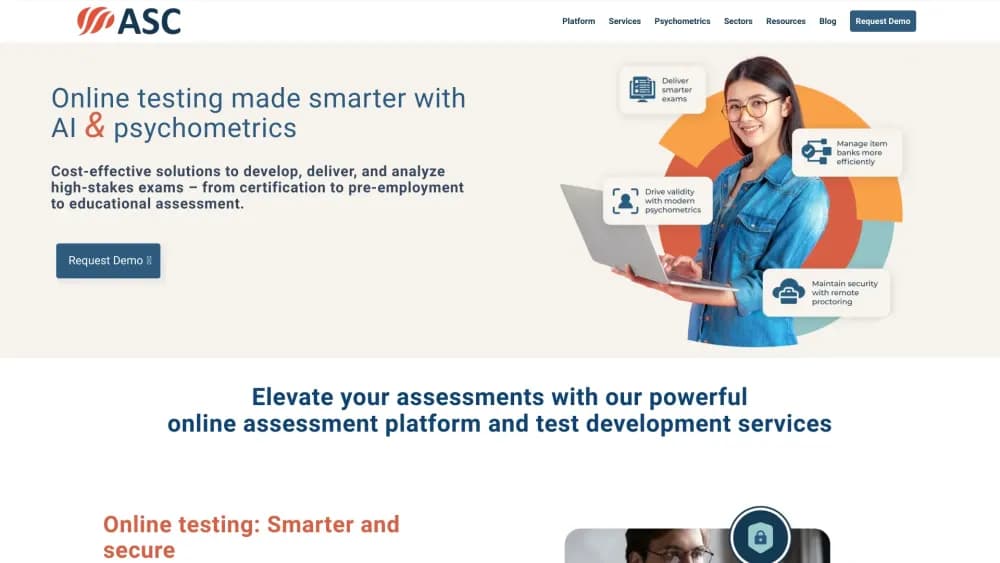
Assessment Systems makes FastTest, an enterprise exam platform with item banking, adaptive testing, proctoring, and psychometric consulting for certification and hiring programs.
About Assessment Systems
What Is Assessment Systems
Assessment Systems (ASC) sells software and expertise to organizations that run exams where a wrong score carries real consequences: licensing boards, civil service agencies, universities, and employers. Its core product, FastTest, is an exam management system that covers the whole testing cycle. You write and store questions, assemble forms, schedule candidates, deliver the exam under security controls, then pull statistical reports on how each item performed.
The company has been at this since 1979 and counts customers in more than 50 countries. That history matters because the platform leans on measurement science rather than quiz widgets. Item response theory, adaptive test delivery, and Angoff standard setting are built in, not bolted on as plugins.
The limits are easy to state. Pricing starts at $5,950 per year on the main site and $6,750 per year on the FastTest page, and ASC screens organizations before granting a trial. A single teacher who wants a ten question quiz for a class should look elsewhere; consumer quiz builders cost a fraction of this and do that job fine. The platform also assumes someone on your side can interpret psychometric output, or that you buy ASC's consulting hours to do it for you.
Getting Started
- Request a demo through the ASC contact form and describe your program, exam volume, and accreditation goals.
- Book a trial account if your organization qualifies, then invite item writers and assign them roles.
- Import an existing item bank or author new questions, routing each one through your subject matter experts.
- Assemble a form by hand or from a blueprint, set cutscores and security options, then publish it.
- Upload candidates directly or connect your applicant tracking system through the API, and start delivering.
Product Information
A quick look at Assessment Systems's pricing, supported platforms, and performance.
Best for
The users, tasks, and scenarios where this tool fits best.
Users
- Certification and licensure boards
- Civil service and HR departments
- University admissions and placement offices
- Independent psychometricians
Tasks
- Building and maintaining a large item bank
- Running a modified Angoff standard setting study
- Shortening an exam with adaptive delivery
- Meeting accreditation requirements
Scenarios
- A licensing body moving from paper booklets to computer delivery
- A national education ministry needing multilingual test forms
- A hiring team with a slow screening funnel
Key features
Item Banking with SME Workflows
FastTest stores questions in banks that track metadata, statistics, and revision history. Items route through configurable approval stages so subject matter experts sign off before anything reaches a live exam. Roles can be scoped by content area, which means your math writers never see the science bank.
IRT and Adaptive Test Delivery
Item response theory runs through the platform rather than sitting in a separate statistics package. Calibrated parameters load from Xcalibre, R, or other software, and the adaptive engine selects each next question based on a candidate's estimated ability. Assessment Systems says this shortens exams by up to 50 to 90 percent and keeps measurement precision intact.
Multistage and Linear on the Fly Assembly
Not every program wants a fully adaptive test. FastTest also supports multistage testing, where candidates move through modules of increasing difficulty, and linear on the fly assembly, which builds a unique form from the blueprint at the moment a candidate starts. Both run from the same item pool.
Automated Psychometric Reporting
One click produces a report in Microsoft Word covering item difficulty, discrimination, distractor performance, reliability indices, and standard error of measurement. Psychometricians still read the output, but the mechanical assembly of tables and plots stops consuming their week.
Security Controls and Proctoring
Passcodes, lockdown browser, IP restrictions, time windows, multi-factor authentication, and activity tracking are switches rather than custom builds. Remote proctoring is available in tiers, from recorded video with AI flagging up to a live person watching two camera streams. ASC also runs its own test center network.
White-Label Delivery and API Integration
The test engine can be embedded in your own branded portal, with SSO and API endpoints for registering candidates and pushing scores out. For employers, that means results land in the applicant tracking system without anyone copying a spreadsheet.
Scoring, eCommerce, and Credential Management
Scaled scoring handles linear and normative conversions, and built-in payment options let candidates register and pay in the same flow. Credicycle, ASC's companion product, covers certificate issuance and renewal once a candidate passes.
Psychometric Consulting and Accreditation Support
ASC's PhD staff run job task analyses, equating studies, standard setting, and test validation. They also prepare the documentation NCCA and ANSI/ISO reviewers expect. Some organizations buy the software alone; others buy the software and let ASC carry the studies.
Pros and cons
Pros
- Modern psychometrics come standard, so IRT, adaptive delivery, and Angoff cutscores don't need separate licenses or scripts.
- SOC 2 Type II audit, WCAG checks, and NIST review give procurement teams documentation they can hand to a security reviewer.
- The same vendor covers software, item development, and accreditation consulting, which reduces the number of contracts a small program has to manage.
- Explicit API and SSO support means scores move into existing HR and student systems without manual exports.
Cons
- The $5,950 to $6,750 annual floor puts it out of reach for individual teachers, small training firms, and anyone running a low-stakes quiz.
- There's no self-serve signup. You request a demo, get screened, and wait for a sales conversation before you can touch the software.
- Even with automated reports, the psychometric output assumes a reader who understands IRT parameters and reliability indices.
- Pricing on the homepage and the FastTest page differs by $800, so you need a written quote before budgeting.
Frequently asked questions
Two things: the FastTest online assessment platform and the people who run studies on it. The software covers item banking, test assembly, secure delivery, and reporting. The consulting side covers job task analysis, standard setting, equating, and accreditation paperwork. Many customers buy both together.
Related content
Explore related tools, skills, and articles for Assessment Systems.
Assessment Systems Alternatives

Base Code
Base44 (Wix) · Coding · ProductivityBase Code is a shared cloud development environment from Base44. Teammates describe changes to an existing GitHub codebase in chat, preview them live and send them back as pull requests.

Google EmbeddingGemma 2
Google DeepMind · Writing · Image · CodingGoogle EmbeddingGemma 2 is a 740M-parameter open model that turns text, code, images, audio, and video frames into vectors in one 768-dimension space, running on phones and laptops.

GitGlow
GitGlow · Coding · ProductivityGitGlow is a local-first desktop Git client that lets independent developers review their own code and their AI agents' changes in one place before shipping.