
Async Voice AI
Podcastle Inc. (Async) · Voice & Language
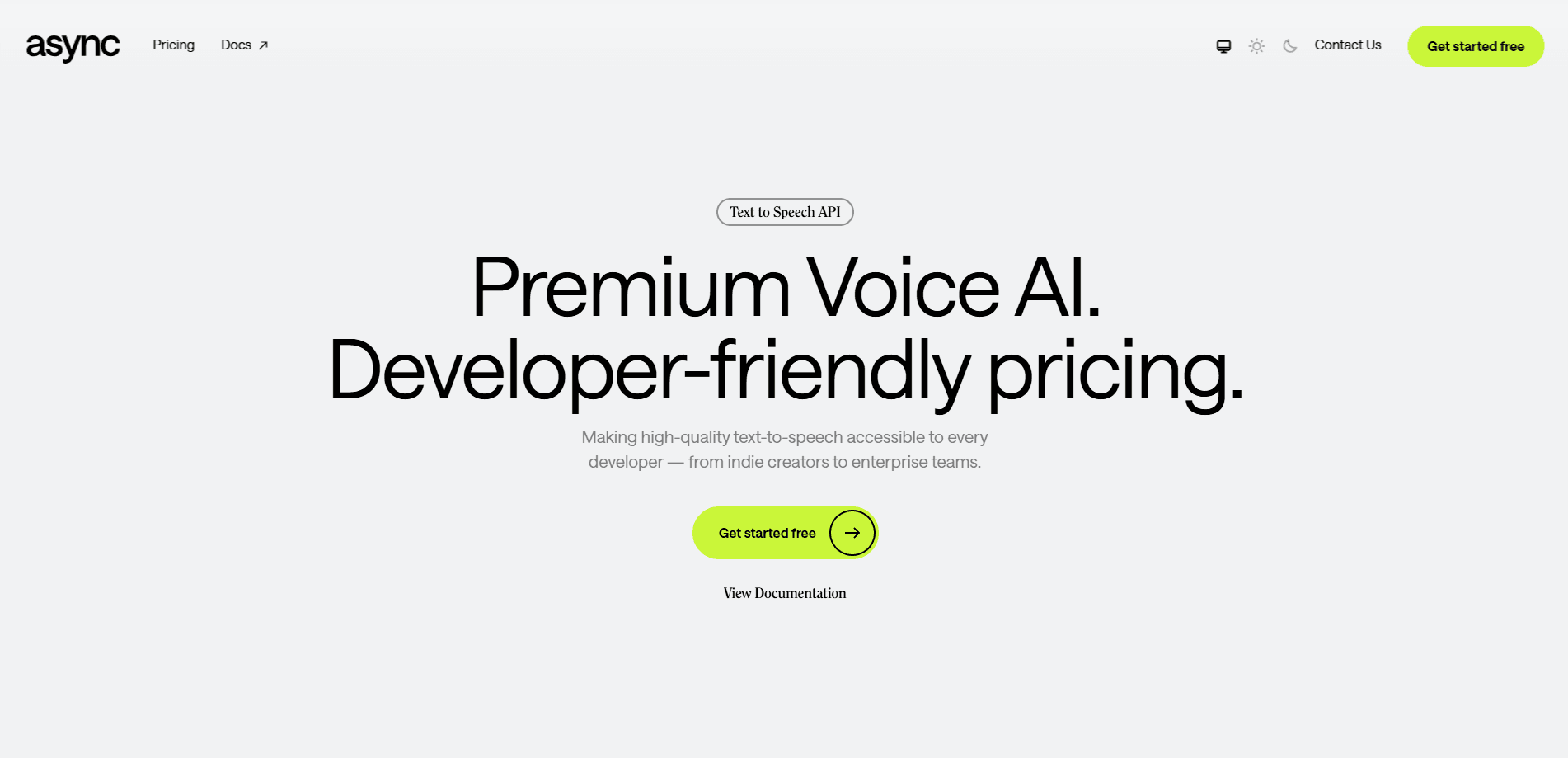
Async Voice AI is a developer text-to-speech API from Podcastle. It streams human-like speech in under 300 ms, clones a voice from a 3-second sample and covers 15+ languages.
About Async Voice AI
What Is Async Voice AI
Async Voice AI is the developer arm of Async, the audio and video tool made by Podcastle. Instead of a studio app, this product is an API: you send text, you get back speech that sounds close to a real person. It aims at the people who build voice agents, phone bots and talking apps, where a robotic voice or a slow reply ruins the whole experience.
The pitch is simple. Plenty of good TTS models exist, but the strong ones cost a lot per hour and start speaking slowly. Async bets that teams want both speed and quality at a price that doesn't block a prototype. It trains its own models, posts blind A/B results on the Hugging Face TTS Arena, and lets you start with 10 free minutes of audio before you pay anything.
Two limits matter up front. The highest-quality voice model, Async Pro v1.0, is tuned for English, so non-English work leans on the Flash series. And there's no monthly subscription at all, which is great until you realize you have to top up a wallet and watch usage yourself.
Getting Started
- Sign up at the Async developer portal and grab an API key, no credit card needed for the free tier
- Pick a model, Async Pro v1.0 for English quality or Async Flash v1.5 for fast streaming
- Send your text to the text_to_speech endpoint, or open a WebSocket for live streaming
- Clone a custom voice by uploading a 3-second sample if you need a branded sound
- Check audio output in the dashboard and top up your wallet when the free minutes run out
Product Information
A quick look at Async Voice AI's pricing, supported platforms, and performance.
Best for
The users, tasks, and scenarios where this tool fits best.
Users
- Developers building voice agents
- Startups shipping on a budget
- Product teams adding voice to an app
- App builders targeting multiple markets
Tasks
- Real-time conversation
- Voice cloning
- Live transcription
- Phone and IVR flows
- Captions and timing
Scenarios
- A voice assistant takes a follow-up question
- A podcaster wants a synthetic host
- A support line handles calls after hours
- A team builds a first prototype
Key features
Ultra-Low Latency Streaming
Speed is the whole point here. Async says its model starts audio faster than the low-latency leaders, with a median time to first byte around 166 ms and total latency under 300 ms. For a voice agent that means the reply lands before the silence gets uncomfortable. The company measures this itself, so treat the exact numbers as its own benchmarks, but the streaming architecture backs up the claim.
Instant Voice Cloning
You can clone a voice from a 3-second sample. No training run, no waiting queue, no separate fee on the developer plan. Upload a clip and you get a voice that keeps the tone, accent and pacing of the original. It's the feature that turns a generic TTS API into something you can brand, whether that's a character, a host or a company voice.
Two TTS Models for Different Jobs
Async splits its text-to-speech into two lines. Async Pro v1.0 is the quality pick and handles English best, with clean treatment of dates, numbers and currencies. Async Flash v1.5 trades a little polish for speed and pairs well with live agents. There's also an older Flash v1.0 with the widest language coverage. Picking between them is really a choice between best sound and fastest reply.
15+ Languages with Native Pronunciation
The API covers more than 15 languages with what the company calls native pronunciation, and the same endpoint serves them all. Text normalization handles the messy parts, like reading dates, currencies and abbreviations the way a person would. For teams shipping in several markets, that means one integration instead of a different model per region.
HTTP, Streaming and WebSocket Delivery
Text-to-speech comes in four shapes: a plain HTTP call that returns one audio file, a streaming endpoint that starts playback before generation finishes, a timestamped version for captions, and a WebSocket for feeding text in as an LLM writes it. Speech-to-text works the same way, with a file upload for recordings and a live stream for real-time transcription. Few other APIs give you this much choice over how audio reaches your app.
Fine Controls and Integrations
Beyond the core models, Async exposes the small knobs that decide whether speech sounds produced or natural. You can set custom pronunciations with IPA phonemes for brand names and acronyms, read numbers digit by digit for phone numbers, and insert exact pauses with a break tag. For wiring it in, there are ready integrations for Pipecat, LiveKit, Twilio, n8n and Picsart Flow, so you're not writing the plumbing from scratch.
Pros and cons
Pros
- Low latency at around 166 ms to first audio byte, which keeps voice agents feeling responsive
- Pricing starts at $0.50 per hour of audio, well below what the major TTS APIs charge
- Voice cloning is included on the developer plan rather than sold as an add-on
- A 10-minute free tier means you can test real output before spending anything
- Ready integrations with Pipecat, LiveKit, Twilio, n8n and Picsart Flow cut setup time
Cons
- The top-quality model, Async Pro v1.0, is built for English, so other languages fall back to the Flash series
- Wallet-based billing means you manage top-ups and usage yourself, with no flat monthly plan
- Latency and quality figures are the company's own benchmarks, not independent third-party tests
- Speech-to-speech and speech enhancement are still listed as coming soon, so those jobs need another tool today
Frequently asked questions
It's a text-to-speech API for building voice features, most often voice agents, phone bots, chatbots and any app that talks back. You send text and it streams back natural-sounding audio, and it can also transcribe speech with its speech-to-text endpoints.
Related content
Explore related tools, skills, and articles for Async Voice AI.
Async Voice AI Alternatives

Off the Record
Weird Machines · Voice & Language · ProductivityOff the Record is a macOS app from Weird Machines that reshapes your voice in real time to block AI transcription, so people hear you normally and notetakers get nothing usable.
Cekura Bench
Cekura · Voice & Language · BusinessCekura Bench is a public benchmark that runs speech-to-speech models and deployed voice agents through 82 simulated phone calls, three times each, then publishes pass rates, latency and cost.
Griffin by Tavus
Tavus · Voice & Language · Video · ChatbotGriffin by Tavus is the first Human Interaction Model: a full-duplex, video-to-video system that watches, listens, and answers during a live video call in real time.