
Griffin by Tavus
Tavus · Voice & Language · Video · Chatbot
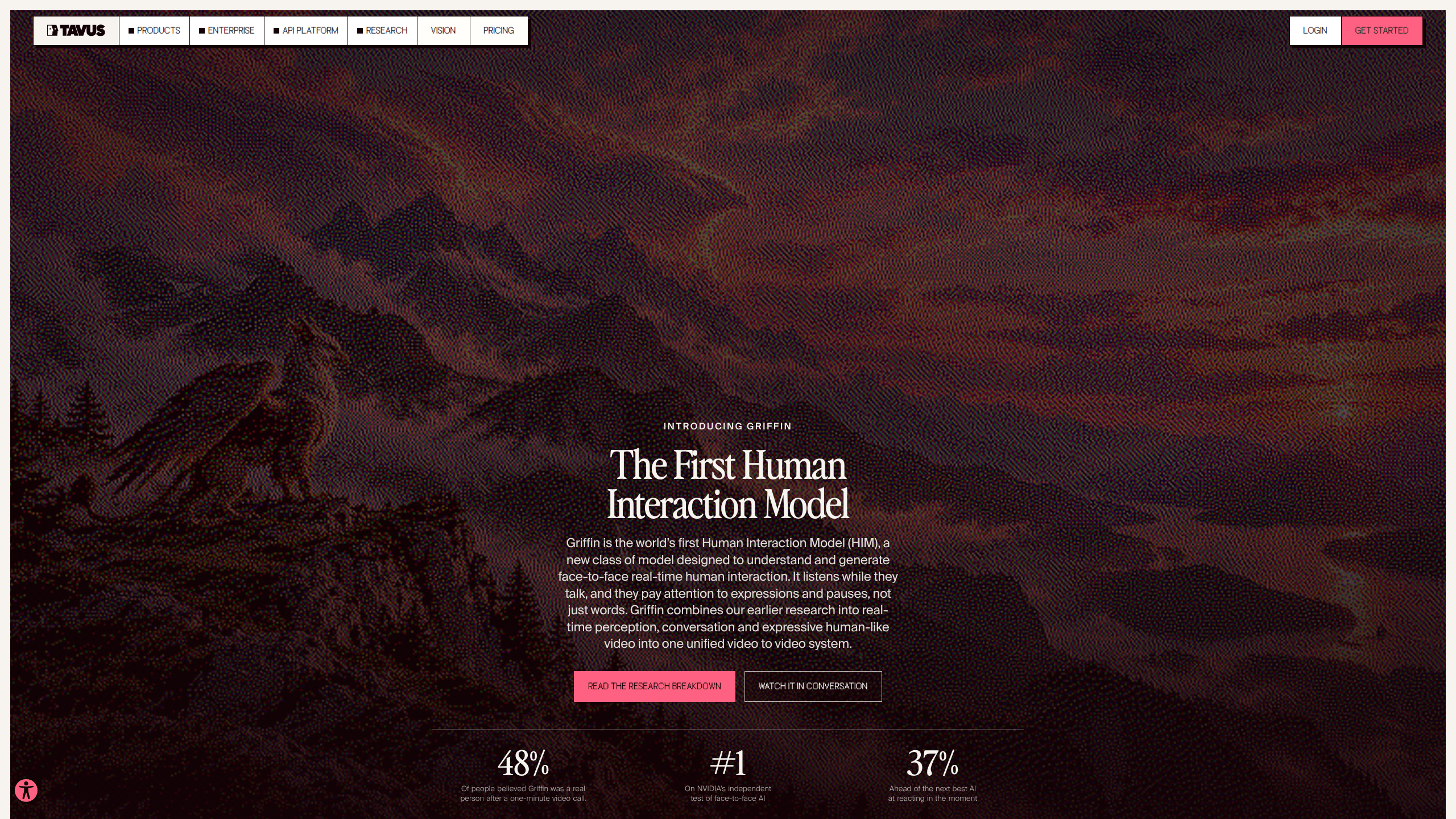
Griffin by Tavus is the first Human Interaction Model: a full-duplex, video-to-video system that watches, listens, and answers during a live video call in real time.
About Griffin by Tavus
What Is Griffin by Tavus
Griffin is a research model from Tavus that holds a face-to-face conversation on a video call. It reads your camera feed and microphone at the same time, decides when to speak, and generates the other person's face and voice as the call goes on. Tavus published it on October 1, 2026 and calls it the first Human Interaction Model, or HIM.
The design departs from the usual stack for conversational video AI. Most systems run speech recognition, a language model, speech synthesis, and an avatar renderer in sequence, and they wait for you to stop talking before they start. Griffin makes conversational decisions at sub-second intervals instead. That lets it nod while you speak, take a pause for thought as a pause rather than a finished turn, and recover when you cut in.
The tradeoff is access. Griffin-Lite, the version that exists today, is a research preview for a small group of trusted testers. Tavus says it is not on the Tavus platform yet, has no published price, and carries no public API. The headline 48% figure also comes from a study Tavus ran itself, with 54 people and one-minute calls.
Getting Started
- Open tavus.io/griffin and submit the access request form. The preview is invitation based, so there is no sign-up button that gets you a seat.
- If you are accepted, join an AI video call from the link you receive. Nothing installs on your machine.
- Grant camera and microphone access, then talk as you would with a colleague. The AI avatar on the other side generates its response as you speak.
- Test one behavior at a time. Interrupt mid-sentence, stop to think, or hold an object up to the camera and watch what the model does with it.
- Treat the session as an evaluation. There is no dashboard, no export, and no billing page, because Griffin-Lite is not a customer product.
Product Information
A quick look at Griffin by Tavus's pricing, supported platforms, and performance.
Best for
The users, tasks, and scenarios where this tool fits best.
Users
- Product teams building real-time video agents
- Learning and development teams
- Conversational AI researchers
Tasks
- Sales call rehearsal
- Interview practice
- Language practice
- Support escalation prep
Scenarios
- Deciding whether a video agent fits a workflow
- Testing interruption handling before a build
- Reviewing a regulated conversation
Key features
Full-duplex conversation
Griffin listens while it speaks. It can hold the floor, yield it, or stop when you cut in, and it keeps tracking the conversation during its own response. Tavus built this as a continuous loop rather than a turn-by-turn handoff, which is why a pause in your sentence does not automatically end your turn.
Full-scene video generation
The model generates every pixel in the frame from a single reference image. That covers the face, hands, and the chair the person sits in, along with shadows and the background. Most AI avatar systems animate a cropped head, so a moving hand or a shifting body breaks the illusion. Griffin does not have that seam.
Real-time 720p output
Video comes out at 720p while the call is running, one latent at a time. That streaming output is the core of the real-time video AI claim. Tavus measured an average of 0.43 seconds to generate the smallest video chunk on an H100, with a best case of 0.27 seconds. The number that matters on a call is the gap between your interruption and the face reacting, and half a second is short enough to read as attention.
Visual perception
Griffin takes video input, not audio alone. It picks up gaze, facial expression, gestures, and objects you show the camera, and it can read a shared screen. That is how it reacts when you hold up a broken part or look away to think, instead of answering the transcript of your words.
Behavior and emotion modeling
The model changes tone, expression, and gesture with the context of the conversation. It laughs at the right moment, shifts when the subject turns serious, and uses non-verbal signals to acknowledge what you said. Tavus trained these behaviors as part of the same system that decides what to say, not as a layer added afterward.
Voice cloning from short audio
Griffin's speech generator clones a voice from about ten seconds of reference audio. It runs on Tavec, Tavus's own audio codec, which streams in chunks as small as 10 milliseconds. For anyone building a branded AI avatar, that short sample requirement removes a recording session from the setup.
Pros and cons
Pros
- 48% of participants in Tavus's live study thought they were talking to a person, against 2.4% for the company's previous Phoenix-4.5 stack.
- Griffin-Lite scored 3.83 on NVIDIA's VideoFDB generation track, with the human reference at 3.92 and the next AI system at 2.80.
- It handles interruptions and backchannels without losing the thread, which is where cascaded speech and avatar pipelines usually fall apart.
- Full-scene generation means hands, posture, and background move with the conversation instead of sitting frozen.
- Voice cloning needs roughly ten seconds of audio, so a custom AI avatar is quick to set up.
Cons
- You cannot buy it. Griffin-Lite is limited to approved testers and Tavus has set no general release date, so no team can plan a launch around it.
- There is no public API, model identifier, or price. Developers cannot benchmark it in their own stack or budget for it.
- The 48% result rests on 54 people and one-minute calls, run by the company that built the model. Longer calls and independent replication are untested.
- The perception track shows a real gap: 3.73 against 4.20 for humans, with a 2.2 second response time against 1.4 seconds. Complex visual context still trips it.
Frequently asked questions
Griffin is a full-duplex, video-to-video model that runs a face-to-face conversation in real time. Tavus calls it a Human Interaction Model because it handles perception, turn-taking, and audio-visual generation in one system instead of chaining separate speech, language, and avatar models.
Related content
Explore related tools, skills, and articles for Griffin by Tavus.
Griffin by Tavus Alternatives

Foley
Hanamori Labs, LLC · Voice & Language · Productivity · AI AssistantFoley is a voice to-do list that turns a spoken sentence into a filed task, complete with project, date and time, then helps you plan the day around what is already there.

HireKey
HireKey · Voice & Language · Productivity · LeaningHireKey is an AI job search copilot built by a former tech recruiter. It checks role fit, tailors resumes, runs interview practice and tracks every application.

Fluence
Yay Software (Yannick Huchard) · Writing · Voice & Language · ProductivityFluence is an Android app that reads PDFs, EPUBs, Word files and web articles aloud, follows each sentence as it speaks, and answers questions about the text on the phone itself.