

Athina AI
Athina AI · Coding
Athina AI is a collaborative platform where teams build, test, and monitor AI features, from prompt management to LLM evaluation.
About Athina AI
What Is Athina AI
Athina AI is a collaborative development platform for teams shipping AI features. It puts prompt management, dataset evaluation, and production monitoring in one place. Engineers and non-technical teammates then work from the same view instead of juggling scattered scripts and spreadsheets.
The platform targets a real gap, because once an AI feature goes live, someone has to answer the hard questions that only production traffic can surface. Is the model still answering correctly? Did a prompt change break something? Which responses were actually good? Athina AI handles all of that with logging, evaluations, and dashboards that track cost, latency, and quality over time so a quiet regression never stays quiet for long.
It isn't a model provider. Athina AI sits on top of whatever models you already use, including custom ones you host yourself. The catch is that the most useful tiers aren't cheap or self-serve. The free Starter plan caps you at 10k logs per month. Unlimited logging sits behind Pro and Enterprise plans, and getting either one starts with a sales conversation rather than a checkout page.
Getting Started
- Sign up for a free account at the Athina web app to get a workspace and API key.
- Create a prompt and pick a model, or log data from an app you already run.
- Evaluate a dataset with the built-in evals, or write a custom one with LLM-as-a-judge.
- Invite teammates to review results and annotate datasets in the shared UI.
- Set up monitoring to track cost and latency on live traffic.
Product Information
A quick look at Athina AI's pricing, supported platforms, and performance.
Best for
The users, tasks, and scenarios where this tool fits best.
Users
- Engineering teams shipping LLM features
- Non-technical QA reviewers
- Teams already running their own models
Tasks
- Testing prompts against a dataset
- Monitoring live AI traffic
- Comparing models side by side
Scenarios
- Launching a RAG feature
- Debugging a bad response in production
- Handing quality review to a part-time QA team
Key features
LLM Observability and Logging
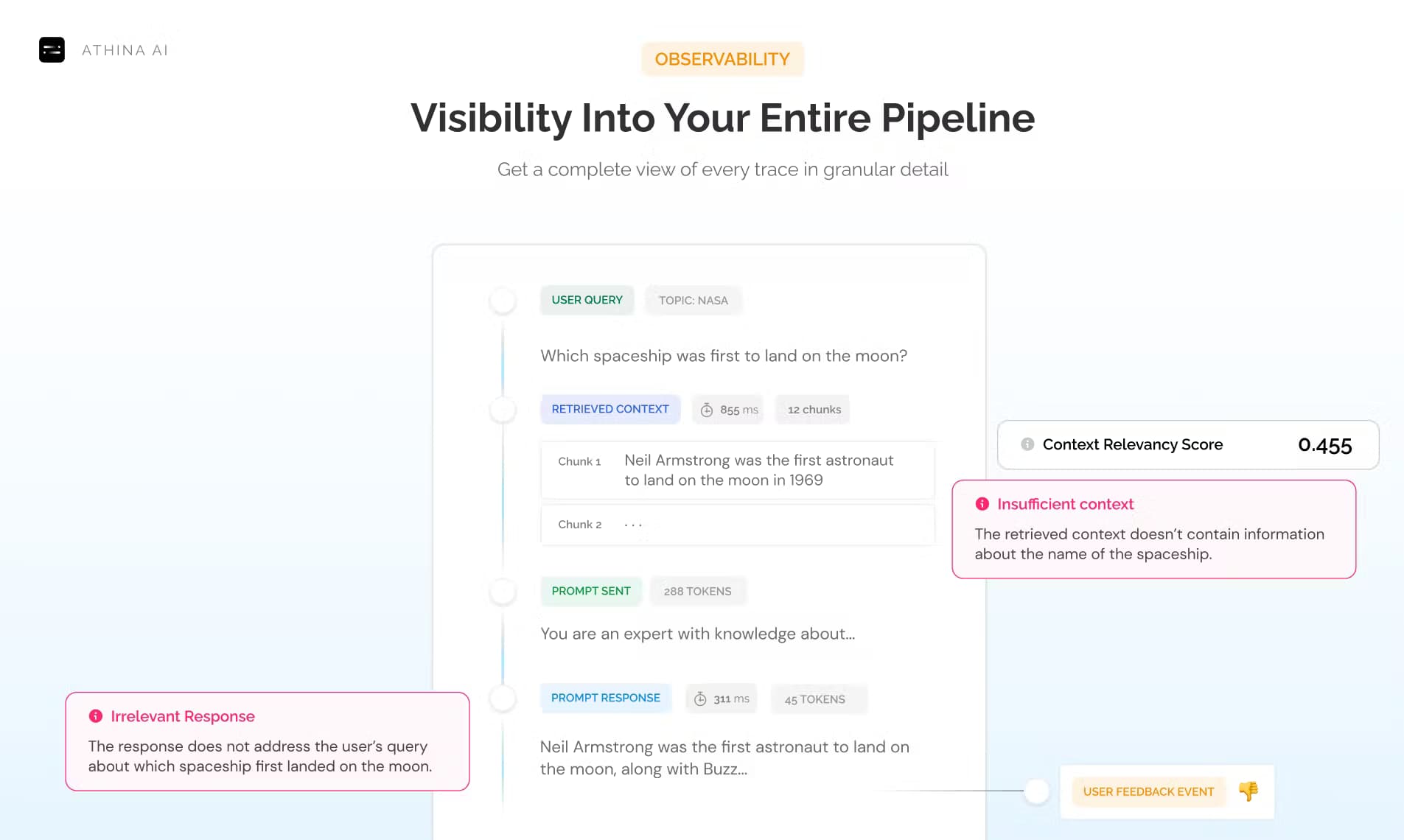
Athina AI logs every request your AI feature makes. It captures the prompt, model, response, cost, and latency in one record. Teams use it to see what actually happened in production instead of guessing from user complaints. The free tier covers 10k logs per month, so heavier apps move to a paid plan. Simple as that.
Evaluation With 50+ Preset Evals
You can score datasets against more than 50 built-in evaluations from providers like Athina, OpenAI, Ragas, and Guardrails. That covers common checks such as answer correctness, context precision, and faithfulness. If none fit, write a custom eval using an LLM judge or a Python function. Plenty of options.
Prompt Management and Versioning
Prompts are stored and versioned like code, with commits and messages attached. Engineers edit them from the UI or push changes through the Python client, so a prompt tweak doesn't have to live in someone's notes or a shared doc nobody reads. Comparing versions side by side makes it easy to pick the better one. No guesswork.
Dataset Regeneration and Comparison
Change the model, prompt, or retriever and re-generate a dataset in a few clicks. This is how teams test whether a swap actually helped rather than assuming it did. Run the same dataset against different setups, and the results line up.
Human-in-the-Loop Review
Athina AI is built for human QA teams to work alongside automated evals. Reviewers can verify evaluation results and annotate datasets in the browser, catching nuances a script misses. That feedback then informs which prompts and models get shipped. Automated evals alone miss plenty, so the human pass matters.
Code and UI in One Platform
Everything works with or without code. Engineers run prompts, flows, and evals programmatically through the Python SDK or GraphQL API, while non-technical users stay in the interface. Both sides see the same data, which cuts down on handoff friction. Fewer meetings, fewer surprises.
Team Collaboration
Experiments, datasets, and prompts are shared across the whole team, not locked to one person's account. Non-technical and technical users work on the same experiments, so quality decisions involve more than just the engineers. Everyone sees the same numbers.
Pros and cons
Pros
- Combines logging, evals, and prompt management in a single platform, so you don't have to stitch together three different tools and keep their data in sync.
- Works with any model, including custom and self-hosted ones, so you aren't locked into a single provider when you want to test whether a cheaper or faster option holds up.
- The free Starter plan covers 10k logs a month and unlimited prompts, which is enough to run a real proof of concept before committing budget to a paid tier.
- Beyond 50 preset evals, custom LLM-as-a-judge and Python evals handle the niche quality checks that off-the-shelf scoring will never cover for your specific use case.
- An open-source Python client and API let engineers keep their existing code pipeline, running prompts, flows, and evaluations programmatically without switching tools.
Cons
- Unlimited logs, evals, and datasets sit behind Pro and Enterprise plans that require booking a demo, so there's no transparent self-serve price.
- The free tier's 10k logs a month runs out fast. Any app with real traffic hits the ceiling quickly.
- Self-hosted deployment and SOC-2 Type 2 certification are Enterprise-only, so regulated teams that need them can't start small before talking to sales.
- Prompts and evals live in Athina's cloud. Some teams won't accept that for sensitive data on the lower tiers.
Frequently asked questions
Athina AI is used to build, test, and monitor AI features. Teams manage prompts, evaluate datasets, and track production quality in one place rather than across several separate scripts and dashboards.
Related content
Explore related tools, skills, and articles for Athina AI.
Athina AI Alternatives

Base Code
Base44 (Wix) · Coding · ProductivityBase Code is a shared cloud development environment from Base44. Teammates describe changes to an existing GitHub codebase in chat, preview them live and send them back as pull requests.

Google EmbeddingGemma 2
Google DeepMind · Writing · Image · CodingGoogle EmbeddingGemma 2 is a 740M-parameter open model that turns text, code, images, audio, and video frames into vectors in one 768-dimension space, running on phones and laptops.

GitGlow
GitGlow · Coding · ProductivityGitGlow is a local-first desktop Git client that lets independent developers review their own code and their AI agents' changes in one place before shipping.