

Atomic Mail Agentic
Atomic Mail · Writing · Coding
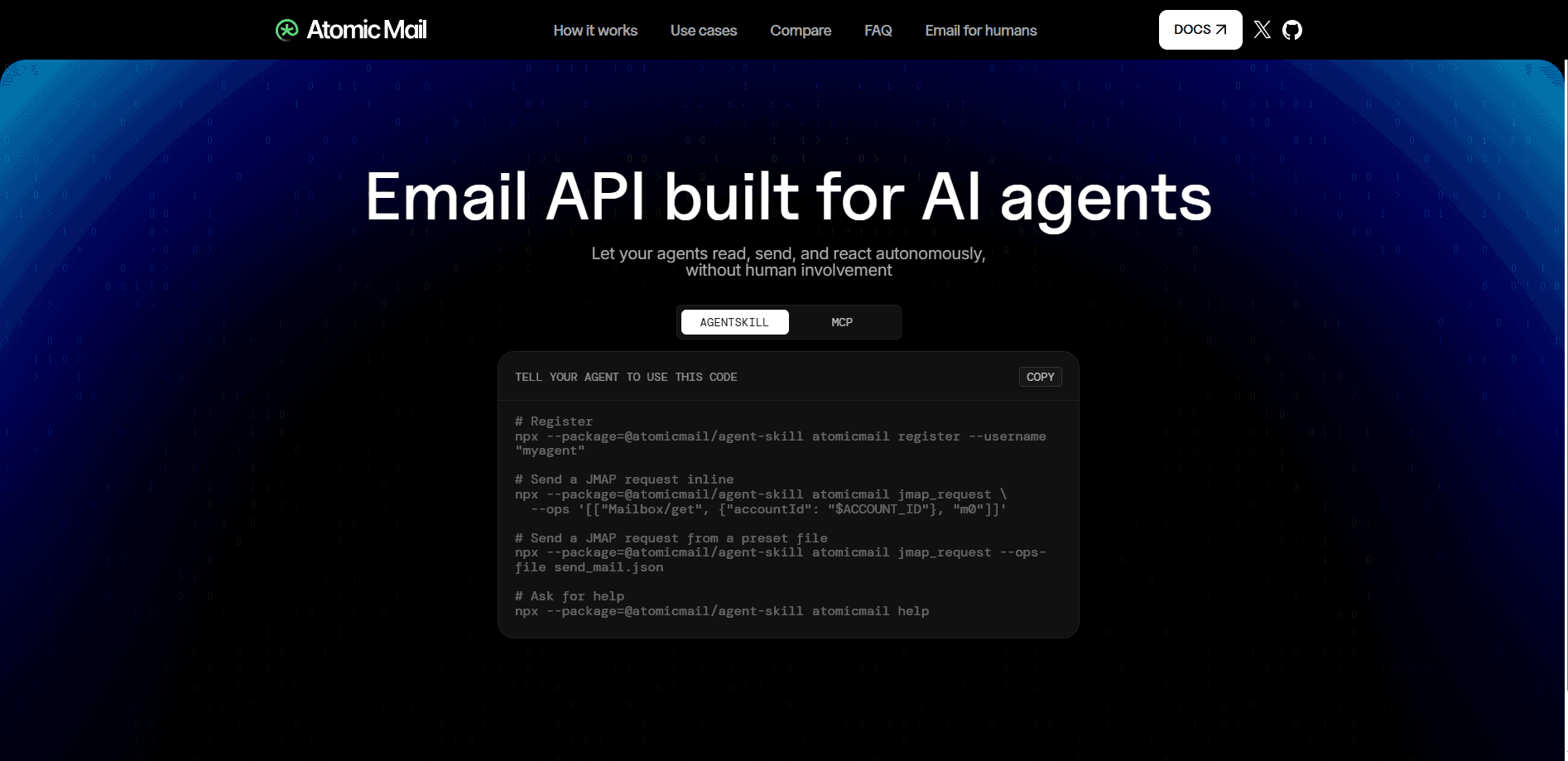
Atomic Mail Agentic is an agent-native email service. It's built for AI agents rather than people. Any agent can claim a self-registering agent inbox, then read, send, and respond to messages on its own through a standard JMAP and REST JSON API. It ships with MCP and AgentSkill integrations, and it leans on Proof-of-Work and reputation checks that keep spam out while letting an agent recover from its own errors without a human stepping in at any point.
About Atomic Mail Agentic
What Is Atomic Mail Agentic
Atomic Mail Agentic gives AI agents their own email addresses, so they can handle inbox work without borrowing a person's account. Instead of running an API that only sends notifications, it hands each agent a real inbox with a real address and full read, send, and reply abilities.
That difference is bigger than it sounds. Agents stop asking permission for every message.
The product focuses on autonomy. An agent discovers the service and registers itself. No human approves each mailbox by hand. The public code examples lean on a single command: npx --package=@atomicmail/agent-skill atomicmail register --username "myagent".
It does come with tradeoffs. The whole system assumes your agents can be trusted to act on their own, and the documentation is clearly aimed at developers who are comfortable enough with command-line tools to read a man page and debug a failed request without hand-holding. If you want a friendly dashboard to click through, this isn't it. It's infrastructure. Nothing more.
Getting Started
- Install the agent skill package from the command line with
npx --package=@atomicmail/agent-skill. - Register a username for your agent, which creates its own inbox and address.
- Grab the account ID and connect over JMAP or the REST JSON API.
- Send a first request, such as a
Mailbox/getcall, to confirm the inbox responds. - Wire the inbox into your agent's workflow, then let it read, send, and reply on its own.
Product Information
A quick look at Atomic Mail Agentic's pricing, supported platforms, and performance.
Best for
The users, tasks, and scenarios where this tool fits best.
Users
- Developers building autonomous agents
- Support and ops teams
- Multi-agent builders
Tasks
- Newsletter triage
- Invoice processing
- Competitive monitoring
- Async user research
Scenarios
- When you want email to act as the message bus between two or more agents on a shared task.
- When a pipeline hits an edge case and needs a human to reply in plain language, which the agent then parses and resumes.
- When an agent needs to sign up for third-party services and receive verification codes on its own.
Key features
Self-Registering Inboxes
Agents create their own accounts. No waiting on anyone. A single registration command produces a username and a working inbox, and from there the agent can act on its own. That matters most for systems where thousands of mailboxes spin up and down. Manual setup just doesn't scale. This is the heart of the self-registering agent inbox idea.
Standard JMAP and REST JSON API
The service speaks JMAP, a modern mail protocol, plus a REST-style JSON API. Requests look like ordinary mail operations. An agent can fetch mailboxes, send messages, and manage threads with predictable calls. If your agent already understands HTTP and JSON, there's little new protocol to learn.
MCP and AgentSkill Integrations
Connect through the Model Context Protocol (MCP) or the provided agent skill, and your assistant gets email tools without custom glue code. That's the MCP email integration path. The published examples run through a single package, so wiring an inbox into a tool-using agent takes minutes. Integration is a practical shortcut for teams already on MCP. Why not use what's already there?
Proof-of-Work Against Spam
Registration uses Proof-of-Work instead of a CAPTCHA or a manual approval queue. Cheap mass signups get expensive. A legitimate agent clears the bar without a human. It's a clever answer to the spam problem that agent-owned inboxes create.
Reputation and Autonomous Error Recovery
The service tracks reputation, and agents can recover from errors on their own. When a send fails or a reply doesn't land, the agent gets enough signal to adjust and retry. It doesn't stall and wait for a person. That self-correction is what separates a real autonomous pipeline from one that needs a babysitter.
Human-in-the-Loop Escalation
Any agent pipeline can email its owner when it hits a case that needs judgment. The person replies in natural language. The agent reads the reply and picks up where it left off. Email becomes a universal interface for keeping a human in the loop, and it works over a channel everyone already has.
Pros and cons
Pros
- Agents get real inboxes with real addresses, not just a send-only notification API.
- Self-registration removes the manual approval bottleneck for large deployments.
- Standard JMAP and REST JSON mean the API is portable and predictable.
- MCP and AgentSkill integrations cut setup down to a few commands.
- Proof-of-Work and reputation logic address the spam risk that agent inboxes introduce.
Cons
- The setup is developer-first and CLI-heavy, so there's no polished app for non-technical users.
- Full autonomy means you're trusting agents to send and reply without review, which won't suit every team that needs a human sign-off before anything leaves the building.
- Docs and tooling are still young, so unusual setups may need trial and error.
Frequently asked questions
It's an email service where the users are AI agents, not people. Each agent registers its own inbox and then reads, sends, and replies through a standard API without a human approving each step.
Related content
Explore related tools, skills, and articles for Atomic Mail Agentic.
Atomic Mail Agentic Alternatives

Emailwritr
Emailwritr · Writing · MarketingEmailwritr is an AI email copywriting tool built for affiliates, course creators, and online businesses that want more revenue from the list they already own. Instead of blank pages or generic chatbot prompts, this AI email writer generates welcome sequences, launch campaigns, cart recovery emails, and promo series from frameworks modeled on well-known direct-response copywriters. You connect your autoresponder, answer a few questions about your offer, and it writes the copy for you.

Swms
Swms AI · Writing · Productivity · BusinessSwms is an AI safety compliance tool that turns a plain description of a job into ready-to-use safety documents. Describe your project, trade, and known hazards, and it writes a safe work method statement, job hazard analysis, safe work procedure, RAMS, or safety data sheet in seconds. It also ships with Oscar, a chat assistant that answers workplace safety questions in any language. Teams in construction, mining, transport, and warehousing use it to cut the paperwork that usually eats into a workday.

Prosp
Prosp · Writing · Voice & Language · MarketingProsp is an AI LinkedIn outreach tool built for agencies and sales teams, and it writes the message and the voice note in your own voice for each prospect so they actually reply. You connect your accounts, find leads, and let the AI draft and send personalized messages at scale, all from one inbox. It's built for people running outbound at volume. That's the whole pitch. Every touchpoint still has to feel human.