

Audience Loop
iCustomer · Marketing
Audience Loop is an AI-powered audience activation platform from iCustomer that helps growth teams clean, score, and activate customer data across advertising channels. It reads your warehouse, scores every person and account on how likely they're to buy, then pushes decisions into Meta, Google, LinkedIn, The Trade Desk, and email. The point is simple: turn the customer data you already own into live audiences that update as signals change, without copying it into another silo.
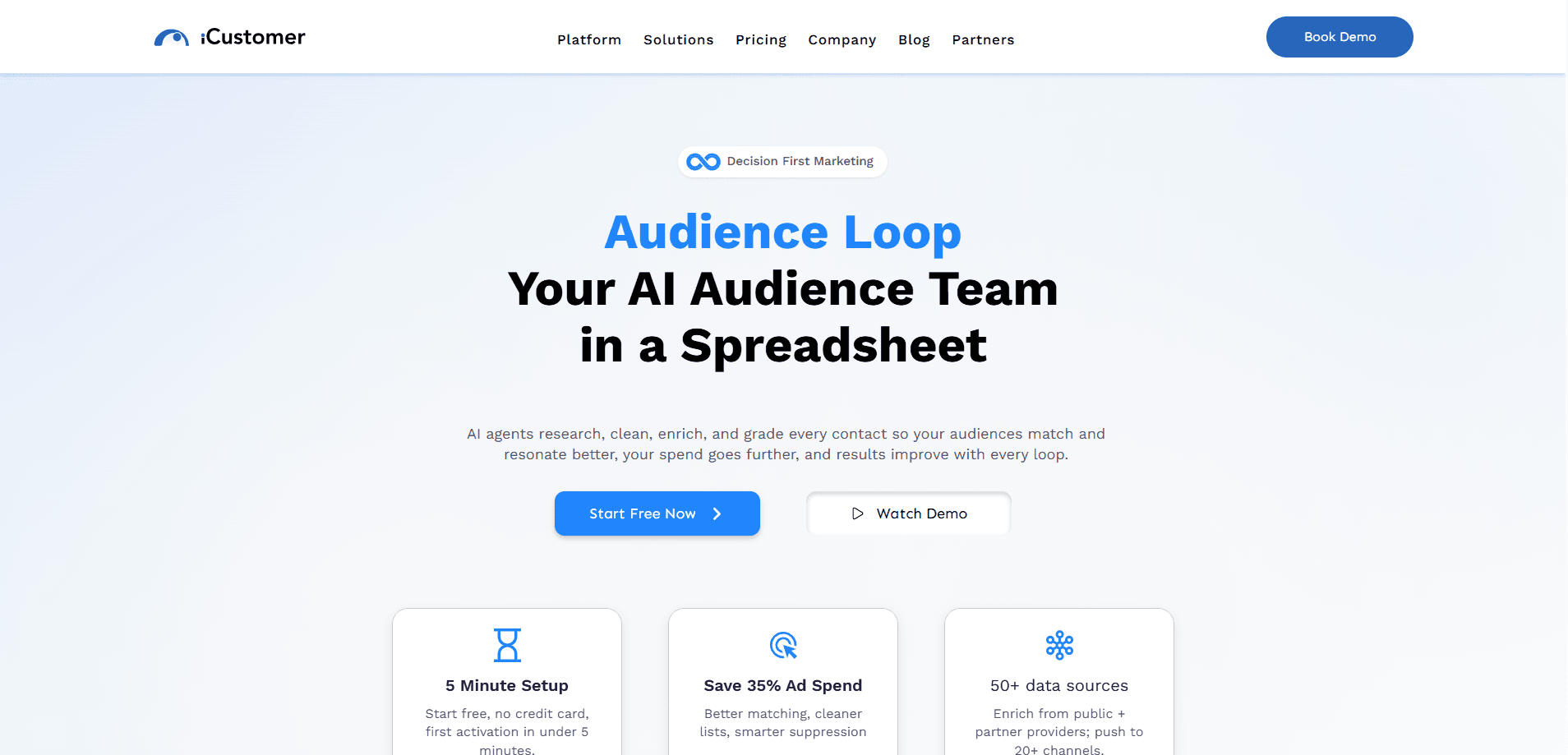
About Audience Loop
What Is Audience Loop
Audience Loop is the audience intelligence layer inside iCustomer's broader decision loops platform. It sits on top of a data cloud you already run, such as Snowflake, Databricks, or BigQuery, and scores every visitor, customer, and account in real time. Marketing teams use it to decide who to reach, when to reach them, and through which channel, instead of guessing from static lists.
The platform is built for warehouse-native work. Your data stays where it lives, so there's no migration and no second copy to keep in sync. iCustomer runs growth-engineer led deployments, meaning specialists embed with your team to build the loop. A self-serve path and a headless CLI option exist too. Compliance sits on SOC 2 Type II, and the company leans on privacy-by-design as a selling point.
The biggest limitation is fit. This isn't a light tool for a solo marketer or a small business with no data warehouse to draw from. It assumes you have first-party data worth activating and a team ready to act on it, and it assumes that team can move quickly enough to keep decisions current as audience signals shift. Pricing follows that same logic: you pay for the intelligence layer, aligned to outcomes, rather than per seat.
Getting Started
- Connect your data cloud. iCustomer hooks into Snowflake, Databricks, or BigQuery and reads your customer and account records in place.
- Let the platform resolve identities. It builds a unified audience and account graph, merging duplicates and flagging existing customers so you don't waste spend on people who already bought.
- Review the scoring. Every person and account gets a live score for purchase likelihood and timing, updated as new signals arrive.
- Set your policy gates. You define which budget moves and audience shifts are allowed, and every decision stays inside those rules.
- Activate and measure. Decisions flow into your existing ad tools, and each cycle feeds results back so the next one starts smarter.
Product Information
A quick look at Audience Loop's pricing, supported platforms, and performance.
Best for
The users, tasks, and scenarios where this tool fits best.
Users
- Growth marketing teams
- Performance marketers at mid-size and enterprise brands
- Data teams in retail, D2C, and B2B software
Tasks
- Resolving and deduplicating customer records
- Suppressing existing customers from prospecting campaigns
- Scoring accounts by purchase intent
- Measuring incremental lift
Scenarios
- Cutting wasted ad spend
- Running multi-channel campaigns from one audience view
- Managing a campaign across channels without switching tools
Key features
Real-Time Audience Scoring
Audience Loop scores every visitor, customer, and account on how likely they're to buy and how soon. Scores update live as signals change, so audiences aren't a snapshot from last quarter. Identity and account graphs resolve continuously, which keeps the data current without manual list rebuilds. Static lists can't do this.
Warehouse-Native Data Activation
The platform runs directly on Snowflake, Databricks, and BigQuery with zero data copies. Your records stay in the data cloud you control, which cuts down on sync jobs and the drift that comes with them. For teams already invested in a warehouse, customer data activation here means no migration and no second copy to maintain.
Cross-Channel Decision Activation
Decisions get pushed into Meta, Google, LinkedIn, The Trade Desk, and email, so the audience you build actually reaches the channels where you spend. No new platform to learn. Budget and audience shifts stay inside policy gates you set, and your team keeps final say, which means the automation never runs further than you've explicitly allowed it to. There's no migration to run either.
Decision Traces and Policy Gates
Every choice the system makes is explainable and reviewable through decision traces. Policy gates keep decisions inside your guardrails, so automated moves can't drift past the limits you approve. Role-based AI agents work from your actual data instead of generic assumptions, which matters for AI audience management when decisions touch real budget.
Incrementality Measurement
Instead of last-touch guesswork, Audience Loop measures what each decision actually added using holdouts, then feeds those results back into the loop so wins and losses both train the next cycle. Over time the system learns what worked in your specific account, not what worked on average. That distinction is the whole point.
Free Self-Serve Entry
You can start free with Audience Loop before committing to the full platform. That gives smaller teams a way to test audience scoring and activation on their own data before moving to an engineer-led build. It's a low-risk entry point into a product that otherwise assumes a bigger setup.
Headless CLI Option
For teams that want control, iCustomer offers a headless path through a CLI. Growth engineers can wire the loop into existing workflows instead of working through a UI. It suits data teams that prefer to keep decisions in code and pipelines.
Pros and cons
Pros
- Warehouse-native design keeps your customer data in Snowflake, Databricks, or BigQuery with no copies to sync.
- Real-time audience scoring replaces static lists with audiences that adapt as signals change.
- Activates decisions directly in Meta, Google, LinkedIn, The Trade Desk, and email, so you keep your existing tools.
- Incrementality measurement with holdouts shows real lift rather than last-touch attribution.
- Free entry point plus a headless CLI option give both small teams and engineering-led teams a way in.
Cons
- It assumes you already run a data warehouse and have first-party data worth activating, so it's not a fit for businesses without that foundation.
- Pricing is custom and outcome-aligned, so you won't get a simple per-seat number up front.
- The free tier covers Audience Loop, but the fuller decision-loop platform and engineer-led builds carry real setup commitment.
- Measuring incrementality requires enough ad spend and traffic to produce meaningful holdout results.
Frequently asked questions
It scores your customer and account data, then turns those scores into advertising decisions across Meta, Google, LinkedIn, The Trade Desk, and email. So what changes day to day? Instead of building static lists, you get audiences that update in real time as signals change, and you can see what each decision added.
Related content
Explore related tools, skills, and articles for Audience Loop.
Audience Loop Alternatives

Emailwritr
Emailwritr · Writing · MarketingEmailwritr is an AI email copywriting tool built for affiliates, course creators, and online businesses that want more revenue from the list they already own. Instead of blank pages or generic chatbot prompts, this AI email writer generates welcome sequences, launch campaigns, cart recovery emails, and promo series from frameworks modeled on well-known direct-response copywriters. You connect your autoresponder, answer a few questions about your offer, and it writes the copy for you.

Prosp
Prosp · Writing · Voice & Language · MarketingProsp is an AI LinkedIn outreach tool built for agencies and sales teams, and it writes the message and the voice note in your own voice for each prospect so they actually reply. You connect your accounts, find leads, and let the AI draft and send personalized messages at scale, all from one inbox. It's built for people running outbound at volume. That's the whole pitch. Every touchpoint still has to feel human.

On Model
On Model · Image · MarketingOn Model is an AI fashion model tool that places your clothing on virtual models so online stores can get on-model product photos without booking a photoshoot. It runs as a Shopify app, letting you swap the model in an existing image, change backgrounds, and generate faces for cropped or headless shots. The goal is simple: match your product photos to your customers and stand out from competitors using the same supplier images.