

Auditive
Auditive, Inc. · Other
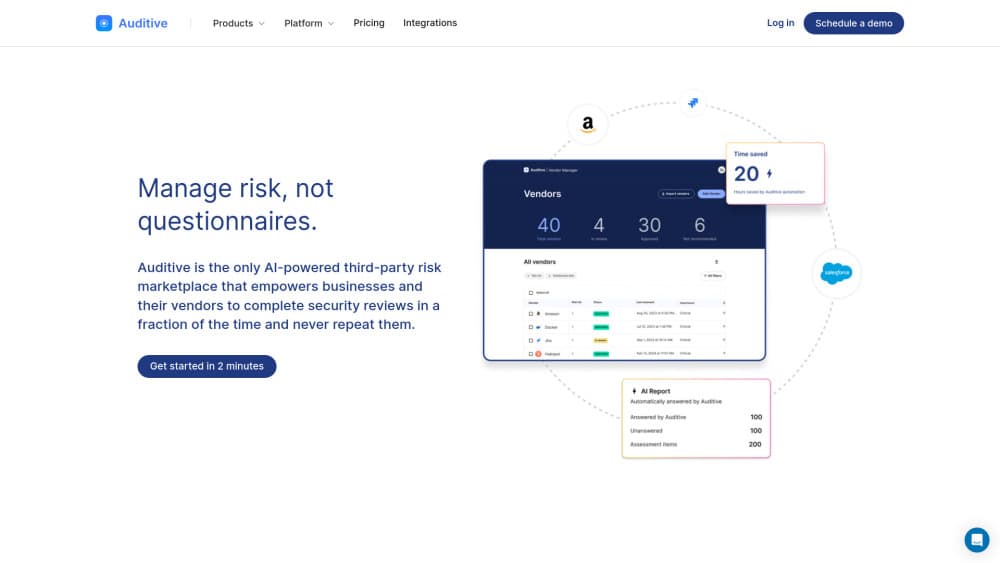
Auditive is a third-party risk management platform that uses AI to automate due diligence, client onboarding, and continuous vendor monitoring for fintech and enterprise compliance teams.
About Auditive
What Is Auditive
Auditive is a TPRM platform from Auditive, Inc., a company based in Walnut Creek, California. It serves two groups: fintech and payments platforms that need to vet the business clients they onboard, and regulated enterprises that manage a long list of suppliers. Both use the same core tools, which cover intake forms, document collection, AI review of the evidence, and ongoing monitoring after approval.
The product targets a familiar mess. Compliance teams collect documents over email, read them by hand, and then wait a year before looking again. Auditive positions its AI compliance automation as the fix, not another place to store files. Auditive moves that work into one workspace, pulls evidence from a shared network of vendors, and raises a flag when a certificate lapses or a contract changes. The aim is fewer spreadsheets and fewer surprises at audit time.
There are limits worth knowing before you book a call. Auditive is built for business-to-business compliance, so it does nothing for individual consumers and isn't a general document tool. Professional and Enterprise pricing is quoted after a demo, which means you can't compare costs from the website. A team with no compliance process at all will find the setup work heavier than the software.
Getting Started
- Book a demo or a strategy call from the Auditive site and describe your current onboarding or vendor review process.
- Choose a plan. The free Basic tier covers evidence sharing and limited AI chat, while Professional and Enterprise add graded risk assessments and full automation.
- Build your intake form around your own risk criteria, so clients or suppliers answer only the questions that apply to them.
- Invite clients or vendors into the workspace and let the network fill in evidence that has already been verified elsewhere.
- Review the AI summaries and scores, set notification rules for your team, and let monitoring run between reviews.
Product Information
A quick look at Auditive's pricing, supported platforms, and performance.
Best for
The users, tasks, and scenarios where this tool fits best.
Users
- Compliance managers at fintech and payments companies
- Procurement and InfoSec teams at regulated enterprises
- Vendors and partners who receive questionnaires
- Operations leads at growing platforms
Tasks
- Client onboarding due diligence
- Vendor risk assessment
- Continuous monitoring
- Audit preparation
Scenarios
- Launching a new payments product
- Annual review season with hundreds of suppliers
- A large client wants to go live in days
- A regulator asks for evidence on a specific vendor
Key features
AI Review of Compliance Documents
Auditive reads the evidence you collect and turns it into a summary and a risk score, so your team reviews conclusions instead of raw PDFs. The Enterprise plan applies this to document summaries, partner assessments, and inherent risk analysis. Accuracy still depends on what the vendor uploads, and a human should sign off on anything that affects a contract.
Shared Trust Profiles and Vendor Network
Vendors publish their verified compliance data once, and every customer on the platform can pull it. That removes the repeated questionnaire cycle that both sides dislike. The network effect is the main reason the free Basic tier exists: the more partners join, the less document chasing everyone does.
Automated Intake and Contract Management
Intake forms are scoped to your own risk criteria, and contracts sit next to the assessment they belong to. Professional and Enterprise plans automate the intake and contract steps. If your criteria change, you edit the form rather than rebuilding a spreadsheet, and the record stays linked to the client.
Continuous Monitoring and Alerts
Instead of a yearly check, Auditive watches for lapsed certifications, regulatory flags, contract changes, and SLA misses, then pushes alerts to the people who handle them. Email notifications mean the compliance team doesn't have to live in the dashboard. The value shows up in the gaps between reviews, which is where most incidents start.
Framework Mapping and Deviation Tracking
Assessments are pre-mapped to common frameworks, including SOC 2, ISO 27001, NIST, PCI, and HIPAA. Auditive tracks each deviation against the framework you report on and flags what needs attention. For teams facing OCC, DORA, or FFIEC guidance, that mapping saves the manual crosswalk at reporting time.
In-Product AI Chat
Every plan includes AI chat, with usage limits that rise from Basic to Enterprise. It answers questions about the evidence in your workspace, which helps when a reviewer needs context on a single vendor. Treat it as a research shortcut rather than an approval authority.
Integrations and Custom Connections
Enterprise includes third-party integrations, and custom connections are available for systems you already run. That matters if your vendor data lives in a procurement or GRC tool and you don't want a second silo. Setup is handled with the Auditive team during onboarding rather than through a self-serve menu.
Pros and cons
Pros
- AI document review cuts the reading load on client onboarding and vendor assessments.
- The shared vendor network shortens evidence collection for both sides, which is rare in TPRM software.
- A free Basic tier lets partners share compliance data before your company buys anything.
- Framework mapping for SOC 2, ISO 27001, NIST, PCI, and HIPAA keeps audit evidence in one place.
- Monitoring runs between reviews, so lapsed certificates surface as alerts instead of audit findings.
Cons
- No public prices for Professional or Enterprise, so budgeting starts with a sales call.
- The interface assumes you already have a risk policy and review workflow, which slows down teams starting from zero.
- AI scoring needs human review on anything contract-related, so it saves reading time rather than headcount.
- Vendor-side adoption decides how much the network helps, and some suppliers will still send PDFs by email.
Frequently asked questions
Auditive automates third-party risk management. It collects compliance evidence from clients or vendors, uses AI to read and score the documents, and keeps monitoring each relationship after approval.
Related content
Explore related tools, skills, and articles for Auditive.
Auditive Alternatives

Odyssey 3
Odyssey · OtherOdyssey-3 is Odyssey's foundation world model. It simulates physics in real time, turns a prompt into an interactive environment, and adapts to robots, cars and games.

JarvisCore
Prescott Data · Coding · Productivity · OtherJarvisCore is an open source Python runtime where AI agents work as equal peers on an agent mesh, claim tasks from a shared ledger, and reach external services through a zero-trust broker.
Clef
Cloudflare · Business · OtherClef is Cloudflare's open-source decision model for Workers AI. It returns calibrated probabilities for typed questions, not generated text, so agents can classify, route, and act fast.