

Codespect
Codespect · Coding
Codespect is a GitHub App for automated pull request analysis. It summarizes each change, checks code against KISS, DRY, and SOLID rules, and posts fix suggestions as comments.
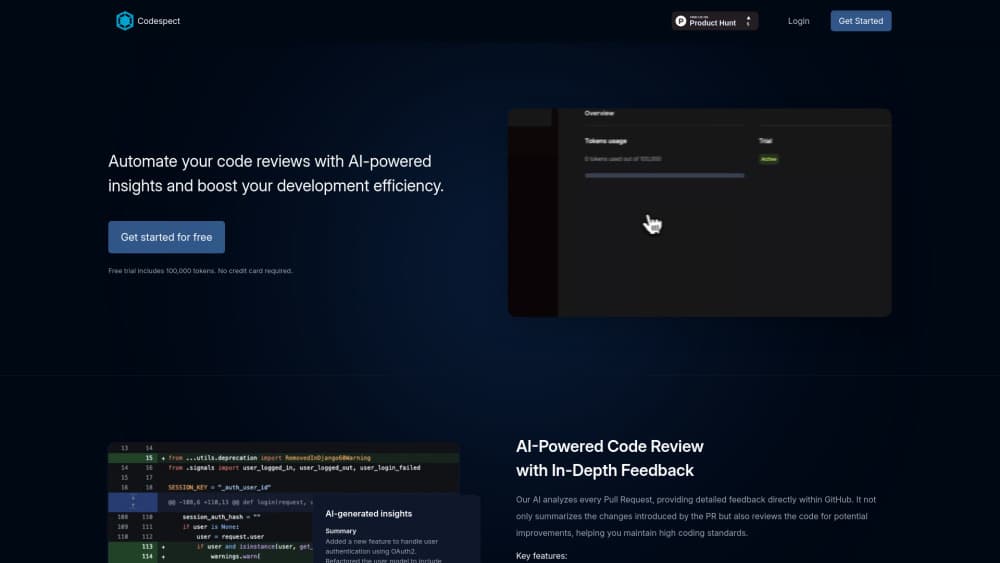
About Codespect
What Is Codespect
Codespect is an AI code review tool that plugs into GitHub and reads every pull request before a teammate opens it. It works as a GitHub App with read-only access to the diff, so it comments on the change but never touches your repository. The company targets software teams and solo developers who want a first pass on a PR without waiting for a senior reviewer, and it leans on framework-aware models instead of one generic language model.
The idea behind the product is simple: the slow part of review is the first read, not the conversation. Someone still has to skim a 400-line diff, note the obvious issue, and ask for a summary. Codespect does that step. When you open a pull request, it detects the stack, picks a matching model, writes a plain-language summary, and drops line-level comments where the code drifts from common practice.
The limits matter as much as the features. Codespect only works with GitHub. There is no GitLab or Bitbucket support, so a team on those platforms gets nothing from it. The specialized models cover Laravel and the JavaScript world of React, Vue, and TypeScript, while other languages fall back to a general model that is less tuned. And a real human still has to make the merge call, because the tool flags and suggests rather than decides.
Getting Started
- Sign up at codespect.io with a GitHub account. The free tier needs no credit card and runs on public repositories.
- Install the Codespect GitHub App and grant read-only access to the repository diffs you want reviewed. Setup takes about 15 seconds.
- Open a pull request as usual. Codespect detects the language and framework, then posts a review automatically.
- Read the summary and the inline comments, then apply a suggested fix with one click or reply in the thread.
- Move to a paid plan if you need private repositories, then set custom analysis rules once so every future pull request is checked against your team's standards.
Product Information
A quick look at Codespect's pricing, supported platforms, and performance.
Best for
The users, tasks, and scenarios where this tool fits best.
Users
- Individual developers on public projects
- Laravel and PHP teams
- React, Vue, and TypeScript teams
- Tech leads and senior reviewers
Tasks
- Summarizing pull requests
- Checking code quality
- Suggesting fixes inline
- Enforcing team standards
- Tracking review patterns
Scenarios
- Triaging a busy open-source repository
- Reviewing a frontend refactor
- Onboarding a new contributor
- Keeping a small team moving
Key features
Automated pull request summaries
Every pull request gets a short, plain-language description of what changed and why the reviewer should care. It turns a raw diff into a summary a teammate can scan in seconds, which is the step that usually eats review time. Developers who skim first and read code second get a faster entry point into an unfamiliar change.
Code quality analysis against KISS, DRY, and SOLID
The reviewer scores the change against battle-tested design principles and calls out violations with a specific line. It looks for duplicated logic, overcomplicated functions, and classes that carry more than one responsibility. The output reads as advice for a teammate rather than a lint warning, which makes it easier to accept or push back on.
Incremental review
Codespect tracks changes across pull requests and avoids repeating comments on code a reviewer already handled. Older tools pile up the same note on every commit, which buries the useful feedback. This feature keeps the thread clean, so the comments you see are the ones that still apply.
Framework-specific AI models
The service ships tuned models for PHP on Laravel and for JavaScript and TypeScript on React and Vue, and it detects the stack when a pull request opens. A Laravel review understands Eloquent and Blade conventions, while a React review understands hooks and component patterns. Other languages still get a general model, so coverage is broad but not evenly deep.
Custom analysis rules
Teams can define their own coding standards once, and Codespect checks each pull request against them alongside the built-in rules. This is how a company encodes choices that generic reviewers cannot know, such as a naming convention or a banned library. It sits on the paid tier and is aimed at tech leads setting team policy.
One-click AI prompt fixes
When a comment needs a nudge, a reviewer can refine the AI suggestion with a single click instead of rewriting it by hand. The tool then reposts an improved suggestion in the same thread. It is a small workflow piece, but it keeps the review moving without a copy-and-paste detour.
Privacy-first access and GDPR compliance
The GitHub App asks for read-only access to pull request diffs, and it does not store source code on its servers. Diffs are analyzed and deleted once the review finishes, and the infrastructure is built to meet GDPR rules. For teams that care where their code goes, this is the detail that decides whether the tool is usable at all.
Pull request analytics
Beyond comments, Codespect tracks review times and surfaces where the process drags. That data tells a team lead whether reviews stall on one phase or one person. It is the reporting layer that sits beside the review itself.
Pros and cons
Pros
- A free tier with unlimited public-repo reviews lets open-source maintainers try it with no budget.
- Framework-tuned models for Laravel, React, and Vue give more useful feedback than a single generic model.
- Read-only diff access and immediate deletion keep source code out of the vendor's servers.
- Incremental review stops the tool from repeating comments on code that was already fixed.
- Setup is quick, around 15 seconds to connect a GitHub account and start reviewing.
Cons
- GitHub is the only supported platform, so teams on GitLab or Bitbucket cannot use it.
- Private repositories need a paid plan, starting at $9 per month for the Starter tier.
- Specialized models cover only PHP and JavaScript ecosystems, and other languages get a less tuned general model.
- Custom analysis rules and team management sit on the $19 Pro tier, so smaller budgets miss the standards feature.
Frequently asked questions
Codespect is an AI code review tool that runs as a GitHub App. It reads each pull request, writes a summary, checks the code against KISS, DRY, and SOLID principles, and posts fix suggestions as comments in the thread.
Related content
Explore related tools, skills, and articles for Codespect.
Codespect Alternatives

Base Code
Base44 (Wix) · Coding · ProductivityBase Code is a shared cloud development environment from Base44. Teammates describe changes to an existing GitHub codebase in chat, preview them live and send them back as pull requests.

Google EmbeddingGemma 2
Google DeepMind · Writing · Image · CodingGoogle EmbeddingGemma 2 is a 740M-parameter open model that turns text, code, images, audio, and video frames into vectors in one 768-dimension space, running on phones and laptops.

GitGlow
GitGlow · Coding · ProductivityGitGlow is a local-first desktop Git client that lets independent developers review their own code and their AI agents' changes in one place before shipping.