

BarRaiser
BarRaiser · Business
BarRaiser is an interview outsourcing service that hands technical rounds to trained expert interviewers, with AI-structured plans and recorded scorecards.
About BarRaiser
What Is BarRaiser
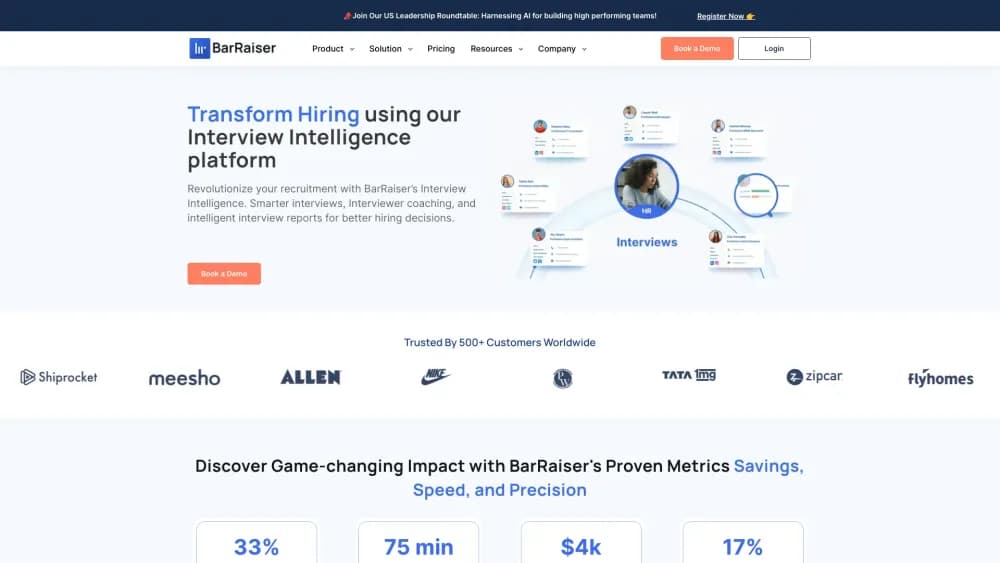
BarRaiser takes over the interview stage of hiring. A company shares a job description, the platform turns it into a structured interview plan, and an interviewer from BarRaiser's network runs the round. Your engineers stay on product work while candidates move through a process that follows the same format every time.
The company started in 2020 and launched its interview platform in January 2021. It reports more than 400,000 interviews completed for over 500 customers, with 4,000+ interviewers covering roughly 400 skills across 40+ countries. The service is sold as interview as a service, and the platform underneath it also runs as a standalone AI interview tool for teams that keep interviewing in house.
The problem it targets is not a lack of candidates. It's the cost of running a good interview loop: scheduling, trained interviewers, consistent scoring, and feedback that arrives while the candidate is still interested. BarRaiser handles those steps and returns a written evaluation. The structured interviews are the product, not a feature bolted onto a scheduling tool.
The limits matter as much as the pitch. This is a managed service, not self-serve software, and pricing comes as a quote. Your team still owns the final hiring decision. Output depends on how clearly the role is defined, and on matching the right interviewer to the domain. Companies that want every conversation conducted by their own staff, or that need rare specialist depth in a narrow field, will find the fit narrower.
Getting Started
- Book a demo and describe the roles you are hiring for, the tech stack, and the volume of candidates.
- Upload the job description. The platform builds an interview plan with skills to test, a timeline, and a question set. You can edit the questions or the time split before the first round.
- Candidates pick a slot that suits them, including evenings and weekends. BarRaiser sends the link and handles reminders, so nobody coordinates calendars by email.
- An expert interviewer runs the session and records it. AI marks the key moments and pulls out evidence for each skill.
- Review the scorecard: skill-wise ratings, behavioral notes, a hire or no-hire recommendation, and the recording. Your team makes the call.
Product Information
A quick look at BarRaiser's pricing, supported platforms, and performance.
Best for
The users, tasks, and scenarios where this tool fits best.
Users
- Engineering leaders at product companies
- Talent acquisition teams with steady technical volume
- Founders hiring their first engineers
Tasks
- Screening backend, frontend, or data candidates before the onsite
- Adding a structured round to an existing process
- Interviewing across time zones
- Calibrating your own interviewers
Scenarios
- A hiring spike with more candidates than your team can interview
- A small team with no bandwidth for interviews during a product launch
- An early-stage company that needs a defensible process before its first senior hire
Key features
Expert Interviewer Network
BarRaiser maintains a pool of 4,000+ interviewers who cover backend, frontend, product, data science, DevOps, and other domains, with sessions available around the clock. Each interviewer goes through BarRaiser's own training and works from the same scoring rubric, which is the part that matters: a large pool is only useful if the people in it evaluate the same way. For teams spread across time zones, the practical gain is that a candidate in Asia can interview in the evening without anyone in California staying up.
AI-Structured Interview Plans
Upload a job description and the platform drafts an interview plan: which skills to probe, how long each section runs, and a question set tied to the role and the candidate's resume. The company says it ships with 5,000+ pre-built templates. Hiring managers can edit the plan, swap questions, or change the time split, so the structure is a starting point rather than a fixed script. Teams that already have a strong loop can keep their questions and use the tool for scheduling and scoring alone.
Recorded Sessions and AI Highlights
Every interview is recorded, and AI evaluation pulls out the moments that carry evidence: a candidate's approach to a problem, a trade-off they explained, a gap they couldn't close. Hiring managers who weren't in the room can review the session instead of relying on a second-hand summary, and a disputed decision can be checked against the actual conversation. Recordings also serve as training material for internal interviewers.
Skill-Wise Scorecards and Hire Recommendations
The output is an interview scorecard, not a transcript. Each skill gets a rating, behavioral notes sit alongside the technical scores, and the report ends with a hire or no-hire recommendation. BarRaiser says reports reach the hiring team within two hours and the full scorecard lands in under two days from the moment a candidate is uploaded. That speed is the difference between closing a candidate and losing them to a slower process.
Proctoring and Standardized Scoring
The platform monitors sessions for signs of cheating and applies the same evaluation framework to every candidate. Standardized rubrics are the main defense against a process where one interviewer is generous and another is harsh, a common reason two candidates with similar ability get different outcomes. BarRaiser frames the same feature as a diversity tool: a fixed rubric and a recorded session give candidates from different backgrounds a comparable shot.
ATS and Scheduling Integrations
Interview plans and scores sync with Lever, Greenhouse, Ashby, SmartRecruiters, Turbohire, and Workday, and the platform connects to Slack, Zoom, Google Meet, and Microsoft Teams for communication and calls. In practice, recruiters keep working inside the ATS they already use, and interview links and feedback don't live in a separate tab. Candidate scheduling is automated, which removes the back-and-forth that eats recruiter hours.
Signal Vetted Shortlists
Signal is BarRaiser's newer offering for teams that want candidates rather than interviews. It sells access to a pool of 50,000+ pre-vetted candidates, each with a vetting score from BarRaiser's structured process. Plans are priced per role on Starter, as a subscription on Growth, and custom on Enterprise. It suits companies that would rather start from a shortlist than run a full funnel.
Pros and cons
Pros
- Deep interviewer bench: 4,000+ trained interviewers across 20+ domains means a specialized round is usually available without a long search.
- Consistent evaluation: one rubric and one report format make candidates comparable, even when different interviewers run the sessions.
- Evidence you can revisit: recordings plus AI-highlighted moments let a hiring manager check a decision weeks later.
- Fast turnaround: reports within two hours and scorecards in under two days keep candidates from drifting to other offers.
- Works with your stack: ATS and video integrations mean recruiters don't have to change tools to use it.
Cons
- No public prices: every plan starts with a sales conversation, so budgeting takes longer than with self-serve tools.
- Cost scales with hiring: you pay per role or per subscription, which can be hard to justify for teams that hire once or twice a year.
- Less control over style: external interviewers follow the rubric, but they won't mirror your internal interview culture exactly.
- Added review work: recordings and AI ratings still need a human to read them, and candidates must consent to being recorded.
Frequently asked questions
BarRaiser runs technical and other job interviews on a company's behalf. You share a job description, its AI builds a structured plan, an expert interviewer conducts and records the session, and you get a scorecard with skill ratings and a hire recommendation.
Related content
Explore related tools, skills, and articles for BarRaiser.
BarRaiser Alternatives

Knocket
Knocket (Tencent RTC team) · Productivity · Business · ChatbotKnocket is a free live chat and contact page tool that lets visitors message you from your website, app, or a shareable link, with every reply handled from Telegram or one inbox.

shippedit.me
Krawlup · Marketing · Businessshippedit.me now redirects to Krawlup, a web platform that audits SEO, AEO and page speed every week, then hands the fixes to AI coding agents over MCP.

Ayven
Alknoma · Productivity · BusinessAyven is an AI control centre by Alknoma that turns a plain-language goal into a dated plan, hands the work to your people and AI agents, and asks for your approval only when the call is yours.