

Basebox AI
basebox GmbH · Writing · Prompts
Basebox AI is a German AI platform for hospitals and public agencies. It runs on your server or in a German datacenter and answers from your documents with sources.
About Basebox AI
What Is Basebox AI
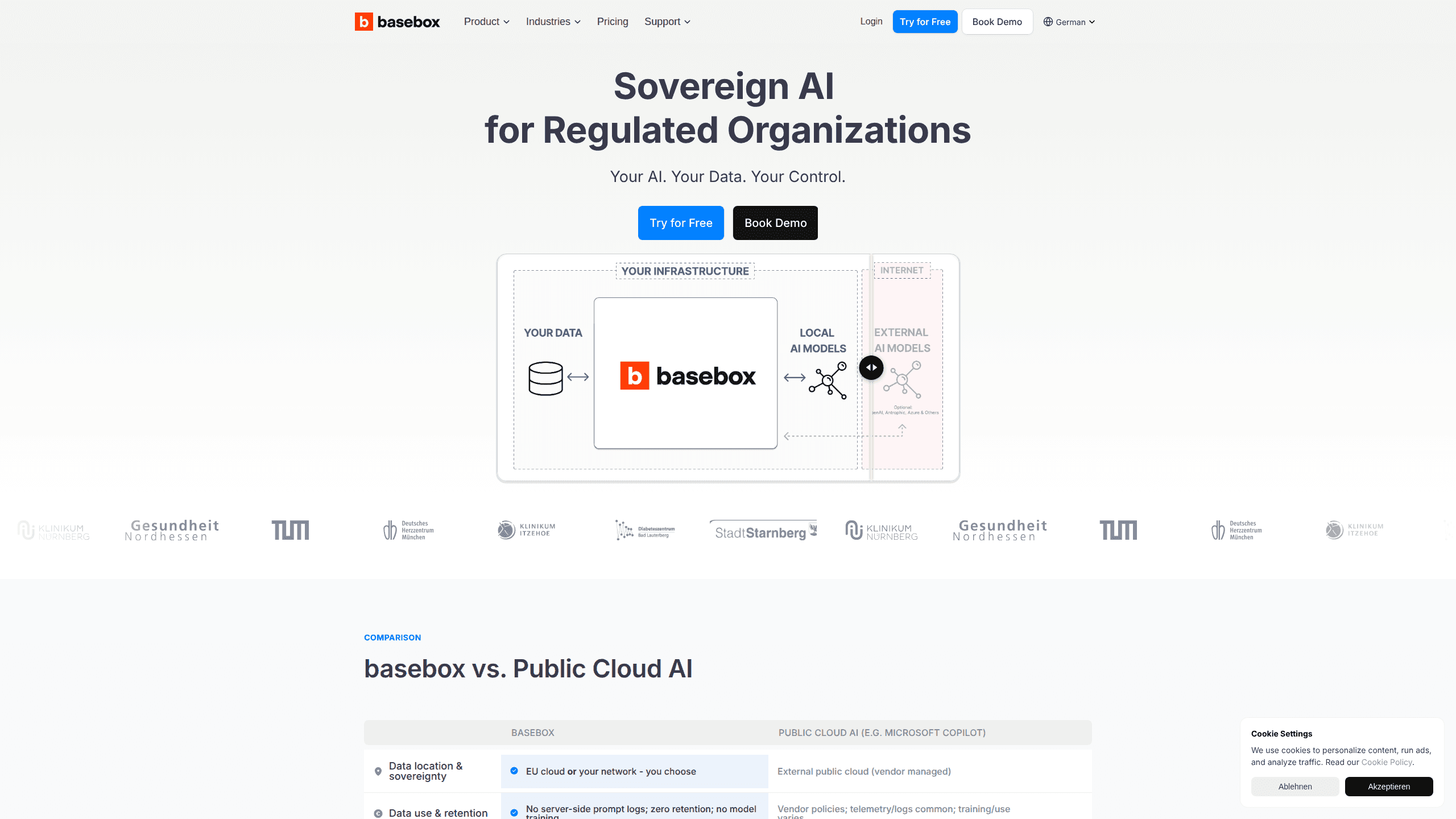
Basebox AI is an AI platform for sensitive data, built by basebox GmbH in Utting am Ammersee, Germany. The pitch is simple: the model comes to your data instead of your data leaving the building. Patient records, citizen inquiries and social files can go in, and nothing leaves without your approval.
The product is a workspace, not a chat box. Staff open a chat, pick a ready made app, or upload a document, and get an answer that shows where it came from. An administrator decides which apps, which connectors and which AI models are available to whom.
The main limit is scope. Teams that need GDPR compliant AI for German healthcare or public administration AI projects are the target buyer, and Basebox AI is sold to organizations in those sectors, with pricing per person per year and contracts by invoice. A solo user or a team outside that market won't find a self serve signup here.
Getting Started
- Choose cloud or a dedicated server. Cloud starts at five people and takes about two minutes to set up. A dedicated server makes sense from roughly 200 people.
- Connect your identity provider. Basebox AI signs users in through Active Directory, LDAP, SAML or OIDC, with an optional second factor.
- Load your material. Point knowledge bases at document collections, and let your admin enable connectors to systems such as Orbis or roXtra.
- Build or pick apps. Take an app from the store, or write a short instruction and attach the documents and connections it needs.
- Share with groups. The author decides who can use an app and who can also edit it. Permissions follow the person, so an app never sees more than the user already sees.
Product Information
A quick look at Basebox AI's pricing, supported platforms, and performance.
Best for
The users, tasks, and scenarios where this tool fits best.
Users
- IT and compliance leads at hospitals
- Department heads in public administration
- Research groups working with patient data
Tasks
- Answering policy questions
- Drafting discharge letters and care reports
- Transcribing meetings and consultations
- Translating and shortening official correspondence
Scenarios
- A clinic that can't send patient data to a US cloud
- A municipality putting AI in front of 300 employees
- A team with one recurring weekly job
Key features
Answers With Sources
Every reply carries a citation back to the document and passage it used. A clerk can open the source and read the exact sentence. That single feature decides whether an answer is usable in a hospital or an authority, where an unsourced claim is worse than no answer.
Ready Made Apps Instead of an Empty Chat
Staff pick a task and get a result. The library covers discharge letters, care reports, guideline lookups, audio transcription, translation, job adverts and summaries, plus hundreds of documented use cases across hospitals, municipalities, insurers and cancer registries. The empty chat window is still there, but nobody has to start from it.
AI Apps Without Coding
An app is an instruction, a set of documents and a set of connections. Authors build one in minutes without writing code, then decide whether a group can only use it or also edit it. Sharing an app never shares the underlying data.
Deployment You Control
Basebox AI runs in a German datacenter on shared infrastructure, or on a server reserved for one customer. On the server route you can use basebox hardware or your own, place it in your room or in a datacenter, and run it with no internet connection at all. Features and security are the same on both paths, which makes the choice mostly about size and procurement rules. A self-hosted AI install with no outside connection is the version security authorities tend to ask for.
Connectors and Per Person Permissions
Connections to hospital and administration systems are gated by the user's own account. Someone opening a patient file through an app sees what they would see in the source system, nothing more. Identity comes from your directory, so leavers lose access when the account closes.
OpenAI Compatible API and Model Governance
Developers get an OpenAI compatible endpoint with a personal key, which means existing tools and research scripts work with little change. Models behave like connectors: an administrator enables them, then an app picks one. A special model trained on your own tasks can be added on request.
Pros and cons
Pros
- Data stays in Germany or on your own hardware, and nothing is used for model training without approval.
- Citations on every answer make the output checkable, which matters more than raw model quality in regulated work.
- Hundreds of prebuilt use cases shorten the search for a first project.
- App sharing with group permissions fits how hospitals and agencies already assign access.
- One license covers models, apps and connectors, and the price per person falls as headcount rises.
Cons
- There's no free tier and no self serve signup, so trying it means talking to sales.
- The offer is aimed at German healthcare and public administration, and the interface language and use case library reflect that.
- A dedicated server only pays off from about 200 people, which leaves small practices on the cloud option.
- The agent based app builder isn't live yet. It's announced for November 2026, so teams that want autonomous multi step apps have to wait.
Frequently asked questions
It's used to put a language model on top of internal documents and routine paperwork. Typical work includes answering questions from policy files and guidelines, drafting letters and reports, transcribing meetings and translating official correspondence. The output is a cited answer or a finished document, not a chat transcript.
Related content
Explore related tools, skills, and articles for Basebox AI.
Basebox AI Alternatives

Google EmbeddingGemma 2
Google DeepMind · Writing · Image · CodingGoogle EmbeddingGemma 2 is a 740M-parameter open model that turns text, code, images, audio, and video frames into vectors in one 768-dimension space, running on phones and laptops.

MePersona
MePersona, Inc. · Writing · Productivity · MarketingMePersona is an AI unified inbox for creators. It learns your voice, drafts replies to fan messages from 12 platforms, and sends only what you approve.

Fluence
Yay Software (Yannick Huchard) · Writing · Voice & Language · ProductivityFluence is an Android app that reads PDFs, EPUBs, Word files and web articles aloud, follows each sentence as it speaks, and answers questions about the text on the phone itself.