

Basedash
Basedash · Coding
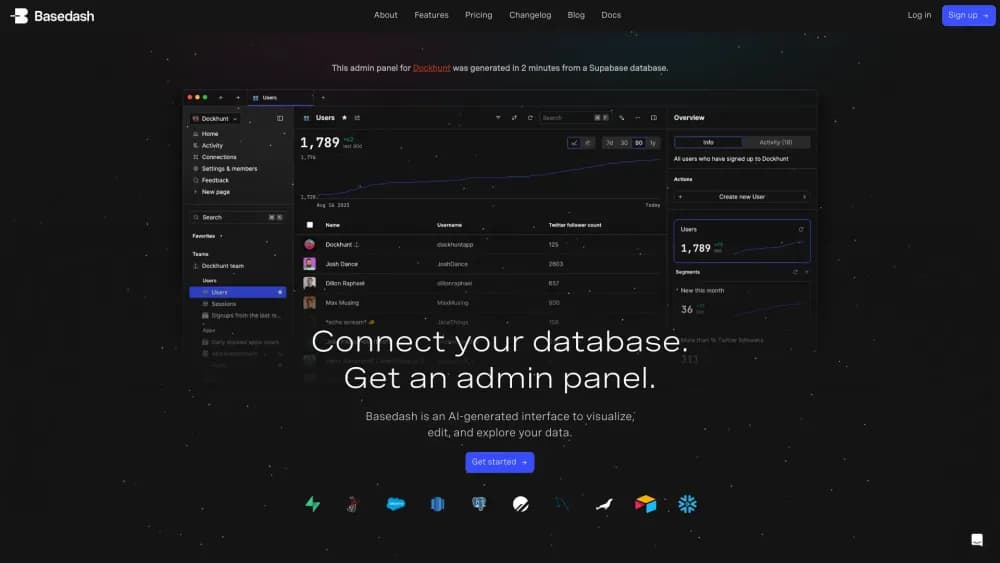
Basedash is an AI-native business intelligence platform that builds charts, dashboards, and insights from plain-English questions, and connects to your data sources or a managed warehouse.
About Basedash
What Is Basedash
Basedash is an AI analytics platform that swaps the usual drag-and-drop chart builder for a chat box. You type "show me monthly revenue growth" or "compare sales by region", and it picks a chart type, writes the SQL, and renders the result. Since every answer shows the SQL and definitions behind it, you can check the work rather than trust a black box.
It also handles the parts most BI tools push onto your data team. Connect a source and Basedash provisions a managed DuckDB warehouse that keeps tables synced, or plug in Snowflake, BigQuery, or Databricks if you already run one. From there, agents watch your metrics, flag what changed, and post a brief to Slack or email. Embedded dashboards and AI chat drop into your own product with a few lines of React.
The main thing to watch is price and lock-in habits. The Startup plan runs a flat $1,000 per month plus AI usage for up to 25 users, so small teams pay enterprise money, and heavy chat or dashboard generation adds usage fees on top. Teams that only need a handful of static reports will find lighter tools cheaper.
Getting Started
- Create an account at charts.basedash.com using your email, then verify it.
- Connect a data source such as Salesforce, HubSpot, Stripe, or Shopify, or point Basedash at your own database or warehouse.
- Ask a question in plain English and let Basedash generate a chart, then refine it with follow-up chat.
- Arrange the results into dashboards, and set up insights or automations to track a metric on a schedule.
- Invite teammates, and add MCP or Slack connections if you want the same answers inside Claude, ChatGPT, or a channel.
Product Information
A quick look at Basedash's pricing, supported platforms, and performance.
Best for
The users, tasks, and scenarios where this tool fits best.
Users
- Product managers
- Startup founders and operators
- Analysts who want a faster first pass
Tasks
- Ad hoc questions
- Building dashboards
- Monitoring metrics
- Embedding analytics
Scenarios
- A weekly growth review
- An anomaly alert
- A customer-facing dashboard
Key features
Plain-English Chat and Charts
The core of Basedash is a natural language BI interface that turns a written question into a chart. You describe what you want to see, and the platform chooses the chart type and formatting, writes the SQL, and shows it alongside the result. Follow-up questions adjust the same chart, which keeps a line of inquiry moving without rebuilding a query each time.
Dashboards and Insights
Dashboards collect charts into a shared view your team can open and scan. Insights push further by having agents watch your metrics around the clock, flag what moved, and explain why in a short brief. You schedule recurring reports, or trigger one the moment your data changes, so you monitor the business much like you monitor production.
Semantic Layer and Models
Basedash lets you define metrics, segments, and business logic once as reusable models, so "active customer" means the same thing in every chart and every chat. You can pull in existing dbt projects rather than rebuild them, and add team context that the AI remembers from conversation to conversation. One metric definition then feeds dashboards, chat, and embedded views alike.
Managed Warehouse and Data Ingestion
Connect a source and Basedash provisions a managed DuckDB warehouse that keeps every table synced and ready for agents to query, with storage that scales and point-in-time recovery. It pulls in Salesforce, HubSpot, Stripe, Shopify, and hundreds more without you building a pipeline, and it connects to Snowflake, BigQuery, or Databricks if those are already in place.
Embedded Analytics and the React SDK
You can embed dashboards and AI chat inside your own product using typed React components and server-side JWT helpers. White-label the view to your brand and scope each customer to their own rows through JWT single sign-on, which gives end users self-serve analytics without pulling engineers off the roadmap. That turns reporting into a product feature rather than an internal tool.
MCP Server, Slack, and REST API
Basedash exposes an MCP server so you can connect Claude, ChatGPT, or Cursor and ask questions from the tools you already work in, and it ships a Slack app that answers and posts automations in a channel. A REST API covers programmatic access for your own apps. All three paths run on the same models and permissions, so answers stay governed no matter where they're asked.
Security and Governance
Every question runs under your permissions, lands in an audit log, and shows the data behind its answer, which addresses the gap left when staff query their own AI tools. The platform adds approval for AI-run write queries, SSO with SAML and OIDC, SCIM provisioning, and row-level security. It holds SOC 2 Type II, offers self-hosting in your own VPC, and never trains models on customer data.
Pros and cons
Pros
- Plain-English chat returns charts and answers fast, so people outside the data team can get numbers without filing a query request.
- Answers surface the SQL and definitions behind them, which makes each result auditable instead of a black box.
- A managed warehouse and 750+ data sources cut the setup work, and existing dbt projects and warehouses connect without a migration.
- Governance controls like audit logs, row-level security, SSO, and self-hosting fit teams that worry about AI data exposure.
Cons
- The Startup plan costs $1,000 per month plus AI usage, so small teams pay a price many lighter BI tools beat.
- Chat and dashboard generation count toward AI usage, and going past the monthly credit adds fees to the bill.
- There's no free plan, so evaluating it means working through a 14-day trial first.
- Embedding and self-hosting sit behind the custom Enterprise tier, which puts those features out of reach for budget-conscious startups.
Frequently asked questions
Basedash builds charts, dashboards, and written insights from plain-English questions so teams can answer business questions without writing SQL. It also embeds that analytics into your own product and monitors metrics on a schedule.
Related content
Explore related tools, skills, and articles for Basedash.
Basedash Alternatives

Base Code
Base44 (Wix) · Coding · ProductivityBase Code is a shared cloud development environment from Base44. Teammates describe changes to an existing GitHub codebase in chat, preview them live and send them back as pull requests.

Google EmbeddingGemma 2
Google DeepMind · Writing · Image · CodingGoogle EmbeddingGemma 2 is a 740M-parameter open model that turns text, code, images, audio, and video frames into vectors in one 768-dimension space, running on phones and laptops.

GitGlow
GitGlow · Coding · ProductivityGitGlow is a local-first desktop Git client that lets independent developers review their own code and their AI agents' changes in one place before shipping.