
Binarly | AI-Powered Firmware Supply Chain Security Platform
Binarly Inc. · AI Detection · Business
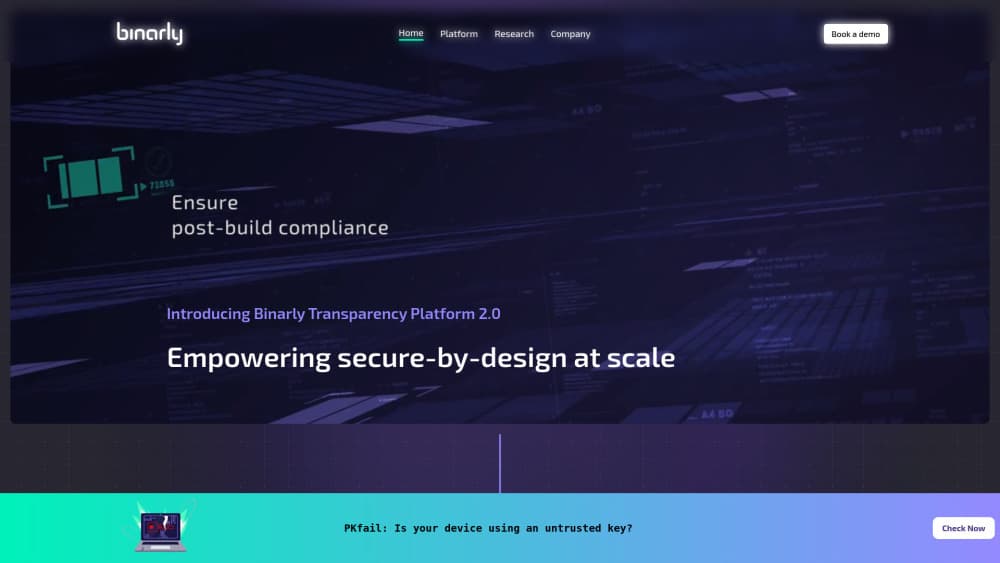
Binarly is a binary risk intelligence platform that scans built firmware and software for zero-days, hidden secrets, and weak crypto, then validates SBOMs and ranks real exploit risk.
About Binarly | AI-Powered Firmware Supply Chain Security Platform
What Is Binarly
Binarly is a firmware supply chain security platform that works on the finished binary. You hand it a BIOS image, a BMC firmware package, an Android partition, a container image, or a virtual machine snapshot, and it unpacks the file, rebuilds a component inventory, and looks for flaws inside the compiled code. No source code, no build scripts, no vendor declarations.
That matters because most firmware risk hides below the level where software composition analysis usually runs. A supplier SBOM says a component exists. It doesn't prove the component matches what shipped, and it can't see code that was compiled in without a manifest entry. SBOM validation against the artifact is the service it sells, which is why procurement teams use it to score deliverables and product security teams use it as a release gate.
The company is Binarly Inc., founded in 2021 by firmware researchers, with the first version of the platform shipped in 2023. The research arm publishes advisories on UEFI and supply chain flaws, and that work feeds back into detection rules. The main limit is fit: this is enterprise security software sold through demos, aimed at device makers, critical infrastructure operators, and large software vendors. A small team without firmware in its product has little reason to look at it.
Getting Started
- Book a demo and pick a package, since Lite, Enterprise, and Advanced all start with a scoping call rather than a signup form.
- Get access to the platform, either the hosted service or the on-prem deployment, and connect it to the build system or artifact store you want to watch.
- Upload a first image or point the scanner at a release, then read the component inventory, secrets findings, and crypto asset list it produces.
- Tune the risk scoring to your environment by weighting reachability, KEV status, and exploit telemetry, and set the severity threshold that blocks a release.
- Wire the same check into CI/CD as a gate, so every build gets scanned before it's signed and shipped.
Product Information
A quick look at Binarly | AI-Powered Firmware Supply Chain Security Platform's pricing, supported platforms, and performance.
Best for
The users, tasks, and scenarios where this tool fits best.
Users
- Device makers and OEMs
- Product security and PSIRT teams
- Procurement and third party risk teams
- Compliance and audit staff
Tasks
- Validating a supplier SBOM against the binary you received, and catching components that were added, removed, or patched without a manifest update.
- Finding unknown vulnerabilities in UEFI, embedded Linux, or RTOS code where public CVE data runs out.
- Hunting embedded secrets such as API keys, OAuth tokens, JWTs, and webhook URLs left inside shipped images.
- Preparing a post-quantum cryptography migration by inventorying algorithms, keys, and certificates actually used at runtime.
Scenarios
- A release gate in CI/CD that blocks builds with critical reachable flaws or missing mitigations before signing.
- Incoming inspection of third party firmware, where a batch of vendor images needs a risk score within hours rather than weeks.
- Field incident response, when a fleet of deployed devices needs a fast answer on which units contain a newly exploited component.
Key features
Binary Analysis Without Source Code
Binarly runs static analysis and symbolic execution on compiled artifacts, with a black-box unpacking engine that handles archives, compressed payloads, vendor wrappers, and uncommon file systems. That lets a team inspect a firmware image from a supplier that shares nothing but the binary. The practical effect is coverage of code that source based scanners never see, including microcode, bootloaders, and third party libraries statically linked into a build.
Zero-Day Detection Across Firmware and Containers
The platform looks for unknown vulnerabilities rather than only matching version strings to CVE records. It covers UEFI firmware, baseboard management controllers, RTOS images, embedded Linux, Android partitions, cloud containers, and VM snapshots. Machine learning models trained on large binary corpora help flag suspicious code patterns, and researchers review what the models surface.
Embedded Secrets Detection
Every shipped image can carry credentials that should never leave the build server. Binarly scans for hardcoded API keys, OAuth tokens, JWTs, webhook URLs, and private keys inside firmware, mobile partitions, containers, and snapshots. Findings point to the exact offset and file, so a developer can confirm and rotate the secret instead of searching a repository by hand.
Patented Reachability Analysis
Reachability analysis maps a reported vulnerability to real execution paths in the binary. If a flawed function can't be reached from any entry point in your configuration, it drops down the list. This is the feature that changes day to day work for most teams, because a stack of hundreds of CVEs becomes a short list of things that can actually be hit in production.
CBOM Generation and Post-Quantum Readiness
Binarly builds a cryptographic bill of materials from the binary itself, listing every algorithm, key, certificate, and protocol it can identify. Weak keys, expired certificates, Secure Boot bypasses, and outdated crypto get flagged, and dashboards track migration progress toward post-quantum algorithms. That makes post-quantum cryptography readiness a measurable project rather than a slide, and the output doubles as audit evidence as regulated industries approach migration deadlines.
Exploit Maturity Scoring
Exploitation Maturity Scoring combines CISA KEV entries, live exploit telemetry, proof of concept availability, and ransomware campaign data into a running risk ranking. The score updates as the threat picture changes, so a patch decision made on Monday doesn't rely on last quarter's severity ratings.
CI/CD Release Gates
The platform plugs into a build pipeline and checks each artifact before release. Builds that fail the policy, whether from a critical reachable flaw, a leaked secret, or a missing mitigation, stop at the gate. Auto-generated advisories and on-demand VEX documents come out of the same workflow, which saves the paperwork step after a finding.
Pros and cons
Pros
- Works on binaries you already have, so suppliers who share nothing but a firmware image can still be assessed.
- Reachability and exploit telemetry push the noise down, which is the difference between a usable queue and a CVE dump.
- CBOM output is generated from the artifact, giving post-quantum planning a factual inventory instead of a vendor questionnaire.
- API, CLI, and CI/CD access are part of every package tier, so automation doesn't require a custom contract.
Cons
- No published pricing. Every plan, including Lite, goes through a demo, which slows down budget planning and rules out self-serve trials.
- There's no free platform tier. The free binary scanner at risk.binarly.io gives a sample of the analysis, but fleet level work needs a paid contract.
- Firmware analysis has a learning curve. Reading component inventories, CBOM entries, and reachability results assumes some familiarity with UEFI and embedded builds.
- The product is built around device and firmware work. Teams that only ship web applications will find lighter software composition tools cheaper.
Frequently asked questions
It analyzes compiled firmware and software, rebuilds a component and crypto inventory, and reports vulnerabilities, embedded secrets, and policy failures. The output is a risk ranked list tied to the binary that will ship, not a list derived from declared dependencies.
Related content
Explore related tools, skills, and articles for Binarly | AI-Powered Firmware Supply Chain Security Platform.
Binarly | AI-Powered Firmware Supply Chain Security Platform Alternatives
Isgen AI
Isgen · AI DetectionIsgen AI is a web-based AI detector that scores text for machine authorship and shows you which sentences and phrases push the number up. It's built for teachers, editors, students, and writers. Their question is simple: did this draft come from ChatGPT, GPT-5, Claude, Gemini, DeepSeek, or another model? You paste or upload content, run a scan, and get a Human, AI, and Mixed breakdown in seconds. There's also a companion editor that scores text while you write it.
Humanizeai Tools
Humanizeai Tools · Writing · AI DetectionHumanizeai Tools is a web-based AI humanizer that rewrites machine-generated text so it sounds like a person wrote it, which is the whole point of the category it belongs to. Paste a draft from ChatGPT, Claude, or Gemini, run it through the tool, and it swaps out the phrases and sentence patterns that AI detectors flag. If your goal is to make AI text sound human before you publish it, this is the kind of tool built for exactly that. It suits students, bloggers, and marketers who need copy that reads naturally and clears tools like GPTZero, Copyleaks, and Winston AI after a single pass.

Hidemyai
Hidemyai · Writing · AI DetectionHidemyai is an AI content humanizer. It rewrites text from ChatGPT, Jasper, and similar tools so the result reads like a person wrote it. You paste your draft, pick a document type and tone, and the service returns a version meant to bypass AI detectors such as Originality.ai, Turnitin, and ZeroGPT. It targets writers, marketers, and students who lean on AI drafts but can't ship copy that sounds robotic. The promise is simple: make AI content undetectable.