

bioloGPT
bioloGPT · Leaning
bioloGPT is an AI biology assistant that answers life science questions with cited, evidence-based summaries for students and researchers.
About bioloGPT
What Is bioloGPT
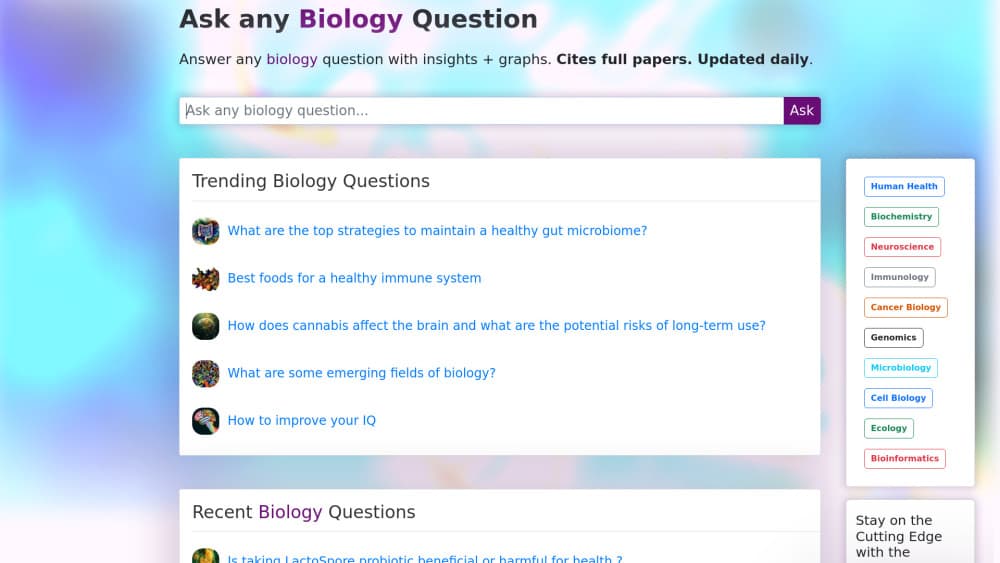
bioloGPT is a web-based biology knowledge engine. You ask a life science question in plain language, and it returns a written answer that pulls from scientific literature and points back to the sources it used. Think of it as a research assistant built for biology rather than a general chatbot that happens to know some science.
The main problem it solves is time. Reading through dozens of papers just to answer one narrow question can easily eat an entire afternoon that you would rather spend on the work itself. bioloGPT compresses that step: you get a structured summary you can scan in seconds, then jump to the cited papers for the details that matter to you. As an AI research tool, it sits in the reading layer of the work.
It isn't a lab tool. No experiment designer, no bench protocol builder, no data analysis suite. It reads and summarizes literature. If your question needs original data, wet-lab validation, or statistical modeling, this tool won't replace that work.
Getting Started
- Open biologpt.com in your browser. No software install is needed.
- Type your biology question in the search box using everyday wording, for example "how do CRISPR base editors avoid double-strand breaks?"
- Read the generated summary and check the citations listed alongside the answer.
- Follow the cited papers to verify claims or dig into the original methods.
- Refine your question if the first answer misses the point, then compare the new summary against the old one.
Product Information
A quick look at bioloGPT's pricing, supported platforms, and performance.
Best for
The users, tasks, and scenarios where this tool fits best.
Users
- Biology students
- Early-career researchers
- Science writers and teachers
Tasks
- Defining terms and mechanisms
- Surveying a topic
- Checking a claim
Scenarios
- Preparing for a lecture or seminar
- Writing a literature review first draft
- Answering a reader or a class question on the spot
Key features
Question Answering With Citations
Ask a biology question and bioloGPT returns a written answer with references attached. The citations matter more than the prose here. They let you verify each claim instead of trusting a black box, which is the single habit that separates a careful researcher from someone who just repeats whatever a chatbot told them. For students, that's the difference between copying an answer and learning where it comes from.
Literature-Grounded Summaries
Answers are drawn from scientific sources rather than general web text. This keeps responses closer to how researchers actually describe a mechanism or finding. It also means the output reads more like a condensed review than a chat reply, which suits people who want density over chit-chat. Want a quick read?
Plain-Language Explanations
You don't need to phrase your question in jargon. Type "why do some mutations cause disease and others don't?" and you get an explanation built around concepts, not a wall of abbreviations. Technical terms show up when they're needed, usually with enough context to follow. That makes it a workable biology study tool for coursework and revision.
Topic Exploration
Beyond single questions, bioloGPT works as a way to map an unfamiliar area. Ask a broad question, read the summary, then follow threads through the citations. It's rough on purpose. You're building a mental outline, not a finished report, and that distinction keeps expectations honest when a summary leaves gaps you still have to close with your own reading.
No Setup Required
It runs in the browser with no install and no account friction for basic use. That lowers the barrier for a student who just wants one answer. It also means the tool stays out of your workflow apps and reference managers.
Pros and cons
Pros
- Answers come with citations, so claims can be checked against the original papers.
- Handles everyday phrasing, so you don't need to know a field's vocabulary to start.
- Cuts the time spent sifting papers for one specific question.
- Works in a browser with no install, making it easy to try before committing.
- Fits students and researchers who want a fast literature starting point.
Cons
- No API means you can't wire it into scripts, notebooks, or a lab pipeline.
- It summarizes literature only, so it won't design experiments or analyze your data.
- Pricing details aren't published on the site, which makes cost planning awkward.
- Summaries can look authoritative even when the underlying literature is contested, so verification is on you.
Frequently asked questions
bioloGPT answers biology questions by summarizing scientific literature and attaching citations to its answers. It's built for people who want a fast, sourced starting point on a life science topic rather than a general-purpose chatbot.
Related content
Explore related tools, skills, and articles for bioloGPT.
bioloGPT Alternatives

Kaggle AI
Google · Coding · LeaningKaggle AI is a community platform where people build, test, and compare machine learning models against shared data. It combines data science competitions, tens of thousands of public datasets, and free cloud notebooks with GPU and TPU access, so anyone with a browser can train a model without buying hardware. Google owns the platform, and joining costs nothing.

Bunch
Bunch AI · Leaning · BusinessBunch is an AI leadership coaching app that turns a few spare minutes a day into real management practice. It hands you one short, personalized tip each day, tracks how you respond, and lets you compare notes with peers inside private groups. The pitch is simple: you lead better by practicing a little, often, instead of sitting through a weekend seminar. Think of it as a leadership training app you actually open.

AI Mock Interview
SQLPad · Coding · LeaningAI Mock Interview is a practice tool built into SQLPad that simulates real job interviews and gives you instant feedback on both what you say and how you say it. You pick a role template or upload a job description, answer questions out loud in real time, and then review a transcript with notes on structure, clarity, and grammar. It's aimed at data professionals prepping for SQL, Python, data engineering, machine learning, and system design roles, and it works entirely in the browser. No install needed.