

Blobfish AI
Blobfish AI · Other
Blobfish AI builds simulated enterprise worlds where AI agents practice real workflows with mock tools, adjustable difficulty and deterministic checks.
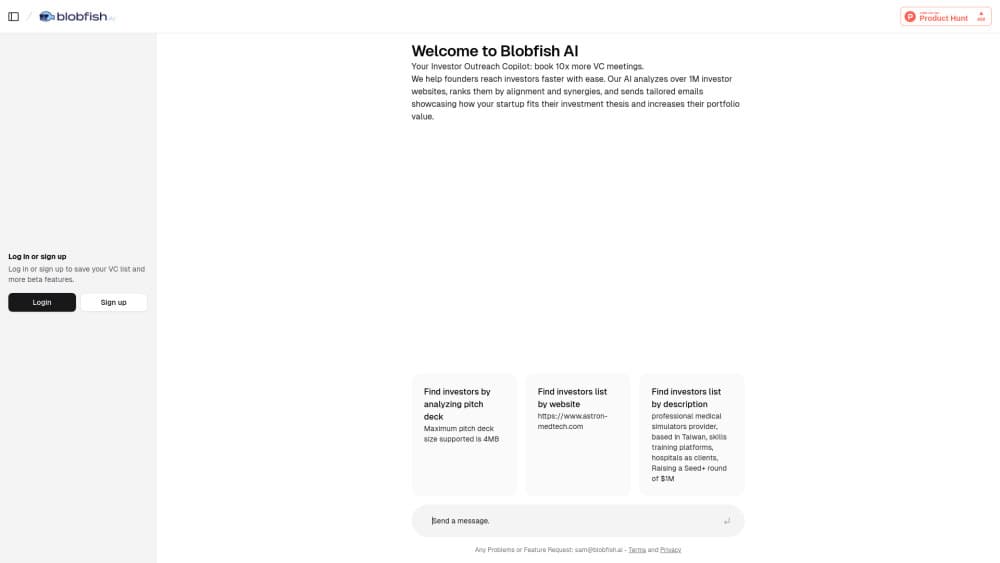
About Blobfish AI
What Is Blobfish AI
Blobfish AI sells something unusual: places for AI agents to practice. Each one is a small working world, with connected spreadsheets, records and mock business systems that an agent can open, edit and wreck. The goal isn't a friendlier chat window. It's a safe spot where a model attempts a real job and gets a precise answer about whether the result came out right.
The target is a specific headache in post-training. Specialists describe their work, engineers rebuild the tools, and researchers hunt for the few tasks that sit near the model's current ability. That hunt takes three to six months. Then the model learns, the same tasks turn trivial, and the cycle starts over. On one project the team mapped thirty workflows and found only six close enough to the capability boundary to be useful. Blobfish's answer is to generate these agent training environments continuously, so every round gets a fresh curriculum.
Constraints matter here. This is a service for teams that train their own models, not a self-serve app. No price list, no signup, no public trial; you talk to the founder. The worlds are mock versions of enterprise software, so behavior that hangs on a specific vendor's API quirks won't show up. The headline benchmark is also an early internal result rather than a third-party replication.
Getting Started
- Talk to the team with three facts ready: which model you train, which workflows you care about, and how your reinforcement learning loop runs.
- Scope the domains. Blobfish picks or builds worlds that match your vertical, such as payments, legal work, support or finance operations.
- Receive the environments. Each one arrives with mock data, mock MCP servers, a command line interface for the agent, and a set of training tasks.
- Run your rollouts against the tasks. Every attempt ends with a deterministic verifier report instead of a model's opinion.
- Ask for a new generation when the current tasks stop being hard, and keep the old set as a regression suite.
Product Information
A quick look at Blobfish AI's pricing, supported platforms, and performance.
Best for
The users, tasks, and scenarios where this tool fits best.
Users
- Post-training and reinforcement learning engineers
- Applied research groups inside larger companies
- Agent product teams selling into enterprises
Tasks
- Generating reinforcement learning tasks at a chosen difficulty
- Testing multi-step tool use
- Building a regression suite for agent behavior
- Expanding into a new vertical without hiring specialists
Scenarios
- A training round where the last task set became too easy
- Pre-release checks on an agent that touches money or customer records
- A domain you've never built tooling for, such as claims processing or invoice reconciliation
Key features
Realistic Mock Data
Every environment ships with connected records, files and state that behave like a workplace. A balance sheet links to the ledger entries behind it, and editing one value changes what the verifier expects. That linkage is what makes an AI agent simulation useful for training rather than a quiz with fake props.
Mock MCP Servers and a Uniform Agent CLI
Tools arrive as mock MCP servers for CRMs, ERPs and spreadsheets, all reachable through one command line interface. The agent calls tools the same way in every world, so your harness doesn't need a new adapter per domain. Permissions and relationships are part of the setup, which means an agent can fail because it lacks access, not only because it picked the wrong row.
Tasks With Adjustable Difficulty
Training tasks are grounded in real workflows and graded by difficulty, with known outcomes attached. You can ask for tasks near the model's current edge instead of guessing which ones will teach it anything. The result is less time spent filtering out runs where the model always passed or always failed.
Deterministic Verifiers
Each run ends with a rule-based check of the world state, not a language model scoring the transcript. Blobfish's approach means the pass or fail verdict is reproducible: the same action produces the same result. For teams burned by noisy judge models, that alone changes how much of a rollout batch is worth reading.
Workflow Graphs and Backward Task Authoring
The company proves a tool workflow first, then writes the request that leads to it. It builds the world, maps valid interactions between tools, samples a path with a known end state, and only then drafts a task an employee might delegate. Requests that look odd get flagged for review without blocking the executable release.
Continuous Generation at Scale
The pitch is volume with a moving target. In one early experiment the team generated 2,000 domain-specific environments and trained a 14-billion-parameter model, which then beat a much larger DeepSeek model on an MCP benchmark. Treat that as a company-reported result: broader independent evaluation was still in progress at the time of writing.
Pros and cons
Pros
- Deterministic verifiers cut the noise that comes with model-as-judge scoring, so a failed rollout tells you something specific.
- The task supply is the product, which addresses the real bottleneck in post-training rather than the setup step everyone already solved.
- Mock enterprise tools with permissions let you test failure modes like missing access or stale records, not just wrong answers.
- One CLI across CRMs, ERPs and spreadsheets keeps your evaluation harness stable when you add a domain.
- Old environments can become a regression suite, so a new checkpoint faces the same worlds as the last one.
Cons
- No published pricing and no self-serve trial, so you can't compare cost or fit without a call.
- Mock systems only approximate real enterprise software, and quirks of a specific vendor's API won't surface until you test against the real thing.
- The benchmark numbers are vendor-reported; there's no independent leaderboard entry to check them against.
- It's infrastructure, not a product you log into and use. Without your own training loop, there's nothing to run.
Frequently asked questions
It supplies simulated workplace environments for AI agent training. Teams use them to generate verifiable reinforcement learning tasks, test multi-step tool use, and check whether an agent changed a system correctly.
Related content
Explore related tools, skills, and articles for Blobfish AI.
Blobfish AI Alternatives

Odyssey 3
Odyssey · OtherOdyssey-3 is Odyssey's foundation world model. It simulates physics in real time, turns a prompt into an interactive environment, and adapts to robots, cars and games.

JarvisCore
Prescott Data · Coding · Productivity · OtherJarvisCore is an open source Python runtime where AI agents work as equal peers on an agent mesh, claim tasks from a shared ledger, and reach external services through a zero-trust broker.
Clef
Cloudflare · Business · OtherClef is Cloudflare's open-source decision model for Workers AI. It returns calibrated probabilities for typed questions, not generated text, so agents can classify, route, and act fast.