
Bodyguard.ai
Bodyguard (Bodyguard.ai) · AI Detection
Bodyguard is an AI moderation platform that screens text, images, and usernames in 46 languages, flags harmful content in under 50ms, and triggers automated actions.
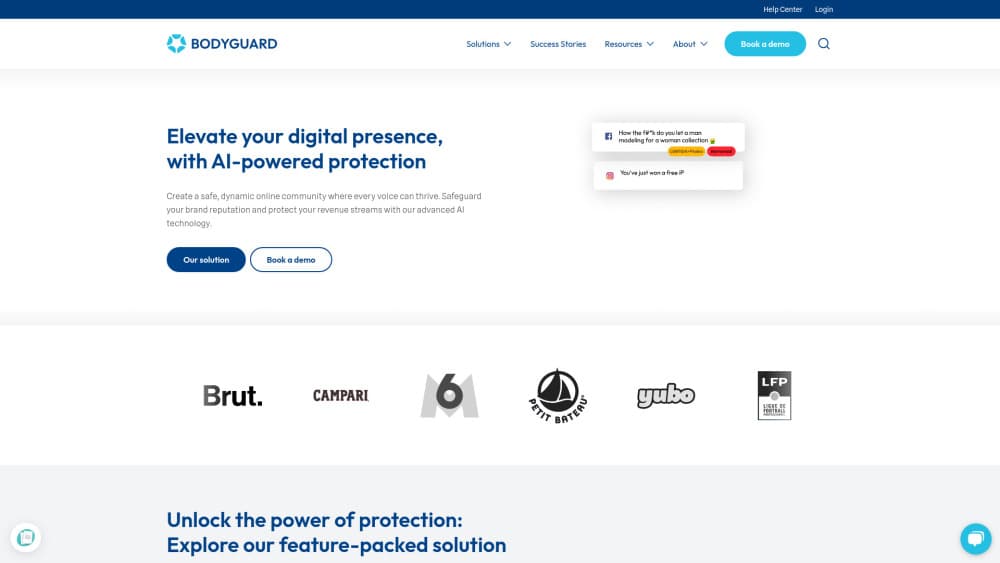
About Bodyguard.ai
What Is Bodyguard
Bodyguard is a content moderation service for platforms, brands, and public organizations that deal with comments, posts, and direct messages at volume. It reads each item, works out what the content contains and how serious it is, then blocks it, hides it, or passes it to a human queue.
The company is based in France and sells mainly to enterprise teams. Customers include social platforms, gaming and streaming communities, telecoms, and consumer brands that run busy accounts. Bodyguard reports analyzing more than 4 billion pieces of content a month for 3.4 billion protected users.
Context is the selling point. A rough word inside a joke between friends scores differently from the same word aimed at a named person, and that gap decides whether a moderator sees the item at all. Toxic content detection here means a scored signal with a target attached, not a binary block. The trade-off is a sales-led product: there's no self-serve signup, and pricing comes as a quote after a demo.
Getting Started
- Book a demo and describe your channels, languages, and monthly volume.
- Agree on a policy: which classifications block automatically, which get reviewed, and which only feed reports.
- Connect a source, either through the content moderation API in your own product or through your social accounts.
- Run a pilot against live traffic, tune thresholds with Bodyguard's team, then widen coverage.
Product Information
A quick look at Bodyguard.ai's pricing, supported platforms, and performance.
Best for
The users, tasks, and scenarios where this tool fits best.
Users
- Trust and safety teams at social platforms
- Brand and social media managers
- Gaming and live streaming operators
Tasks
- Screening comments and direct messages as they arrive, with a verdict before the content renders.
- Catching image-based abuse, from explicit material to CSAM, with OCR pulling text out of memes and screenshots.
- Checking usernames at signup, which stops the accounts that exist only to harass.
- Building reports on recurring abuse themes so policy changes rest on counts, not anecdotes.
Scenarios
- A product launch or live event that floods mentions within minutes and needs an automatic brake.
- Overnight and weekend coverage, when a small team can't watch every channel in every language.
- Audit preparation, where you need a record of what was flagged, why, and what action followed.
Key features
Contextual Text Moderation
Bodyguard reads each comment, message, or post against industry context, topic, severity, and the person or group it targets. That combination separates criticism from harassment, so negative feedback about a product doesn't get treated as hate. The same content moderation API returns classifications, severity, and a recommended action in one response.
Image Moderation and OCR
Images arrive by URL or as raw data, and the service returns every detected classification with a confidence score. The taxonomy covers explicit content, violence, hate symbols, regulated products, minors, personal information, and scannable codes including CSAM as the top severity. Optional OCR extracts text inside the image and runs it through text moderation in the same request, which catches abuse hidden in captions baked into a picture.
Username Moderation
Display names get checked like any other content, so impersonation, slurs, and coded harassment are caught before an account goes live. It's the cheapest place to stop a repeat offender, since a blocked name never produces a report or a takedown.
Severity Scoring and Targeting Signals
Every item lands on a five-level scale from None to Critical, and Bodyguard records who the content was directed at. Teams use that to route threats to a fast lane and leave mild rudeness in a bulk queue. It also gives you a defensible reason for the order in which cases were handled.
Automated Policies and Escalations
You write the rules: auto-hide, auto-reject, warn, or escalate to a named queue, per classification and severity. Actions run 24/7 without a reviewer touching the item, and the audit trail records which policy fired. The platform won't invent your standards, so the policy work stays yours.
Custom Classifications and Insights
Beyond the shared taxonomy, Bodyguard's NLP team builds custom classifications for signals specific to your business, in your languages. Live dashboards show volume, trends, and audience behavior, and you can export reports for stakeholders. The insights side turns UGC moderation data into something a product team can act on.
Pros and cons
Pros
- Contextual analysis cuts keyword false positives, so reviewers stop wasting time on slang and jokes.
- One service covers text, images, and usernames, which means fewer vendors and fewer integrations to maintain.
- Sub-50ms responses make inline blocking realistic instead of a post-hoc cleanup job.
- Severity levels plus targeting signals give moderators a priority order rather than a flat queue.
- SOC 2 Type 2 and GDPR compliance fit enterprise procurement reviews.
Cons
- There's no public price list and no free trial, so a small team can't test it without a sales conversation.
- Custom classifications are built on request, which adds lead time before a launch.
- The platform enforces your policy but doesn't define it, so someone on your side still has to write the rules.
- Coverage for rare languages and fast-moving local slang can trail English, so some queues still need native speakers.
Frequently asked questions
It analyzes text, images, and usernames and returns what the content contains, how severe it is, and who it targets. Your system then blocks, hides, or escalates based on those signals.
Related content
Explore related tools, skills, and articles for Bodyguard.ai.
Bodyguard.ai Alternatives
Isgen AI
Isgen · AI DetectionIsgen AI is a web-based AI detector that scores text for machine authorship and shows you which sentences and phrases push the number up. It's built for teachers, editors, students, and writers. Their question is simple: did this draft come from ChatGPT, GPT-5, Claude, Gemini, DeepSeek, or another model? You paste or upload content, run a scan, and get a Human, AI, and Mixed breakdown in seconds. There's also a companion editor that scores text while you write it.
Humanizeai Tools
Humanizeai Tools · Writing · AI DetectionHumanizeai Tools is a web-based AI humanizer that rewrites machine-generated text so it sounds like a person wrote it, which is the whole point of the category it belongs to. Paste a draft from ChatGPT, Claude, or Gemini, run it through the tool, and it swaps out the phrases and sentence patterns that AI detectors flag. If your goal is to make AI text sound human before you publish it, this is the kind of tool built for exactly that. It suits students, bloggers, and marketers who need copy that reads naturally and clears tools like GPTZero, Copyleaks, and Winston AI after a single pass.

Hidemyai
Hidemyai · Writing · AI DetectionHidemyai is an AI content humanizer. It rewrites text from ChatGPT, Jasper, and similar tools so the result reads like a person wrote it. You paste your draft, pick a document type and tone, and the service returns a version meant to bypass AI detectors such as Originality.ai, Turnitin, and ZeroGPT. It targets writers, marketers, and students who lean on AI drafts but can't ship copy that sounds robotic. The promise is simple: make AI content undetectable.