
BookLed
Robotoons · Writing
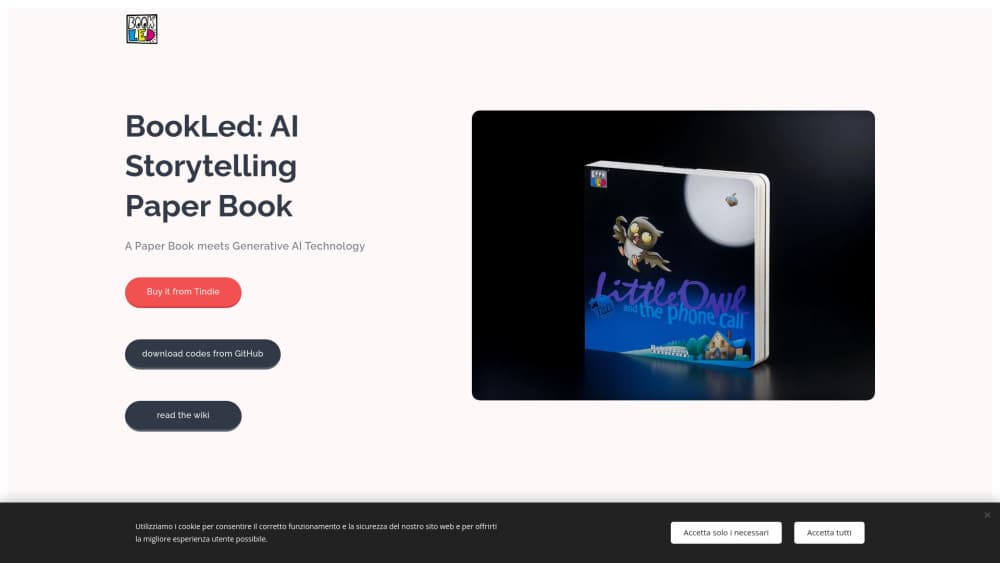
BookLed is a hardcover paper book with electronics inside and a magnet-based page sensor. It sends each page turn to a generative AI model that reads the story aloud.
About BookLed
What Is BookLed
BookLed is a physical book made by Robotoons. The pages are thick card, the cover is hard, and a small board hidden in the binding tracks where you are in the story. It is a paper book with AI on the other end of a USB cable, built for people who want storytelling to stay tactile.
The problem it attacks is a real one. Screens hold a child's attention, and a plain page often doesn't. BookLed keeps the page and adds the parts a screen usually supplies: a narrator that performs the text, light that responds to the scene, and small sounds that mark a page turn. The story still lives on paper. In practice it's an AI storytelling book that runs on a paper spine, and a working example of generative AI for children that never asks them to swipe.
The limits matter as much as the features. BookLed is not a standalone device. It needs a computer, an internet connection and an AI account to speak, because the reading is generated on demand rather than stored on the book. The book you hold also has to match the titles the software knows about.
Getting Started
- Buy the BookLed kit and unpack the book, the USB cable and the printed setup card.
- Connect the book to a laptop or desktop with the USB cable. The board draws power from that port.
- Install Python and the project's dependencies, then add your own API key for the AI model in the config file.
- Run the script, open the book to page one, and turn pages at a normal pace while the narration plays.
For the consumer edition aimed at parents and teachers, steps three and four are handled by a companion app, so the setup is closer to pairing a speaker than writing code.
Product Information
A quick look at BookLed's pricing, supported platforms, and performance.
Best for
The users, tasks, and scenarios where this tool fits best.
Users
- Parents and grandparents who want interactive reading for kids without handing over a tablet, and value screen free reading at home, as long as they will set up the app once.
- Teachers who want a prop for a lesson about how generative AI turns text into speech, and who have a classroom computer near the reading corner.
- Makers and Python learners who want a small hardware project with a visible result, since the DIY AI book kit ships with open code they can edit.
Tasks
- Reading a bedtime story in a different voice each night
- Explaining how a page sensor, a script and an AI model fit together
- Running a multilingual story session
Scenarios
- A weekly reading ritual at home where the book stays on the shelf and the laptop comes out for twenty minutes.
- A classroom demo during a science or media literacy unit, with the page turns acting as the input the class can see.
- A weekend build project for someone who already owns a soldering iron and wants a reason to use it.
Key features
Magnet-Based Page Detection
A set of magnets sits under the pages, and a sensor in the spine reads which one is open. That gives the software the page number and the direction of the turn, without a camera or a touchscreen. It's the part that makes the book feel responsive rather than pre-recorded.
Generative Narration Instead of a Fixed Recording
A read aloud book usually ships with one audio file per page. BookLed sends the page text to a generative AI model and asks it to perform the passage, so the tone, pacing and character voices change between sessions. A child who has heard the story ten times still gets a slightly different telling.
Light and Sound Cues
The hardware drives LEDs and a small speaker alongside the narration. Light marks a scene change, and short sounds confirm a page turn, which gives a child feedback that something happened even before the voice starts. These cues are how the book holds attention without a screen.
USB Connection and Python Control
One cable handles power and data. The board appears to the computer as a serial device, and a Python script reads the page events and calls the model. Because the logic lives in a readable script, you can change the voice, the prompt or the timing yourself.
Open Source Code
The full code is published on GitHub, so the project doubles as a teaching example of a hardware-to-API pipeline. You can read every step from sensor event to spoken sentence, fork it, and point it at a different model or a local one.
Multilingual Storytelling
The narration is generated from text, not from a fixed recording, so the same pages can be read in another language. That makes BookLed useful in bilingual households and in classrooms where several first languages sit in one room.
Pros and cons
Pros
- Keeps reading on paper while adding the performance a screen usually provides
- The page sensor works without a camera, so nothing has to be aimed or calibrated
- Open source code makes the whole pipeline inspectable and modifiable
- Changing voices and languages costs a settings change, not a new audio purchase
Cons
- Needs a computer, an internet connection and an AI account, so it isn't a take-anywhere device
- The DIY version assumes Python skills, which puts it out of reach for many parents
- Only titles that match the software's page maps work, so your existing shelf won't plug in
- Running costs depend on your AI usage, and that bill is separate from the book
Frequently asked questions
BookLed is a hardcover paper book with a small circuit board and a magnet-based page sensor inside. A connected computer reads the page number, sends the text to a generative AI model, and plays the result as narration with light and sound.
Related content
Explore related tools, skills, and articles for BookLed.
BookLed Alternatives

Google EmbeddingGemma 2
Google DeepMind · Writing · Image · CodingGoogle EmbeddingGemma 2 is a 740M-parameter open model that turns text, code, images, audio, and video frames into vectors in one 768-dimension space, running on phones and laptops.

MePersona
MePersona, Inc. · Writing · Productivity · MarketingMePersona is an AI unified inbox for creators. It learns your voice, drafts replies to fan messages from 12 platforms, and sends only what you approve.

Fluence
Yay Software (Yannick Huchard) · Writing · Voice & Language · ProductivityFluence is an Android app that reads PDFs, EPUBs, Word files and web articles aloud, follows each sentence as it speaks, and answers questions about the text on the phone itself.