
BookstoRead.ai
BookstoRead.ai · Writing
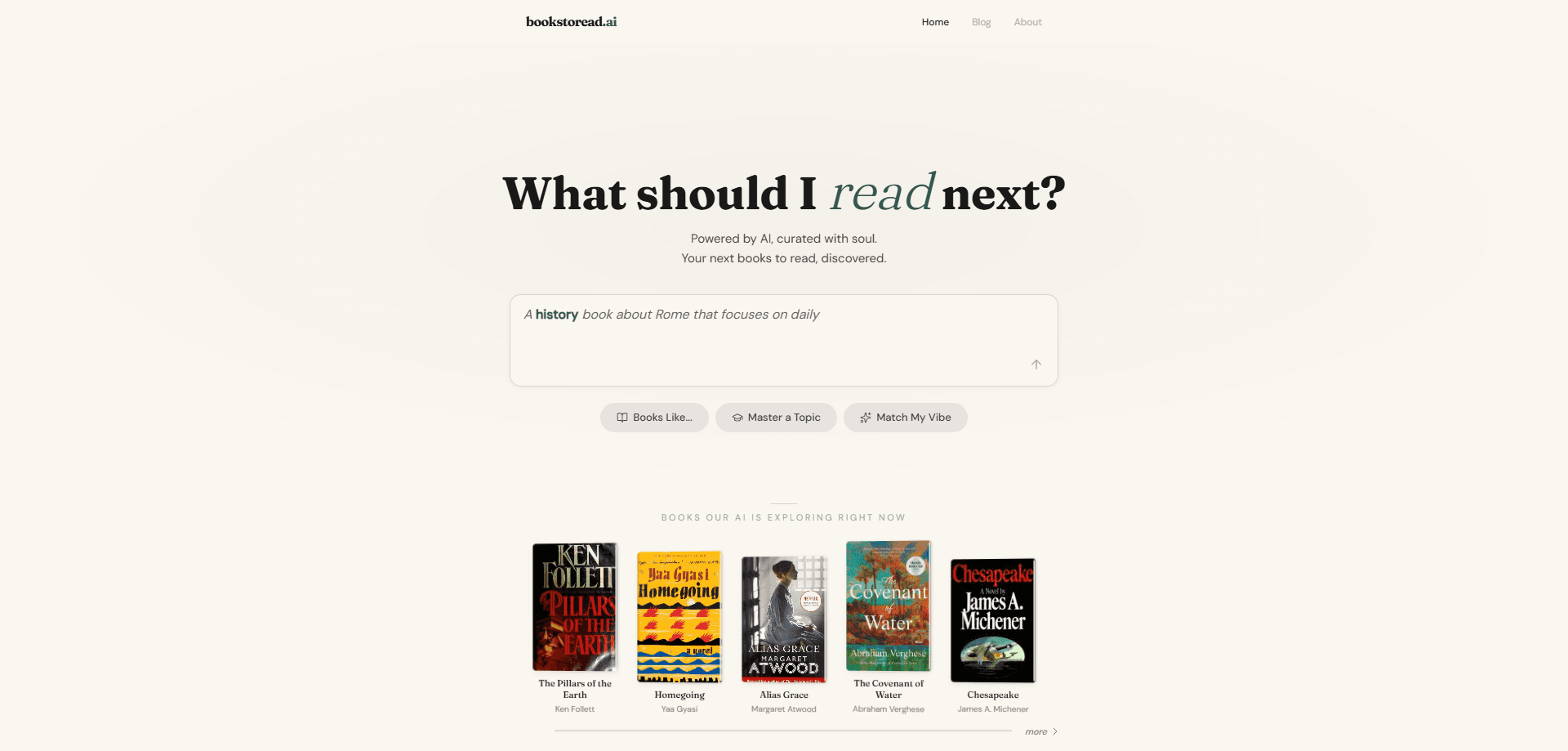
BookstoRead.ai is an AI-powered book recommendation engine that answers one nagging question: what should I read next? Instead of a single lucky pick, it builds curated reading lists organized around a role, a job to be done, or a topic, so an AI engineer gets a different shelf than a product manager. Each guide pairs a handful of titles with a short note on why the book earns its spot and which chapter actually matters. It runs in the browser. Browsing costs nothing. When you decide to buy, it leans on Amazon Associate links. Think of it as a book discovery tool built for people who read to stay sharp.
About BookstoRead.ai
What Is BookstoRead.ai
BookstoRead.ai is a web-based recommendation engine for people who read to stay sharp in their work. You don't get a generic top-ten list. You get a guide written for a specific reader, like the best books for forward deployed engineers or for leaders taking a company AI-native, and that framing is the point.
The engine pairs AI with a curated editorial layer. Each guide explains the angle it's taking, then lists books with a one-line verdict and a deeper note on what the book gets right, whether that's a chapter on why saddle points matter more than local minima in deep learning, or a reframe that most machine learning systems fail on data, not models. The tone reads like a well-read colleague pointing you to the right shelf. It doesn't feel like a search results page.
The main limits are worth knowing up front. It's a recommendation and discovery service, not a reading app, so you won't read or track books inside it. The catalog skews toward technology, business, and strategy rather than fiction. And because it earns through Amazon Associate links, purchases route through Amazon, which means availability and pricing follow Amazon's rules, not the site's. That last point matters if you care about where your book recommendations come from and who profits when you act on them.
Getting Started
- Open bookstoread.ai in any browser. No signup or account is needed to browse.
- Scan the Guides page, which groups reading lists by profession and role, from AI engineers to engineering managers to Internet history buffs.
- Pick the guide that matches your role or the skill you're trying to build.
- Read the short intro and the per-book notes to judge which titles fit. Cross out the ones you already own or have read.
- Click through to Amazon on the titles you want, then buy directly there.
Product Information
A quick look at BookstoRead.ai's pricing, supported platforms, and performance.
Best for
The users, tasks, and scenarios where this tool fits best.
Users
- Working professionals building a skill stack
- Readers new to a field who want a starting point
- People who own too many unfinished books
Tasks
- Choosing what to read next
- Preparing for a new role or field
- Finding audiobook picks
Scenarios
- Planning a reading list before a career switch into AI or data work.
- Filling an Audible credit and wanting a book that will actually hold up.
- Building a small library for a team or a book club around one theme.
Key features
Role-Based Reading Guides
The core of the site is a growing catalog of guides, each written for a named reader rather than a broad topic. You'll find "Best Books for AI Engineers," "Best Books for Product Managers," "Best Books for DevOps Engineers," and narrower ones like guides for forward deployed engineers or fans of a particular newsletter. That framing does real work: it filters the catalog before you see it, so you're not scrolling past books that were never for you. Few sites bother. This one does.
Curated Theses, Not Just Titles
Every book in a guide comes with a reason. There's a one-line hook, then a longer note explaining the book's central claim and the specific chapter or idea that earns it a place. One entry argues that retrieval quality, not prompt wording, is usually the first thing to fix when an LLM app underperforms. That kind of note gives you something to judge against, rather than marketing copy.
Topic Coverage Beyond Tech
The catalog isn't only for engineers. Business strategy, timeless philosophy, Internet history, and how companies really build products all show up. A guide on the Internet's origin stories sits next to one on algorithmic bias and the alignment problem. If your interests wander between tech and ideas, the selection keeps you in one place. No hopping between five sites.
Guides Built for Audiobook Listeners
Several lists are designed for listening from the start. Guides for audiobooks about AI and for product managers, for example, note that the picks were chosen to hold up by ear. That's a small but useful distinction, because dense technical books often don't translate well to audio, and the guide says so up front.
Plain Inverse, No Account Required
There's no login, no paywall, and no onboarding flow to get through. You land, pick a guide, and read. The trade-off is that nothing is personalized or saved between visits, so the site works like a well-organized magazine rack rather than a reading tracker.
Pros and cons
Pros
- Free to browse, with no account, signup, or paywall in the way.
- Guides are framed around a specific reader, which makes choosing faster than scanning generic bestseller lists.
- Per-book notes explain why each title earns its spot, so you can judge before buying.
- Covers tech, business, and ideas, with a separate set of guides tuned for audiobook listeners.
Cons
- It's a discovery layer only, so you can't read, track, or sync books inside it, and reading happens elsewhere.
- Because buying routes through Amazon Associate links, the site earns a commission on purchases, which is worth knowing when you read its picks.
- The catalog favors non-fiction in technology and business, so readers looking for fiction or a broad literary range won't find much here.
Frequently asked questions
Yes. Browsing the guides and reading the recommendations costs nothing, and there's no account or subscription to set up. The site makes money as an Amazon Associate, so it earns a commission when you buy a book through its links, but that commission is paid by Amazon, not by you.
Related content
Explore related tools, skills, and articles for BookstoRead.ai.
BookstoRead.ai Alternatives

Google EmbeddingGemma 2
Google DeepMind · Writing · Image · CodingGoogle EmbeddingGemma 2 is a 740M-parameter open model that turns text, code, images, audio, and video frames into vectors in one 768-dimension space, running on phones and laptops.

MePersona
MePersona, Inc. · Writing · Productivity · MarketingMePersona is an AI unified inbox for creators. It learns your voice, drafts replies to fan messages from 12 platforms, and sends only what you approve.

Fluence
Yay Software (Yannick Huchard) · Writing · Voice & Language · ProductivityFluence is an Android app that reads PDFs, EPUBs, Word files and web articles aloud, follows each sentence as it speaks, and answers questions about the text on the phone itself.