

BookSurfAI
BookSurf AI · Writing
BookSurfAI is a book discovery platform that turns your reading mood and taste into personalized book recommendations. It studies why you picked a title, then suggests what to read next.
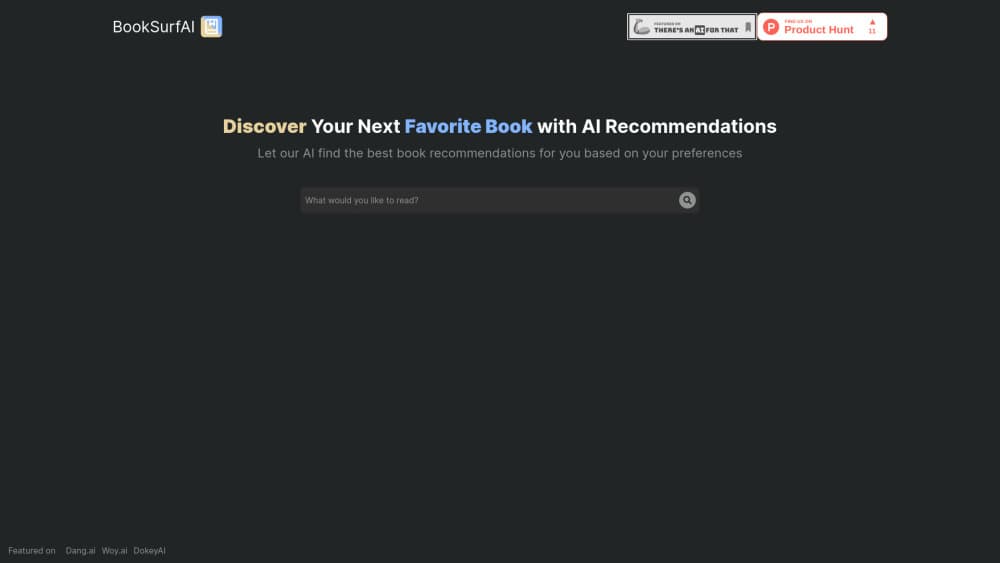
About BookSurfAI
What Is BookSurfAI
Most sites that offer AI book recommendations build them from star ratings, finished titles, and genre tags. BookSurfAI works from a different premise. Readers often choose books for reasons they can't neatly explain, and the platform treats those reasons as the most useful data in the room. It watches how you arrive at a book, not only whether you liked it.
That makes the recommendation engine behave more like a friend with steady taste than a bestseller chart. It notices when you step away from literary fiction after three heavy reads, when you reach for something fast after a slow burn, and which titles you keep circling without committing. The picks aim at the reading mood you're in now instead of the reader you were two years ago.
The limits are worth stating plainly. BookSurfAI runs in a browser, so there's no native app and no offline shelf. Suggestions stay broad until you've fed it a few real choices, which means a new account feels generic for a while. There's no public API either, so you can't plug it into your own tools.
Getting Started
- Open booksurfai.com in any modern browser. Nothing to install.
- Give it a starting point: a few books you loved, a few you abandoned, and one you feel guilty about skipping.
- React to the first batch of suggestions. Save what looks right and reject what doesn't.
- Read the note attached to each pick, since it names the signal that put the book in front of you.
- Keep reacting as your taste moves, and the shortlist shifts with you.
Product Information
A quick look at BookSurfAI's pricing, supported platforms, and performance.
Best for
The users, tasks, and scenarios where this tool fits best.
Users
- Readers stuck in a recommendation rut
- People whose taste changes with their mood
- Readers who quit books often
Tasks
- Choosing your next read after a heavy book
- Escaping the bestseller loop
- Rebuilding a tbr list you'll actually finish
Scenarios
- A Sunday night when nothing on the shelf appeals
- The slump after finishing a series
- Reading burnout after a long nonfiction stretch
Key features
Taste Signals Beyond Star Ratings
A five star rating flattens a reading experience into one number. BookSurfAI reads the pattern around that number: what you picked next, what you dropped halfway, and which genres you fled. Those moves say more about your taste than a score does, and the book recommendation engine weights them accordingly. The practical effect is a shortlist that reflects how you actually read, not how you rate.
Mood First Recommendations
Mood based book recommendations are the core of the product. Instead of asking for a genre, the platform asks what kind of reading experience you're after: something absorbing and fast, something slow and unsettling, something that asks little of you. That framing matters when you're tired or restless, because the book that fits your taste can still be wrong for tonight.
Reading Choices That Go Against the Grain
Some of the most revealing picks are the contrarian ones. You read a novel because someone said you wouldn't like it, or because a dismissive review made you curious. BookSurfAI treats those choices as emotional data rather than noise. It tracks what you're reacting against, which often points at a real preference hiding underneath the impulse.
Discovery That Skips the Bestseller Loop
The platform leans toward titles that don't dominate store tables. If your reading year keeps collapsing into the same handful of releases, that's a discovery problem, not a taste problem. BookSurfAI uses your signals to reach for lower profile books that fit the pattern, so the shortlist looks less like a bestseller list and more like something built for you.
Recommendations That Track Taste Changes
Reading taste grows up. The thriller reader who swore off literary fiction ends up weeping over a quiet novel about grief, and the shift is normal. BookSurfAI expects it. Older signals lose weight as new ones arrive, so the recommendations follow the reader you've become instead of locking you into an early profile.
Reading Life Guides Alongside the Picks
The site pairs its picks with essays about reading itself: how to vet a book in a minute, why sequels disappoint, how to recover from reading burnout. The guides give you language for what you want, which makes your next request to the engine sharper. It's a small thing that makes the personalized book recommendations feel less like a black box.
Browser Based, No Install
BookSurfAI runs as a web app, so you can open it on a laptop, a tablet, or a phone without downloading anything. The site is installable as a browser shortcut if you want an icon on your home screen. There's no desktop client and no offline mode, which keeps the footprint small but ties you to a connection.
Pros and cons
Pros
- Each suggestion comes with a reason, so the picks stop feeling random.
- Abandoned and disliked books count as data instead of being ignored.
- Mood is treated as a first class input, which genre filters handle badly.
- Free to use in a browser, with no download or subscription barrier.
- The editorial guides help you describe what you want before you search.
Cons
- New accounts get broad, generic picks until there's enough history to work with.
- Web only, so there's no native app and no offline shelf for flights or commutes.
- No public API, which blocks integrations and any custom tooling.
- Details on how reading data is stored and used are thin, so privacy conscious readers have to guess.
Frequently asked questions
Yes. The platform is free in the browser and no paid tiers are published. You create an account, feed it some reading history, and start reacting to suggestions.
Related content
Explore related tools, skills, and articles for BookSurfAI.
BookSurfAI Alternatives

Google EmbeddingGemma 2
Google DeepMind · Writing · Image · CodingGoogle EmbeddingGemma 2 is a 740M-parameter open model that turns text, code, images, audio, and video frames into vectors in one 768-dimension space, running on phones and laptops.

MePersona
MePersona, Inc. · Writing · Productivity · MarketingMePersona is an AI unified inbox for creators. It learns your voice, drafts replies to fan messages from 12 platforms, and sends only what you approve.

Fluence
Yay Software (Yannick Huchard) · Writing · Voice & Language · ProductivityFluence is an Android app that reads PDFs, EPUBs, Word files and web articles aloud, follows each sentence as it speaks, and answers questions about the text on the phone itself.