

BooleanMaths Pulse
BooleanMaths · Marketing
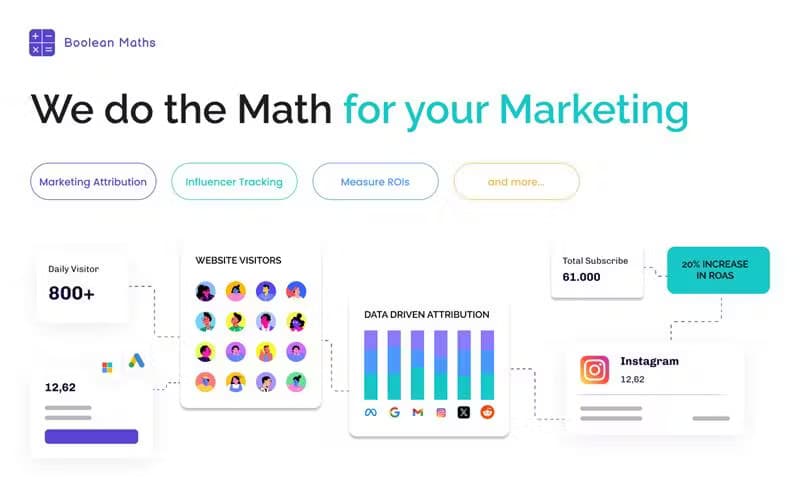
BooleanMaths Pulse is the AI-powered analytics layer of BooleanMaths. It stitches full customer journeys, runs multi-touch attribution and shows live P&L for Shopify and D2C brands.
About BooleanMaths Pulse
What Is BooleanMaths Pulse
BooleanMaths Pulse is the analytics and intelligence layer inside the BooleanMaths marketing data platform. As an AI marketing attribution tool, it pulls order, ad, shipping and survey data into one place, then rebuilds each customer journey so you can see which channels actually drive revenue. Think of it as the dashboard plus the AI that reads it for you.
The core problem it targets is broken attribution. Meta and Google feel that browser pixels lose a large share of signals to ad blockers, cookie limits and iOS privacy rules. When that happens, each platform tends to claim credit for the same order, and your reported ROAS stops matching what your bank account shows. Pulse attacks this from two sides. First, server-side tracking and conversion APIs (CAPI) send purchase events straight from your server to Meta and Google, so the ad platforms get cleaner optimization signals. Second, Pulse rebuilds the journey across browsers, devices and third-party checkouts, then lets you compare true ROAS against the platform claimed numbers.
The AI part sits on top of that data. A new intelligence feature called BooleanVision tracks your creatives, pulls out the hooks and messaging underneath them, and suggests which combinations tend to work. Pulse also connects to Claude, Gemini, OpenAI and Cursor through an MCP connector, so you can ask questions about your own marketing in plain language instead of writing SQL.
Two limits are worth knowing up front. Pulse is built for commerce brands that run paid ads, and it leans heavily toward Shopify and Indian DTC workflows, including cash-on-delivery orders and high return-to-origin rates. If you sell software or run a purely content site, the fit is weaker. And the platform carries a real price tag, so it makes sense mainly once you're spending a meaningful amount on ads.
Getting Started
- Install the BooleanMaths app from the Shopify App Store, or add the tracking pixel with a custom code setup
- Connect your ad accounts and channels, starting with Meta and Google Ads
- Turn on server-side CAPI so conversion events flow from your server to the ad platforms
- Open the Pulse dashboard to review attribution, channel ROAS and live P&L, then use the MCP connector to query the data inside Claude or ChatGPT
Product Information
A quick look at BooleanMaths Pulse's pricing, supported platforms, and performance.
Best for
The users, tasks, and scenarios where this tool fits best.
Users
- Shopify store owners
- D2C growth teams
- Performance marketers
- Ecommerce agencies
- Founders without a data team
Tasks
- Rebuilding customer journeys
- Multi-touch attribution
- Running server-side CAPI
- Calculating true product profitability
- Analyzing creatives
- Querying data through MCP
Scenarios
- A brand's ad platforms each claim the same order
- A cash-on-delivery heavy store loses revenue to returns
- A marketer wants to know which SKU makes money
- Budget season arrives
- A privacy update breaks the pixel
Key features
Server-Side Tracking and Conversion APIs
Pulse sends conversion events from your own server to Meta and Google instead of relying on the browser alone. That keeps purchase and add-to-cart signals flowing when cookies, ad blockers or iOS restrictions would otherwise drop them. The payoff shows up in the ad platforms themselves, since cleaner conversion data tends to improve automated bidding and targeting.
Multi-Touch Attribution With Flexible Models
The platform tracks every touchpoint across Meta, Google, email and other channels, then shows how those channels overlap on a single order. You can switch between first-click, last-click, linear and a custom model that blends multi-touch attribution with post-purchase surveys and media mix modeling. Attribution windows run from one day up to lifetime, so longer purchase cycles still get counted.
Live P&L and Profitability Analytics
Pulse computes contribution margin by channel, SKU and cohort, including shipping, returns and discounts. That matters because a product can look strong on ROAS and still lose money once real costs are counted. The Business plan adds a P&L configuration aimed at keeping the error under one percent.
BooleanVision Creative Intelligence
The newest AI feature tracks your ad creatives, extracts the underlying hooks and messaging, and recommends the combinations that tend to work. Instead of guessing which angle to scale, you get a read on which creative patterns drive results across your account.
MCP Connector for AI Assistants
An MCP connector links your marketing data to Claude, Gemini, OpenAI and Cursor. The model calls pre-built tools like attribution or P&L instead of writing SQL against raw tables, which cuts token use and keeps definitions consistent between runs. Customer data is tokenized or removed at the MCP layer, so raw personal data doesn't cross into the AI context.
Post-Purchase Surveys and Audience Segmentation
Pulse runs post-purchase surveys to capture why customers actually bought, then validates attribution against their answers. You can also build audience groups from source and purchase patterns and push them to Meta, Google or WhatsApp campaigns. The platform reports that brand-built audiences beat standard RFM groups in its own case studies.
Pros and cons
Pros
- Recovers conversion signals that browser-only tracking loses, which can lift the ROAS the ad platforms see
- Combines attribution, server-side CAPI, post-purchase surveys and live P&L in one dashboard instead of a scattered stack
- MCP connector lets Claude, Gemini or ChatGPT answer questions about your own marketing data in plain language
- Built around Shopify, WooCommerce and Indian DTC realities such as cash-on-delivery orders, third-party checkouts and return-to-origin rates
- Self-serve setup with a one-click Shopify install, so marketers don't need a developer to get running
Cons
- Starts at $99 per month and steps up with order volume, so it's hard to justify for very small stores
- The strongest fit is Shopify and D2C commerce, which means software or content businesses get less value from the attribution model
- No free tier and the free trial runs shorter than some rivals offer, so testing it fully takes a commitment to a paid plan
- The heavy India-focused features may add less value for brands selling mainly in the US or Europe
Frequently asked questions
BooleanMaths Pulse is the analytics layer of the BooleanMaths platform. Brands use it to track where every order came from, run multi-touch attribution across paid and organic channels, and see true profitability after returns and shipping, all in one dashboard.
Related content
Explore related tools, skills, and articles for BooleanMaths Pulse.
BooleanMaths Pulse Alternatives

ngram 2.0
ngram · Video · Marketingngram 2.0 is an AI video generator for teams. It turns a prompt, a screen recording, or a product URL into a narrated explainer, product demo, or AI avatar video, and every scene stays editable.

shippedit.me
Krawlup · Marketing · Businessshippedit.me now redirects to Krawlup, a web platform that audits SEO, AEO and page speed every week, then hands the fixes to AI coding agents over MCP.

MePersona
MePersona, Inc. · Writing · Productivity · MarketingMePersona is an AI unified inbox for creators. It learns your voice, drafts replies to fan messages from 12 platforms, and sends only what you approve.