
Bossjob
Bossjob · Business · Chatbot
Bossjob is an AI recruitment platform built around direct chat. Employers post jobs free, message candidates, and get AI scoring on resumes and job translations.
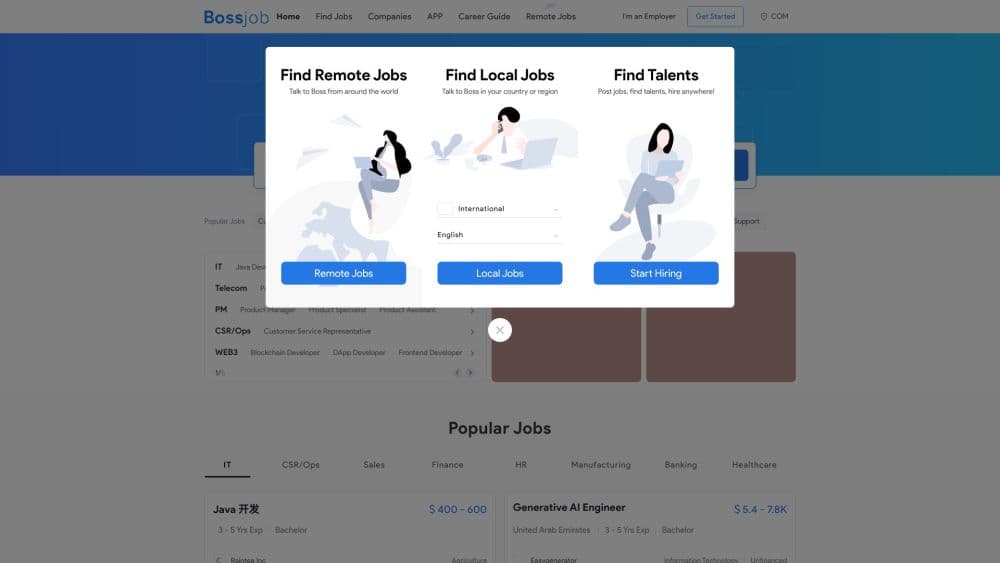
About Bossjob
What Is Bossjob
Bossjob is a hiring platform where the conversation starts before the screening does. As a job search app, it flips the usual order: employers post an opening, describe what they need, and then talk to candidates in a chat window instead of waiting on emailed applications. The model is the one Chinese job seekers already know from BOSS Zhipin, and Bossjob is the version built for overseas markets.
It started in the Philippines in 2018 and now lists roles across Southeast Asia and further out, with a heavy showing of Web3 jobs and remote work. The company calls its approach MDD, short for mobile, direct chat, and AI features. Chat carries the hiring work. AI carries the sorting: it ranks candidates, reads job text, and fills the gap when a recruiter and a candidate do not share a language.
The limit to know up front is scale. Bossjob is strongest in the Philippines and in Web3 hiring, which is a narrow slice compared with LinkedIn or Indeed. Employers should check whether the roles they need have a live pool before committing, and job seekers looking for roles in Europe or North America will find thin pickings.
Getting Started
- Pick a side: sign up as a job seeker or as an employer. Both run on the same account system, and the web app lives at bossjob.com alongside the mobile apps.
- Fill in the profile. Job seekers add work history, education, and skills, which the matching model reads. Employers add a company page so candidates know who they are talking to.
- Post or search. Employers publish a job in a few minutes and set the salary range and location. Job seekers browse suggestions or search by title, industry, and country.
- Start chatting. Messages open straight into a thread with the hiring person. From there you exchange requirements, ask for a resume, and book an interview.
- Close out. Employers mark the role filled or archive the thread. Job seekers can keep several conversations open at once.
Product Information
A quick look at Bossjob's pricing, supported platforms, and performance.
Best for
The users, tasks, and scenarios where this tool fits best.
Users
- Employers hiring for Web3, remote, and cross-border roles
- Job seekers in Southeast Asia, especially the Philippines
- Recruiting teams that hire people from other countries
Tasks
- Filling a role without spending on job ads
- Screening a large stack of applicants
- Hiring across a language gap
- Building a talent pool for repeat hiring
Scenarios
- A small company hiring its first overseas staff
- A Web3 team filling a remote engineering slot
- Checking whether a market has candidates before opening an office
Key features
Direct Chat Between Employer and Candidate
The main screen is a message thread, not a resume database. Employers and candidates talk in real time, which collapses the days that usually pass between an application and a first reply. The web app also surfaces which employers respond most often, so a job seeker spends less time on threads that go quiet.
AI Job Matching
The matching model reads a candidate profile and suggests roles, and it scores candidates for an employer based on the job text and past feedback. The stated goal is for a recruiter to review around five resumes per hire rather than a full stack, which is the claim to test against your own results.
AI Resume Analysis
Employers get a read on each applicant that goes past keyword fitting. The analysis grades compatibility with the role and with company culture notes, and it runs free for employers. Job seekers get a resume builder that drafts and tightens wording with a language model, useful if writing a CV in a second language.
AI Translation for Job Posts
A posting written in one language opens in another, and readers can switch between the translation and the original. This matters most for remote roles where the recruiter and the candidate sit in different countries, and it removes a common reason a good listing gets skipped.
Free Posting for Employers
Employers publish openings at no cost, which puts the paid alternatives in a different light for small teams. Posting, chatting, inviting candidates to interview, and working with colleagues on a role all sit in the free employer account.
Mobile First Apps
The product was designed for phones, and the apps carry the whole flow rather than acting as a companion to a desktop site. A recruiter can reply from a queue, and a job seeker can apply between other tasks, which fits markets where mobile is the main way people get online.
Pros and cons
Pros
- Chat replaces the application funnel, so a first reply often arrives the same day instead of the same week.
- Free posting for employers takes the cost question off the table while you test the candidate pool.
- AI translation makes cross-border roles readable on both sides without hiring a translator.
- The candidate base skews toward Web3, remote work, and Southeast Asia, which is a real edge if that is your market.
- Resume scoring and profile suggestions cut the manual first pass for small recruiting teams.
Cons
- Coverage outside Southeast Asia is thin. A search for roles in Europe or North America returns little.
- There's no published pricing page, so paid options are unclear until you ask a sales contact.
- Listings lean toward overseas and Web3 hiring, and some posts carry vague company names, which slows a candidate's check.
- There's no public API, so the platform cannot feed your own applicant tracking system without manual work.
Frequently asked questions
Bossjob connects employers and job seekers through direct chat. Employers post a role, candidates message them, and the two sides settle requirements and interviews inside the app. AI handles matching, resume scoring, and translation.
Related content
Explore related tools, skills, and articles for Bossjob.
Bossjob Alternatives

Knocket
Knocket (Tencent RTC team) · Productivity · Business · ChatbotKnocket is a free live chat and contact page tool that lets visitors message you from your website, app, or a shareable link, with every reply handled from Telegram or one inbox.

shippedit.me
Krawlup · Marketing · Businessshippedit.me now redirects to Krawlup, a web platform that audits SEO, AEO and page speed every week, then hands the fixes to AI coding agents over MCP.

Ayven
Alknoma · Productivity · BusinessAyven is an AI control centre by Alknoma that turns a plain-language goal into a dated plan, hands the work to your people and AI agents, and asks for your approval only when the call is yours.