

Breakout Learning
Breakout Learning · Leaning
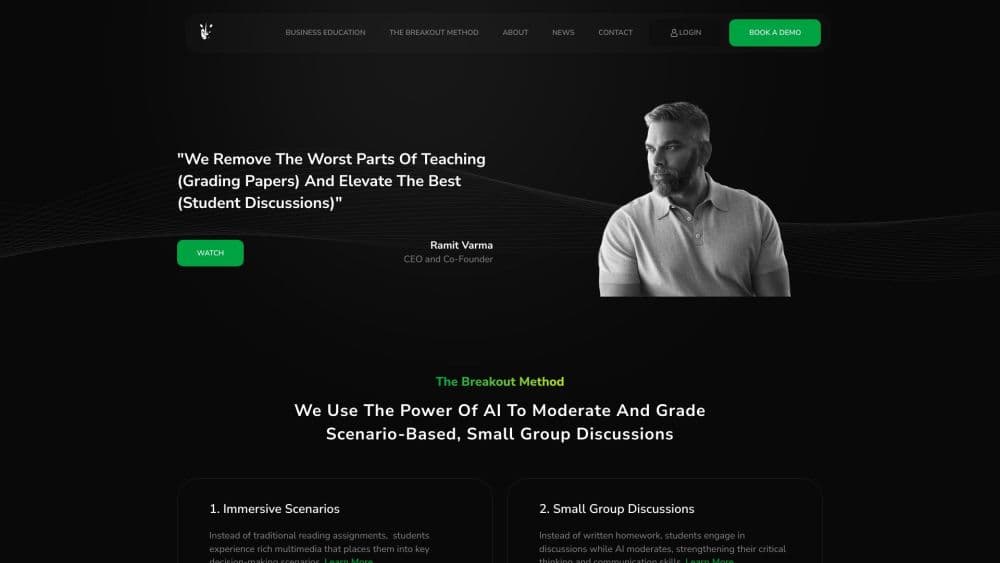
Breakout Learning is a classroom platform where small groups of students discuss a case with an AI moderator that grades the conversation against the professor's rubric.
About Breakout Learning
What Is Breakout Learning
Breakout Learning is a teaching platform built around one idea: students learn more when they have to talk through a problem with each other than when they read a chapter alone. It was founded in 2023 in Dallas, Texas, by Ramit Varma, Steven Walters and Josh Oster-Morris, and it sells to colleges and universities rather than to individual learners.
Here's how a session runs. Students get a case, simulation or short video before class and discuss it in a small group, usually three to four people. An AI moderator keeps the conversation on track, asks follow-up questions and records a transcript. When the group finishes, the platform reads that transcript against a rubric the instructor set and sends back a score, a summary of what the group covered and notes on where it got stuck. The instructor opens the dashboard and sees who prepared, who stayed quiet and which concepts never came up.
The moderation is the part that changes how instructors use it. A professor teaching 600 students can't listen to every group. The AI can, at least on the transcript level, and the rubric keeps the standard the same across sections. The company reports that about 90% of students complete their assigned reading before a session. That's a vendor figure, not an independent study.
The limits are real too. Everything runs in a browser, so there's no phone app to hand out. Content and pricing are built around per-student, per-course purchases, which suits institutions and doesn't suit a hobbyist who wants to try one case. And the AI grades discussion quality, not factual recall, so courses that lean on multiple-choice testing won't get much from it.
Getting Started
- Request a demo or a pilot through the official site and pick the courses you want to test first.
- Choose modules from the catalog or build your own with the content tools, then attach your rubric and learning objectives for each one.
- Bring students in through your learning management system or a direct roster upload, and confirm they can sign in before the first class.
- Run the first module as a low-stakes assignment, then review the dashboard transcripts and scores before converting more of the syllabus.
- Once the format fits your course, move to a per-student plan sized to the number of modules you need.
Product Information
A quick look at Breakout Learning's pricing, supported platforms, and performance.
Best for
The users, tasks, and scenarios where this tool fits best.
Users
- Business school professors who want graded discussion without listening to every group
- Instructors at large lecture courses who need every student talking
- Instructional designers building custom curriculum
Tasks
- Replacing threaded discussion boards
- Preparing students before a case discussion
- Running oral exams at scale
Scenarios
- A 300-seat marketing lecture where only a handful speak up in class
- A semester-long course that keeps drifting toward memorization
- A pilot semester where one faculty member tests AI assessment before the department commits
Key features
AI-Moderated Small-Group Discussion
The core loop runs without an instructor present. Students join a group of three or four, get a case prompt and talk it through while an AI partner nudges the conversation, asks for evidence and keeps everyone in the exchange. Groups can finish on their own schedule, which makes it usable as homework as well as classwork.
Rubric-Driven Grading From the Transcript
Each session produces a transcript that the platform scores against the instructor's rubric, using Bloom's taxonomy levels to judge depth rather than word count. Each student gets a mark, and the instructor can see participation patterns and where the group stalled. The appeal is consistency: the same rubric applies to section one and section nine.
Instructor Dashboard With Discussion Insights
The dashboard collects scores, summaries and struggle points in one place, so a professor can walk into class knowing which arguments the room missed. The company positions this as lecture prep as much as grading, and that's where most of the time saving shows up.
Built for Higher Education Software Stacks
The product is aimed at colleges and universities as higher education software, not as a consumer study app. Rosters, sections and grading all assume an institutional course, and the sales process runs through departments and faculty committees.
Ready-Made Catalog of Cases and Simulations
Breakout Learning publishes its own library of discussion modules, built with input from business school faculty. Instructors can mix cases, simulations, role-play scenarios and practice tests, or use the catalog as a starting point before writing their own. The library started as a set of business case studies, expanded to community-generated modules, and works as a template for teachers who want their own topic.
Custom Module Builder
Faculty can create, edit or refresh course material inside the platform, with questions, rubrics and multimedia attached to each module. Schools that already teach with their own cases can keep them and still get AI evaluation and discussion mechanics.
NextBook as a Textbook Replacement
NextBook packages a set of modules into a course-length alternative to a static textbook, priced per enrolled student. A full version covers unlimited modules for a semester, and smaller packages cover four modules or a single one for shorter courses and pilots.
AI Study Partner Named Sophia
Aside from group sessions, students can work with Sophia, a Socratic tutor that pushes them to reason through an answer instead of handing one over. It supports tutor sessions, role-play practice and test preparation between the graded modules.
Pros and cons
Pros
- Grading comes from a rubric you set, so discussion scores stay consistent across large sections.
- Students arrive having done the reading, according to the company's figure of 90% completion.
- The dashboard turns a live conversation into a written record you can review in minutes instead of hours.
- Modules can be customized, so schools aren't locked into a fixed publisher library.
- Per-student pricing matches how departments already buy course materials.
Cons
- No free plan and no single-seat option, so an individual teacher can't test it without going through a department.
- It runs only in a browser, which matters for classes where phones are the main device.
- A transcript-based grade rewards speaking up, so quiet students may score lower even when they followed the discussion.
- The catalog leans toward business and management cases, so courses in other fields have less ready material to draw on.
Frequently asked questions
It runs a classroom discussion with an AI moderator and grades the conversation against the instructor's rubric. Students work through a case together, and the professor gets scores and summaries afterwards.
Related content
Explore related tools, skills, and articles for Breakout Learning.
Breakout Learning Alternatives
Kaggle AI
Google · Coding · LeaningKaggle AI is a community platform where people build, test, and compare machine learning models against shared data. It combines data science competitions, tens of thousands of public datasets, and free cloud notebooks with GPU and TPU access, so anyone with a browser can train a model without buying hardware. Google owns the platform, and joining costs nothing.

Bunch
Bunch AI · Leaning · BusinessBunch is an AI leadership coaching app that turns a few spare minutes a day into real management practice. It hands you one short, personalized tip each day, tracks how you respond, and lets you compare notes with peers inside private groups. The pitch is simple: you lead better by practicing a little, often, instead of sitting through a weekend seminar. Think of it as a leadership training app you actually open.

AI Mock Interview
SQLPad · Coding · LeaningAI Mock Interview is a practice tool built into SQLPad that simulates real job interviews and gives you instant feedback on both what you say and how you say it. You pick a role template or upload a job description, answer questions out loud in real time, and then review a transcript with notes on structure, clarity, and grammar. It's aimed at data professionals prepping for SQL, Python, data engineering, machine learning, and system design roles, and it works entirely in the browser. No install needed.