

BrowserAct
BrowserAct · Coding
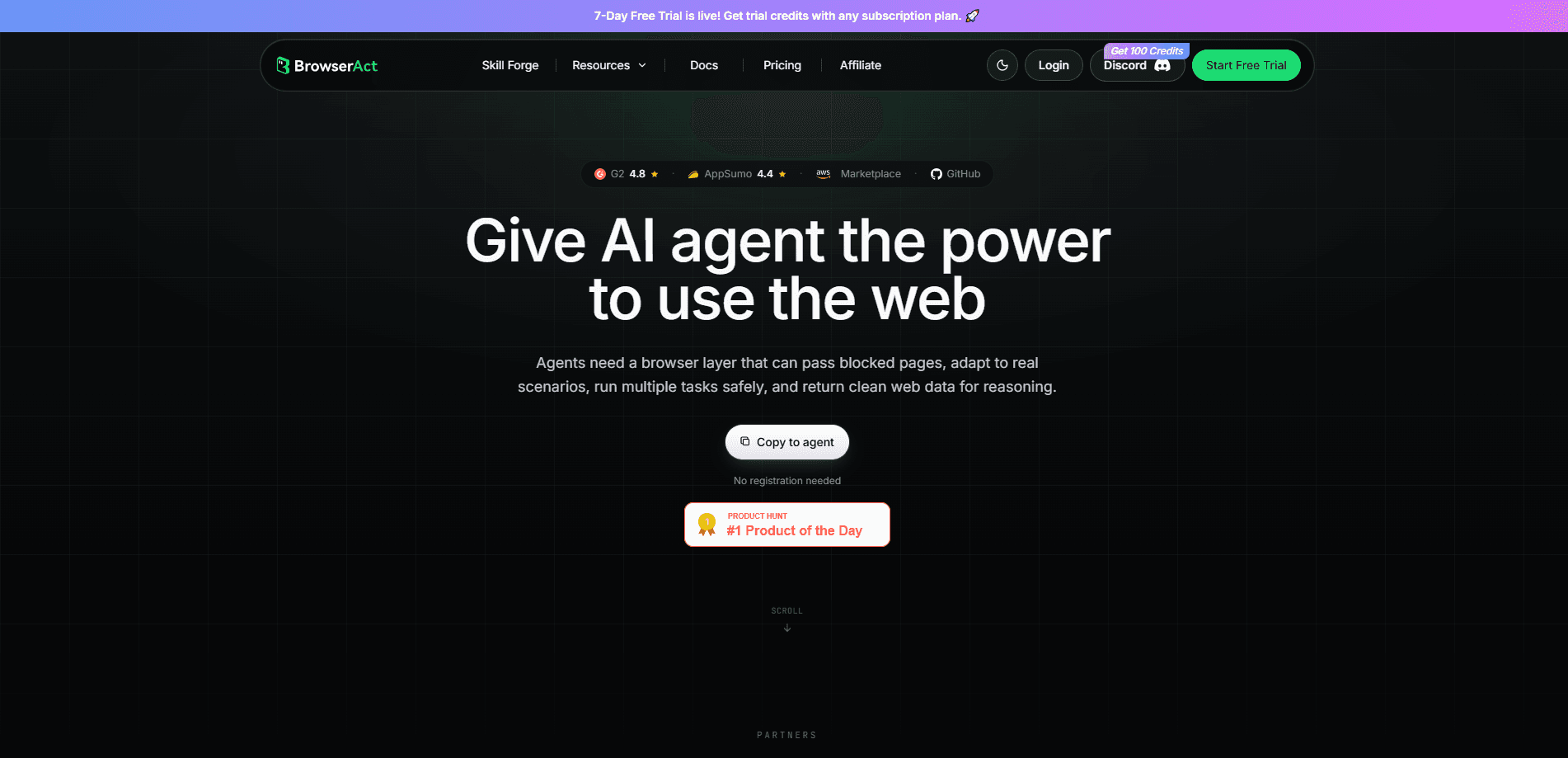
BrowserAct is a browser automation runtime built for AI agents, letting them open real, stealth Chrome sessions to scrape or act on any site. It handles the messy parts on its own. CAPTCHA solving, fingerprint rotation, residential proxy routing. Then it returns clean structured data your agent can reason over. As a web scraping tool, it works through a CLI, a visual workflow builder, or an API and MCP server, so the same bot runs whether you code or not.
About BrowserAct
What Is BrowserAct
BrowserAct runs the browser layer that AI agents usually can't handle by themselves. Instead of your agent hitting a wall on a login page or a CAPTCHA, BrowserAct spins up a Chrome session with a real device identity, solves the challenge, and keeps going.
The platform sits between your agent and the web. It manages browsers, proxies, and capacity, then hands back structured output like CSV or JSON rather than a raw HTML dump. That output is the part that matters most. It's clean enough for an LLM to reason over without a second cleaning step. For plain web data extraction, that saves a whole processing stage.
The main limit is cost structure. Running stealth sessions through residential IPs burns credits fast, and when a scraping job spans thousands of pages across several regions the monthly bill can climb well past the entry-tier price before you notice. Heavy scraping jobs add up. So if your workload is small and occasional, the free tier is plenty. If it's large and constant, watch the credit math.
Getting Started
- Sign up at the official site and claim the free trial, which starts with 200 credits and 2 free agent builds.
- Choose how you want to drive it: install the CLI, open the cloud workflow builder, or connect your agent through the API or MCP server.
- Describe the task in a prompt, or point the builder at a target page, and let BrowserAct explore the site and assemble a bot.
- Review the bot it builds, then run it once to verify the extraction before scaling up.
- Schedule the run or trigger it on demand, and set delivery to CSV, JSON, or a connected tool like Make, n8n, or Zapier.
Product Information
A quick look at BrowserAct's pricing, supported platforms, and performance.
Best for
The users, tasks, and scenarios where this tool fits best.
Users
- AI agent developers
- E-commerce and market analysts
- Lead-generation teams
- Solo builders and small teams
Tasks
- Scraping product listings
- Monitoring competitors
- Collecting creator and job-market data
- Running signed-in workflows
Scenarios
- A daily price-watch that re-runs the same bot each morning
- Research where target pages fight back with CAPTCHAs and geo-blocks
- One-off bulk pulls for a report
- Handing browser control to a local AI agent
Key features
Agent-Native Browser Runtime
BrowserAct is designed for agents first, not humans clicking around. It exposes the browser through a CLI, workflow builder, and API/MCP, so an agent can launch a session, act on whatever it finds, and pull results back without a human ever touching the loop. The local mode gives your own agent a browser it couldn't otherwise reach.
Stealth Sessions With Real Fingerprints
Each Chromium session gets a real device identity built from 30+ fingerprint attributes, paired with residential IP infrastructure. That combination is what keeps sessions from being flagged and blocked at scale. It just works. You can run a fresh browser every time, or keep a signed-in session when a task needs login.
Automatic CAPTCHA Handling
The runtime resolves reCAPTCHA, Turnstile, DataDome, and other common challenges on its own, so a task doesn't stall the moment a site decides to test you. A human-in-the-loop handoff covers the cases automation can't clear.
Self-Healing After Page Changes
When a site updates its layout, BrowserAct finds and verifies a new path, then resumes the task. That cuts the maintenance tax that normally comes with scrapers, since you rebuild less often.
Global Residential Proxies
You can run from the countries you need, using rotating or persistent residential IPs. Sticky sessions suit account work; rotation suits high-volume collection where you don't want one identity tied to everything.
Clean Structured Output
Results come back as structured data, not a wall of HTML. You can download CSV or JSON, push straight into Make, n8n, and Zapier, or route results through your own API and webhook endpoints whenever you'd rather keep everything inside your existing pipeline. The output is formatted so an LLM can reason over it directly.
Cloud Runs and Scheduling
Bots run on demand or on a schedule, around the clock, without you managing browser infrastructure. BrowserAct handles capacity, so a burst of parallel tasks doesn't require you to provision anything.
Pros and cons
Pros
- Handles CAPTCHAs, proxies, and fingerprinting. Agents don't get stuck on anti-bot defenses.
- Converts raw pages into structured output that LLMs can use without extra cleanup.
- Self-healing extraction cuts the rebuild work when target pages change. Less maintenance, less time lost.
- Multiple control surfaces (CLI, no-code builder, API, MCP) fit both developers and non-coders.
Cons
- Credit-based pricing means heavy residential-proxy use gets expensive quickly, and costs are hard to predict up front.
- The free tier's 2 simultaneous tasks and limited credits won't support serious production volume.
- Scraping at scale raises legal and terms-of-service questions you have to sort out yourself.
Frequently asked questions
You can build reusable web scrapers and agent-driven browser tasks: pulling product data, monitoring competitors, assembling lead lists, and tracking public job or launch data. It runs in the cloud or hands a browser to your local agent.
Related content
Explore related tools, skills, and articles for BrowserAct.
BrowserAct Alternatives
Forefront
Forefront · CodingForefront is a web platform for building with open-source AI. It lets you fine-tune leading open-source language models on your own data, evaluate how they perform, and run them through an API or export them to host yourself. Developers who want the convenience of a closed-source platform but insist on owning their models and data are the target audience here.

Startkit
StartKit.AI · CodingStartkit is a boilerplate for building AI SaaS and AI wrapper products. Think of it as an AI startup boilerplate with the boring parts already wired up: authentication, Stripe and Lemon Squeezy payments, usage limits, transactional email, and an AI API starter that talks to OpenAI, Anthropic, Groq, or Llama. You clone the repo, set your price, and start on the part of your product that people actually pay for. It's Next.js under React and Tailwind, so most of the boilerplate code already feels familiar.
Testim
Tricentis · CodingTestim is an AI-powered test automation platform for building and running end-to-end tests across web, mobile, and Salesforce applications. It leans on machine learning to keep tests stable when an interface changes, so teams spend less time fixing broken selectors. Not bad for an automated testing tool you can start using today. You create tests by recording actions in a browser, then optionally add JavaScript when you need more control. It's a solid pick for busy QA teams.