

Bugster
Bugster Inc. · Coding
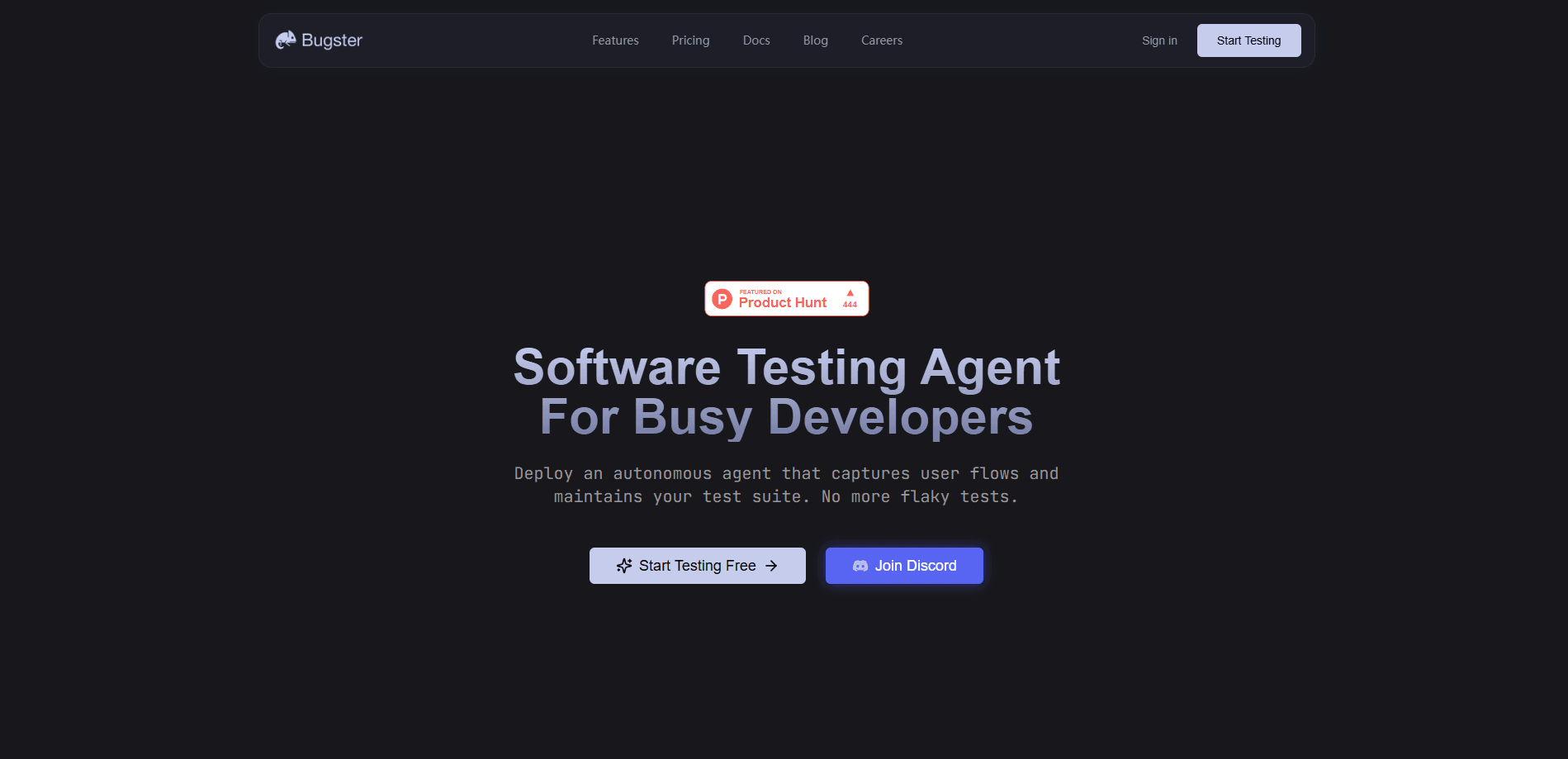
Bugster is an AI end-to-end testing tool that turns plain English user flows into runnable browser tests, so QA and dev teams skip scripts and selectors.
About Bugster
What Is Bugster
Bugster is an AI-powered end-to-end testing and QA automation platform built for engineering teams. Instead of writing and maintaining test scripts, you describe a user flow in plain English and an AI agent opens a real browser, clicks, types and navigates the way a person would.
The product targets the gap between manual QA and heavy coded test suites. Its own pitch is blunt: ten times more coverage than manual testing, and a full suite for any web application in under five minutes. Whether or not those numbers hold for your codebase, the appeal is clear. You stop babysitting brittle selectors and start describing what should happen.
Two limits shape how you'd actually use it. Bugster runs tests only against deployed environments, so it fits end-to-end and smoke checks rather than unit tests inside your pipeline. And it's a cloud service, so results, logs and recordings live on Bugster's infrastructure under a 30-day default retention.
Getting Started
- Sign up for a free account at app.bugster.dev and connect a web application you want to test
- Describe a user flow in plain English in the web app, or write tests as YAML and sync them locally
- Let the AI agent run the flow on a real browser and watch it click, type and navigate
- Review the pass or fail result, then read the bug report with steps to reproduce and a video if something breaks
- Wire runs into CI/CD or a nightly schedule and organize tests into suites once the basics work
Product Information
A quick look at Bugster's pricing, supported platforms, and performance.
Best for
The users, tasks, and scenarios where this tool fits best.
Users
- QA engineers
- Engineering leaders
- Developers
- Product teams
Tasks
- Test generation from a description
- Smoke checks on every pull request
- Migrating an existing suite
- Reproducing flaky failures
- Scheduling nightly regression runs across multiple environments from one place
Scenarios
- A checkout flow breaks in staging
- A small team ships daily but has no dedicated QA
- You're onboarding a new teammate
- A release looms and you need a safety net
- A pull request touches the login screen
Key features
Plain English Test Specs
You state what should happen, not how to locate each element. Describe a flow such as adding a book to a cart, and the agent handles the clicking, typing and navigation on its own. There are no selectors to record and no scripts to maintain, which is the main reason the tool survives a redesigned UI where a recorded test would break.
AI Agents on Real Browsers
Tests run on real browsers rather than a headless simulation of one. The agent reads the page, decides where to click and adapts as it goes, so a minor layout change does not always kill the run. For QA teams used to brittle automation, that resilience is the headline feature, and it's what makes the plain English approach practical.
CLI and YAML Workflow
Developers who live in the terminal or an IDE are not left out. You can pull tests locally as YAML, edit them in Cursor or Claude Code, and push them back to the platform. Human-readable files mean a coding agent can help, and quick tests can be added from the CLI in natural language without opening the web app.
One Place to Orchestrate Runs
Tests live in suites and run on CI/CD, on a nightly schedule, or across multiple environments. Everything runs from one place, so you don't stitch together separate tools to trigger, schedule and report on them. Increasing parallel execution is part of the paid plan for teams that need faster feedback.
Detailed Bug Reports
When a test fails, Bugster returns a report with the steps to reproduce and a video recording of the failure. You see exactly where the flow broke instead of inferring it from a stack trace. The stated goal is fixing issues in minutes rather than days, and the video is what makes that realistic for non-developers.
Security by Design
Bugster does not store your source code. It fetches code from GitHub only at runtime, then discards it, and it never trains models on customer code or artifacts. Traffic is encrypted in transit with TLS 1.2 or 1.3, evidence artifacts live in AWS S3 with a 30-day default retention, and deletion on demand is available.
Pros and cons
Pros
- Turns a written user flow into a runnable end-to-end browser test in minutes, with no selectors to record or maintain
- AI agents adapt to page changes on real browsers, so small layout shifts don't always break a run
- Works from the web app, the CLI and an IDE, with tests stored as readable YAML that coding agents can edit
- A free Starter plan covers 70 E2E runs a month, up to 5 tests per PR and 3 tests running in parallel
- Failed runs come with steps to reproduce and a video, which helps non-developers understand what broke
- No source code is stored and customer data is never used for training, which matters for privacy-sensitive teams
Cons
- Tests only run against deployed environments, so it isn't a fit for unit tests or anything inside the code pipeline
- There is no public price for the Team plan, which means a sales conversation before you can budget for scale
- It's a cloud-only service, so teams that need fully self-hosted testing have no on-premises option here
- The free tier's run and parallelism limits are modest, so real projects will hit the ceiling quickly
Frequently asked questions
Bugster is an AI end-to-end testing tool for engineering teams. You describe a user flow in plain English and an AI agent runs it on a real browser, where it clicks, types and navigates like a person, then reports whether it passed.
Related content
Explore related tools, skills, and articles for Bugster.
Bugster Alternatives

Base Code
Base44 (Wix) · Coding · ProductivityBase Code is a shared cloud development environment from Base44. Teammates describe changes to an existing GitHub codebase in chat, preview them live and send them back as pull requests.

Google EmbeddingGemma 2
Google DeepMind · Writing · Image · CodingGoogle EmbeddingGemma 2 is a 740M-parameter open model that turns text, code, images, audio, and video frames into vectors in one 768-dimension space, running on phones and laptops.

GitGlow
GitGlow · Coding · ProductivityGitGlow is a local-first desktop Git client that lets independent developers review their own code and their AI agents' changes in one place before shipping.