

ByteAsk Embedded MCP - Open Source
ByteAsk · Coding · Business
ByteAsk Embedded MCP - Open Source is an embedded MCP server built for firmware work. It lets MCP clients such as Claude Code, Codex, and Cursor pull exact, page-cited snippets from datasheets, register maps, protocol specs, and SCPI references. No match? You get a clear "no match" instead of a guess. This firmware datasheet MCP server is a register map lookup you can cite. The point is simple: your coding agent cites what the source says instead of guessing a register value. It ships as the open-source edition of ByteAsk's grounded reference layer, so the whole thing runs as a local MCP server you point your client at.
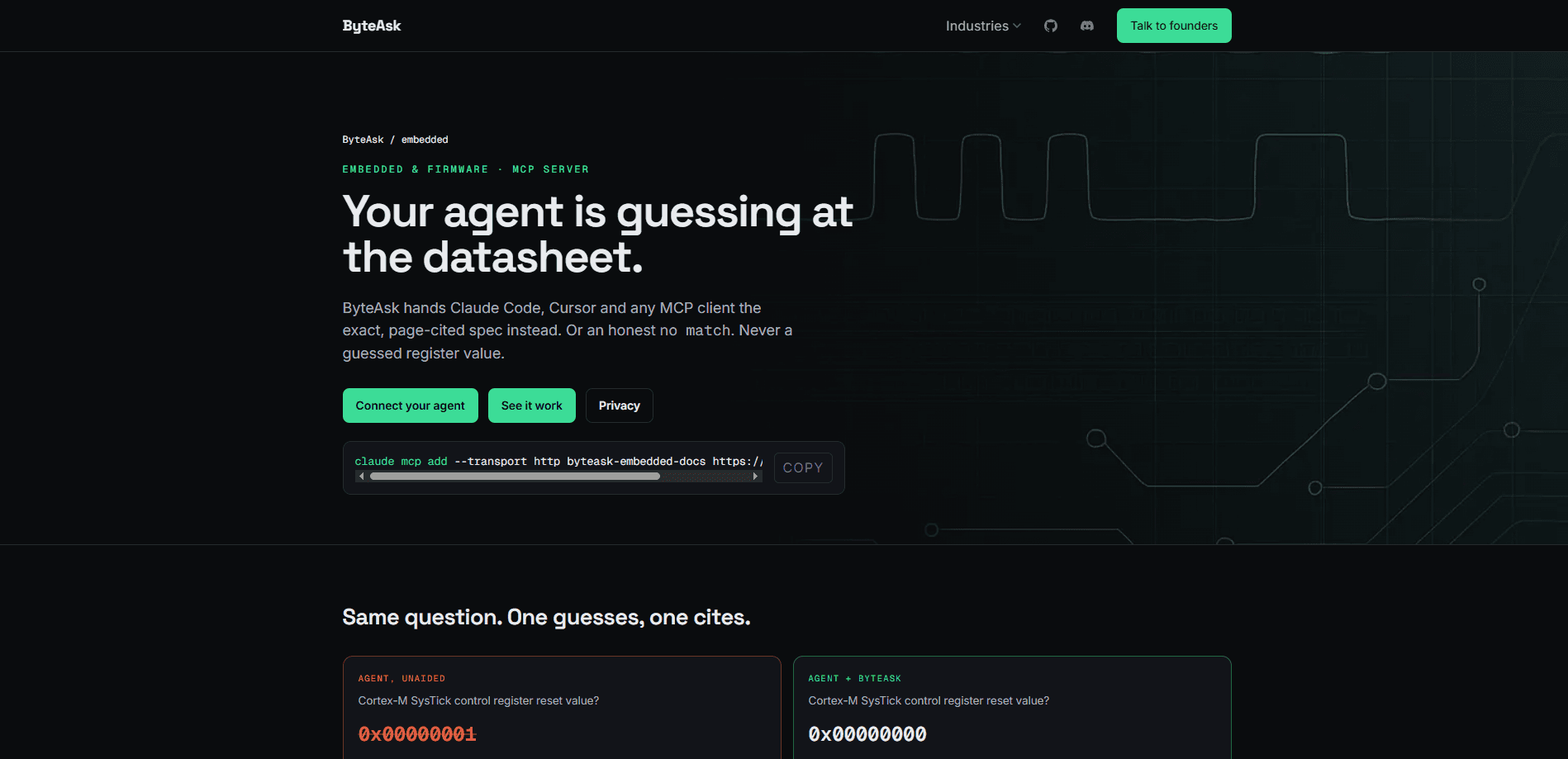
About ByteAsk Embedded MCP - Open Source
What Is ByteAsk Embedded MCP - Open Source
ByteAsk Embedded MCP - Open Source is a Model Context Protocol server that turns embedded reference documents into something a coding agent can query. Instead of loading entire datasheets into a context window, the agent asks a narrow question and gets back a verbatim excerpt with a citation, or an honest miss. It's aimed at the moment when a model invents a register address, a function code, or a threshold value that looks right but isn't. That's hardware hallucination, and it's costly.
The problem it targets is real and expensive. Language models are good at writing firmware-shaped code and bad at remembering which bit in which register enables which peripheral, and the gap between those two skills is where bugs and lost afternoons hide. A fabricated register value compiles fine and fails on hardware, often after a long debug cycle. Grounding the lookup in indexed source material removes most of that guesswork.
The honest limits matter here. Results only cover what's in the indexed corpora. If your specific part number or vendor document isn't indexed, you get "no match" and you're back to reading the PDF yourself. It also focuses on embedded and firmware references, so it won't help with, say, web API docs. The open-source edition is the piece ByteAsk publishes for developers who want to run the server themselves. That's the whole scope.
Getting Started
- Install an MCP-capable client if you don't have one. Claude Code, Codex, Cursor, and other MCP hosts all work.
- Get the server. The open-source edition is published by ByteAsk; grab the latest release or build the server from its source repository.
- Register the server in your client's MCP config so it launches as a local process or connects over the supported transport.
- Point the server at your reference corpora, or use the bundled embedded and firmware set that ships with it.
- Ask your agent a specific question, like the reset value of a status register, and check that the answer comes back with a citation.
Product Information
A quick look at ByteAsk Embedded MCP - Open Source's pricing, supported platforms, and performance.
Best for
The users, tasks, and scenarios where this tool fits best.
Users
- Firmware engineers
- Embedded developers on tight deadlines
- Developers burned by hallucinated hardware details
Tasks
- Checking register maps
- Looking up protocol function codes
- Confirming SCPI commands and thresholds
- Auditing an agent's output
Scenarios
- Debugging a peripheral that won't come up
- Writing a new driver from scratch
- Reviewing firmware a teammate wrote
- Working with a spreadsheet-style spec
Key features
Cited datasheet snippets
The server returns verbatim excerpts from indexed datasheets and specs, each tied back to its source page. That means an answer you get in the editor can be verified against the original document. No more guessing. For anyone who's been handed a confident but wrong register value, the citation is the whole value of the tool.
Explicit no-match responses
When a query doesn't match anything in the corpus, the server says so instead of filling the gap. Ever had a model invent a bit field? This is the antidote. This is a deliberate design choice, and it matters: a clean miss tells you to go read the source, while a hallucinated answer sends you down a wrong path. The miss is a feature, not a failure.
Works as an MCP server for Claude Code and more
Because it speaks the Model Context Protocol, this MCP server for Claude Code also fits Codex, Cursor, and other MCP hosts without custom glue. You configure it once per client and the agent can call it mid-task. That's the practical reason to use MCP here rather than a bespoke plugin. Setup takes a minute.
Embedded and firmware coverage
The indexed material focuses on register maps, protocol function codes, SCPI commands, standard thresholds, and datasheet specs. It's the dense, exact stuff that models tend to blur. The scope is narrow on purpose, and it covers the categories embedded developers actually query. Register maps. Function codes. Thresholds.
Open-source edition
This release is the open-source build, so you can inspect how it works, run it locally, and adapt the corpus to your own documents. For teams with proprietary parts, running it yourself avoids sending internal specs to a third party. The trade-off is that you own the setup and the indexing.
Local-first operation
The server runs alongside your client rather than as a hosted service you call over the internet. For firmware work, that keeps sensitive part data closer to home. It also means latency depends on your machine and the size of your corpus. That's the trade-off you accept.
Pros and cons
Pros
- Returns citations, so a register value can be traced back to its source page and verified against the original document before you commit it to a driver.
- Gives an explicit no-match instead of inventing a value when the corpus has nothing.
- Drops into Claude Code, Codex, and Cursor through standard MCP config.
- The open-source build lets you run it locally and index your own documents.
- Focused on the embedded data models blur most: register maps, function codes, thresholds.
Cons
- Answers only cover indexed corpora, so an unindexed part returns "no match" and no help.
- Scope is embedded and firmware references, so it's useless for web or app API docs.
- You handle setup and indexing yourself, which is real work for proprietary material.
- Pricing and hosted options beyond the open-source build aren't clearly published.
Frequently asked questions
It's an MCP server that answers embedded and firmware reference questions with cited snippets from indexed datasheets and specs. Your agent calls it mid-task and gets a source excerpt or an explicit no match.
Related content
Explore related tools, skills, and articles for ByteAsk Embedded MCP - Open Source.
ByteAsk Embedded MCP - Open Source Alternatives
Forefront
Forefront · CodingForefront is a web platform for building with open-source AI. It lets you fine-tune leading open-source language models on your own data, evaluate how they perform, and run them through an API or export them to host yourself. Developers who want the convenience of a closed-source platform but insist on owning their models and data are the target audience here.

Startkit
StartKit.AI · CodingStartkit is a boilerplate for building AI SaaS and AI wrapper products. Think of it as an AI startup boilerplate with the boring parts already wired up: authentication, Stripe and Lemon Squeezy payments, usage limits, transactional email, and an AI API starter that talks to OpenAI, Anthropic, Groq, or Llama. You clone the repo, set your price, and start on the part of your product that people actually pay for. It's Next.js under React and Tailwind, so most of the boilerplate code already feels familiar.
Testim
Tricentis · CodingTestim is an AI-powered test automation platform for building and running end-to-end tests across web, mobile, and Salesforce applications. It leans on machine learning to keep tests stable when an interface changes, so teams spend less time fixing broken selectors. Not bad for an automated testing tool you can start using today. You create tests by recording actions in a browser, then optionally add JavaScript when you need more control. It's a solid pick for busy QA teams.