

Byterat - Battery Data Platform
Byterat (now Ohm), San Francisco, Y Combinator backed · Coding · Business
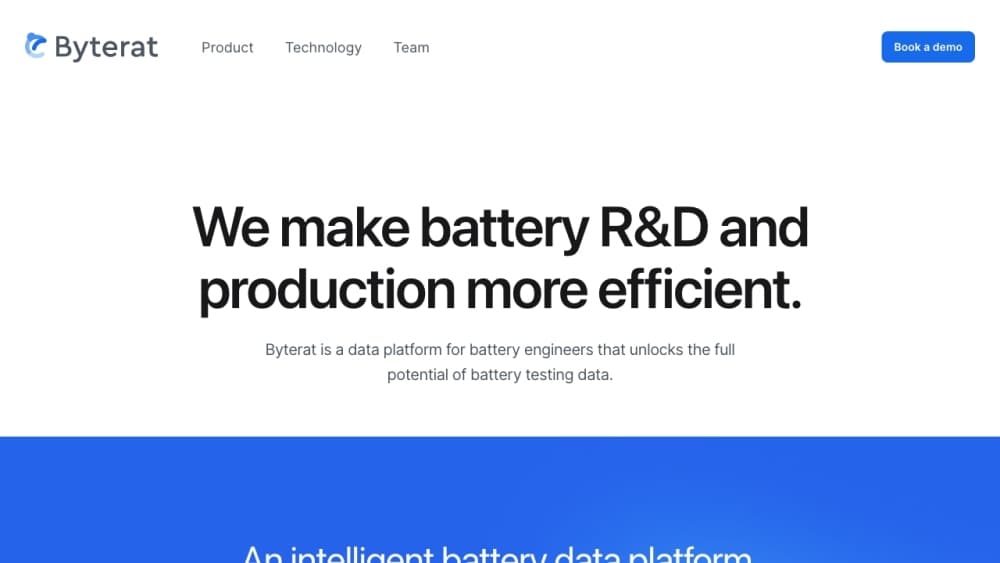
Byterat is a battery data platform that pulls cycler, test lab and spreadsheet data into one place, then runs AI-assisted analyses that shorten qualification work and speed up battery R&D decisions.
About Byterat - Battery Data Platform
What Is Byterat
Byterat is a battery data platform for teams that test cells, packs and materials. It collects files from cyclers and outside test houses, cleans them up, and puts every test on one searchable timeline. In May 2026 the company renamed the product Ohm and widened its scope to hardware engineering beyond batteries. The battery workflows described on this page still ship under that new name.
Battery R&D data management is the job it was built for. A normal lab runs two or three cycler brands, receives PDFs from an external test house, and keeps half its history in spreadsheets. Byterat normalizes all of it and attaches metadata, so an engineer can compare a new build against a control without writing a parser first. Buyers normally weigh it against older battery testing software from vendors like Voltaiq, Batalyse and Astrolabe, and the difference shows up after ingestion.
The catch is the sales model. There's no self-serve signup and no published price. A single engineer with one cycler is not the target buyer, and the evaluation takes weeks rather than minutes.
Getting Started
- Talk to the team and scope your test programs, cycler brands and data sources.
- Connect cyclers and external lab feeds so files sync automatically and metadata maps to your schemas.
- Invite engineers, then set roles and permissions for each program.
- Import a first build and define the metrics you care about, such as capacity fade or coulombic efficiency.
- Run an analysis or delegate it in plain language, then save the workflow as a template.
Product Information
A quick look at Byterat - Battery Data Platform's pricing, supported platforms, and performance.
Best for
The users, tasks, and scenarios where this tool fits best.
Users
- Battery test lab engineers
- Cell and materials researchers
- Engineering managers
- Qualification and reliability leads
Tasks
- Consolidating cycler data from several vendors
- Root cause work on failing cells
- Qualification reporting
- Test capacity planning
Scenarios
- A lab running mixed cycler brands
- Programs that depend on an external test house
- A team losing a senior engineer
Key features
Cycler Ingestion With Automatic Stitching
Byterat pulls data from the major cycler brands and from external test labs, including PDF and CSV drops. Multi-file sequences get stitched together automatically, which removes the step where someone renames files and hopes the channels line up. New formats are handled by the vendor rather than by your engineers, so a supplier software update doesn't turn into a two-week parsing project.
Quality Checks and Metadata Sync
Automated checks run as data lands, flagging format problems before they reach a downstream model. Metadata sync from your schemas keeps cell IDs, build numbers and test conditions attached to the right records. The practical effect is that cycler data analysis starts from clean input, and a bad import gets caught the same day instead of after a report goes out.
Natural Language Analysis With Inspectable Code
Engineers describe the question, for example comparing degradation trends across three formulations, and the platform decides what to pull, writes the analysis code, runs it, searches internal and published literature for context, then produces a report. Every line of generated code stays visible, including hyperparameters and statistical methods. That transparency is the difference between a tool a lab will trust and a black box it won't.
ML Playground and Anomaly Detection
Standard model types can be trained and deployed inside the platform without writing code, and models run inside live pipelines rather than in a notebook rerun. Anomaly detection watches for slope changes and performance deviations that sit outside expected noise. The payoff is early test termination: a program that costs $1 million a year recovers about $200,000 in capacity when average test duration drops 20%, according to the vendor's own estimate.
Control Room and Cross-Build Comparison
Live dashboards show what is running now, how each channel is being used, and where a build differs from its predecessor. Operational alerts cover the cases a lab would otherwise catch by walking the floor. As a battery analytics platform it goes past storage here, because the comparison view is the part engineers use during a review meeting rather than after it.
PyBaMM Runs and Reusable Workflows
Physics-based models run through native PyBaMM integration next to the experimental data, so simulation and measurement share one environment. Validated workflows can be saved as templates that execute on every new dataset, and the knowledge base keeps the reasoning behind each one. Most battery lab software stops at plotting; this is the layer that carries a method from one engineer to the next.
Pros and cons
Pros
- One dataset across cycler brands, external labs and spreadsheets, which kills the merge step that slows every campaign.
- Analysis delegation that returns inspectable code, so results can be checked instead of taken on faith.
- Predictive models sit in the ingestion pipeline, which makes early test termination a routine decision rather than a manual review.
- Unlimited named users on the platform, so a whole lab can look at the same data without per-seat math.
- Workflow templates and data lineage turn a senior engineer's method into something the team keeps.
Cons
- No published pricing and no self-serve path. You have to talk to sales, and a real evaluation takes weeks.
- There's no free tier, so a small lab can't test the workflow on one cycler before committing budget.
- The 2026 rename to Ohm splits the documentation trail. Search results, old links and internal notes still point at Byterat, which slows onboarding.
- It's enterprise software aimed at programs with real test volume. For a two-person team with one cycler, the setup work outweighs the gain.
Frequently asked questions
It stores and analyzes battery test data. Teams use it to ingest cycler files and lab reports, compare builds, detect anomalies and run repeatable analyses across a qualification program.
Related content
Explore related tools, skills, and articles for Byterat - Battery Data Platform.
Byterat - Battery Data Platform Alternatives

Base Code
Base44 (Wix) · Coding · ProductivityBase Code is a shared cloud development environment from Base44. Teammates describe changes to an existing GitHub codebase in chat, preview them live and send them back as pull requests.

Google EmbeddingGemma 2
Google DeepMind · Writing · Image · CodingGoogle EmbeddingGemma 2 is a 740M-parameter open model that turns text, code, images, audio, and video frames into vectors in one 768-dimension space, running on phones and laptops.

GitGlow
GitGlow · Coding · ProductivityGitGlow is a local-first desktop Git client that lets independent developers review their own code and their AI agents' changes in one place before shipping.