

Byword
Byword · Writing · Marketing
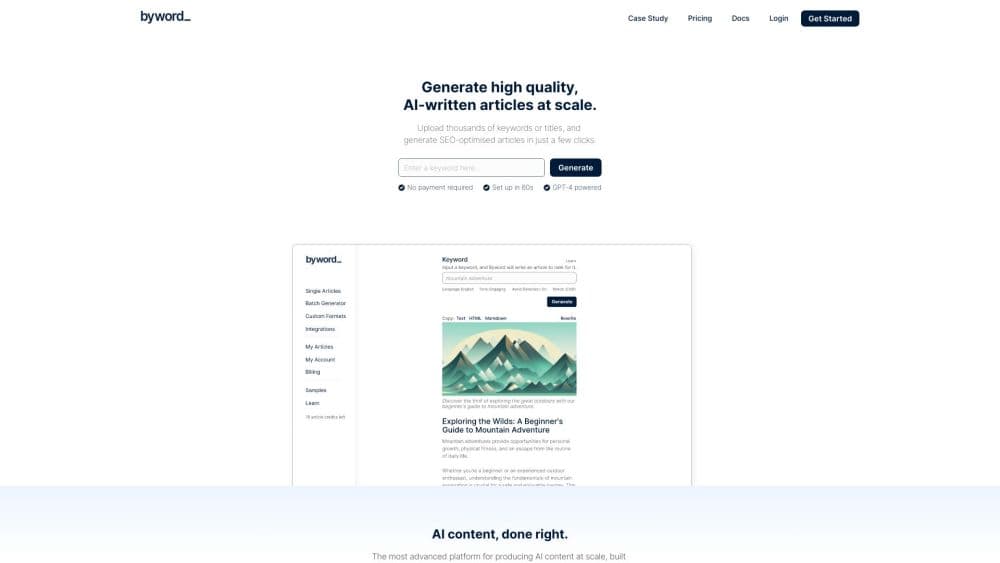
Byword is an AI article writer built for SEO teams. Enter a keyword and it researches the SERP, drafts a long-form post in your voice, then publishes to WordPress, Webflow, or another CMS.
About Byword
What Is Byword
Byword is a web platform that turns a keyword or a template into a publishable article. Mack Grenfell shipped the first version in November 2022 as a small service: you sent a topic and got an article by email. It has since grown into a full content workflow with keyword research, article settings per domain, brand voice matching, an editor, and publishing connections.
The product suits anyone running a repeatable SEO article generator workflow rather than writing one-offs: marketing teams, agencies, and publishers. Marketing teams need a steady publishing rhythm, agencies juggle several client sites at once, and founders building a content-led site need volume without hiring a writing staff. Byword keeps each domain's article preferences and CMS logins separate, so a single account can serve several sites.
Two limits matter before you buy. Plans are sold by monthly article credits, so a short campaign can sit on credits you have already paid for, although those credits carry over. And the drafts still need a human read: the software handles research and production, while facts, nuance, and editorial judgment stay with you. The company says so on its own about page.
Getting Started
- Sign up at byword.ai. Every new account gets five free articles with no card required.
- Add your website and set article preferences: voice, structure, and internal linking rules.
- Bring a topic, run the research dashboard to find keywords, or prepare a template with a dataset for repeated formats.
- Generate a draft, then open the editor to check facts and add your own expertise.
- Publish through a connected CMS such as WordPress or Webflow, or export the article into your existing workflow.
Product Information
A quick look at Byword's pricing, supported platforms, and performance.
Best for
The users, tasks, and scenarios where this tool fits best.
Users
- SEO and content agencies
- In-house marketing teams
- Founders and publishers building a content site
- Freelance SEO writers
Tasks
- Writing long-form guides from a keyword
- Producing comparison and listicle pages
- Refreshing existing content
- Publishing straight to a CMS
- Bulk article generation for a content calendar
Scenarios
- A programmatic SEO campaign
- A monthly client content pack
- A new site that needs depth fast
Key features
Research Before Writing
Every article can start from the research dashboard, which pulls live SERP data, ranks the top results, and shows the questions people ask around a term. The brief that comes out lists sources, signals, and a proposed outline, so the writing stage begins with evidence rather than a blank field. For teams that already know their keywords, research works as an optional add-on.
Voice Matching
You upload samples of existing content and Byword learns the patterns: sentence length, tone, and the words the brand uses and avoids. Once a site has its voice on file, every draft starts closer to what an editor would accept, which cuts the rewrite time. Voice matching is basic on the free plan and full on every paid plan.
Multi-Model Generation
Drafts can be produced by several frontier models, and the company lists GPT-5.4, Claude Opus 4.6, and Gemini 3.1 Pro among them. Each plan includes all the models, so the choice comes down to which one handles your topic best. Running the same brief through two models is a quick way to compare structure and tone before committing.
Programmatic Content With Templates
Templates combine a fixed structure with a dataset, so a spreadsheet of rows becomes a set of articles that share an outline but differ in detail. This is the feature behind thousands of pages from one setup, and it is why the agency and publisher cases fit. Build the template once, fill the data, then review the batch.
Optimization With Real-Time Scoring
While you edit, Byword scores the draft on keyword density, heading structure, readability, and internal links. The suggestions appear as you type, so fixes happen before the article leaves for review. It is a checklist rather than a guarantee: search performance depends on much more than on-page scores.
Publishing Connections and API
Finished articles go to WordPress, Webflow, Ghost, Shopify, HubSpot, Notion, Google Docs, Airtable, Medium, Slack, and Sheets, and webhooks cover the rest. API access ships with the Standard plan and above, which suits teams that want to trigger generation from their own tools. The Unlimited plan goes further by letting you connect your own Anthropic and Google keys.
Pros and cons
Pros
- Five free articles with no card, enough to test voice matching and output quality.
- Research, drafting, editing, and publishing sit in one place, with fewer handoffs.
- Per-domain settings make it workable for agencies with several clients.
- Templates plus datasets allow batches of hundreds of pages from one setup.
- API access from the Standard plan and full model choice on every paid plan.
Cons
- Plans are priced by article credits, and $99 a month for 25 articles is steep for a solo blogger.
- The cheapest plan is single user, so team work starts at the $299 Standard plan.
- Voice matching and templates only pay off after you invest setup time.
- Drafts still need fact checking and a human edit, especially on technical topics.
- SEO scores come from the platform itself and say nothing about actual rankings.
Frequently asked questions
Yes. Every new account gets five free articles without a credit card, which is enough to test the research tools, voice matching, and draft quality. After that you move to a paid plan, starting at $99 a month for 25 articles.
Related content
Explore related tools, skills, and articles for Byword.
Byword Alternatives

Google EmbeddingGemma 2
Google DeepMind · Writing · Image · CodingGoogle EmbeddingGemma 2 is a 740M-parameter open model that turns text, code, images, audio, and video frames into vectors in one 768-dimension space, running on phones and laptops.

MePersona
MePersona, Inc. · Writing · Productivity · MarketingMePersona is an AI unified inbox for creators. It learns your voice, drafts replies to fan messages from 12 platforms, and sends only what you approve.

Fluence
Yay Software (Yannick Huchard) · Writing · Voice & Language · ProductivityFluence is an Android app that reads PDFs, EPUBs, Word files and web articles aloud, follows each sentence as it speaks, and answers questions about the text on the phone itself.