

Callbook.ai
Callbook AI · Voice & Language · Marketing
Callbook.ai is an AI collections platform that calls, texts, and emails borrowers, negotiates payment plans, and writes each outcome back to your CRM.
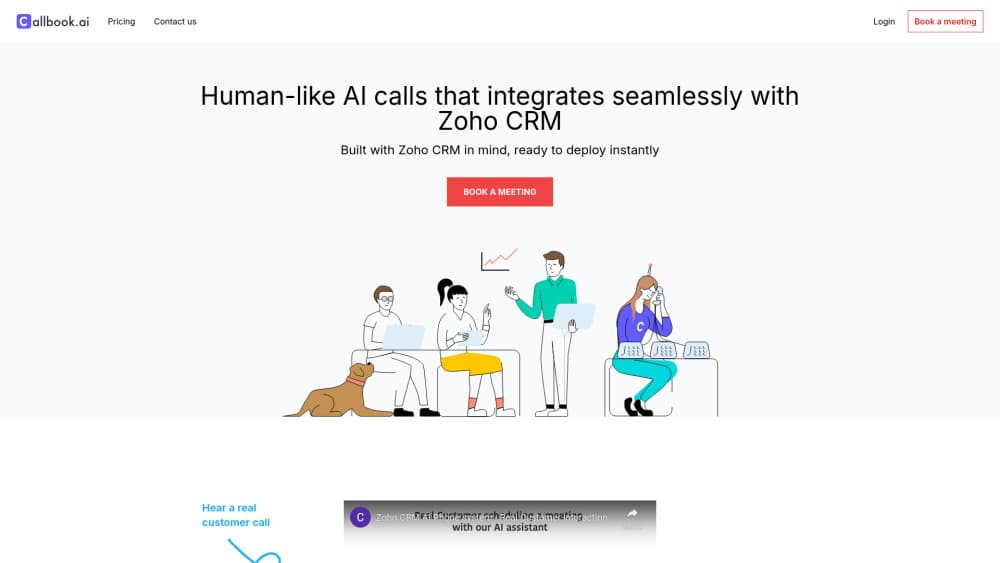
About Callbook.ai
What Is Callbook.ai
Callbook.ai is an AI debt collection software built for the boring, expensive part of recovery work: the first call, the second call, and the follow-up nobody has time for. Its agents talk to borrowers in natural speech, work through a payment conversation, and hand back a structured result.
The company describes itself as an AI collections agency. That framing matters. You are not buying a dialer with a script attached. You are renting a team of agents that keeps working a portfolio and remembers what happened on every account.
Callbook began as an AI calling layer for CRM users, and the CRM webhook still sits at the center of its API. Accounts, balances, and call outcomes move between the platform and the system your team already lives in, which is what makes a Zoho CRM integration practical rather than theoretical.
Getting Started
- Share your portfolio and your current playbook with the Callbook AI team during onboarding.
- Map the fields that matter in your CRM, so balances, promises to pay, and outcomes land in the right places.
- Approve the conversation design for each account segment, including what the agent can offer and when it must stop.
- Launch a pilot on one bucket of accounts, then compare recovery rates against your human team before scaling.
Product Information
A quick look at Callbook.ai's pricing, supported platforms, and performance.
Best for
The users, tasks, and scenarios where this tool fits best.
Users
- Collections managers at lenders and fintechs
- Small finance and subscription teams
- Recovery agency operators
Tasks
- First-contact outreach on newly delinquent accounts
- Payment plan negotiation
- Follow-up after a missed promise
Scenarios
- Early-stage delinquency, roughly the first month past due
- Inbound calls about a balance
- Accounts that dispute the amount
Key features
Voice, SMS, and email in one thread
Callbook.ai treats channels as one conversation instead of three campaigns. A borrower who ignores a call may answer a text ten minutes later, and that reply lands in the same history. Each AI voice agent picks up where the last message stopped, which cuts the repetition that makes people hang up.
Ability and willingness segmentation
Before outreach, every account gets sorted by ability to pay and willingness to pay. Two borrowers with the same balance get different treatment: one gets a firm reminder, another gets a plan offer. The platform also surfaces why people fall behind, whether that's a broken product, a hard-to-reach app, or a payment option that doesn't fit.
Negotiation that follows your rules
The agent works inside guardrails you define: how many installments, what discount is allowed, when a human must approve. It's a scripted negotiator in the good sense, because the limits come from your policy and the words come from the model. Every commitment is captured as a structured outcome rather than a free-text note.
Structured results back in your CRM
Call outcomes return as fields, not paragraphs. You choose where call data lands inside Zoho CRM, and the CRM integration can also trigger outbound AI calls from a workflow rule. Teams that already run on webhooks can push results into their own stack with the same payload.
Developer API for outbound AI calls
A REST API covers the operational loop: start a call with an assistant ID and customer context, receive webhooks with the outcome, and query analytics on volume, duration, and results. The request shape is small, so a first integration takes an afternoon rather than a sprint.
Security controls for regulated work
The platform is pitched at financial institutions, with controls around identity, access, encryption, logging, continuity, and vulnerability management. That matters for AI debt collection software, where a leaked call log is a compliance incident, not just a bad day.
Pros and cons
Pros
- Channel continuity is the real differentiator: call, SMS, and email stay on one account record instead of drifting into separate tools.
- Segmentation pushes effort toward accounts that will respond, which is where recovery rates actually move.
- CRM writeback is configurable, so promise-to-pay dates and outcomes land where your reports already look.
- A working REST API means outbound AI calls can be triggered from your own systems without a middleware project.
Cons
- No public price list. You have to book a call to learn what a portfolio will cost, which slows down budgeting.
- The product is built for collections, so using it as a general customer support agent means fighting the design.
- Segmentation is only as good as your account data. Messy balances or missing contact details weaken the whole chain.
Frequently asked questions
It contacts borrowers about overdue balances across voice, SMS, and email, negotiates payment arrangements, and returns the result to your CRM. The focus is recovery work, not general customer service.
Related content
Explore related tools, skills, and articles for Callbook.ai.
Callbook.ai Alternatives

Foley
Hanamori Labs, LLC · Voice & Language · Productivity · AI AssistantFoley is a voice to-do list that turns a spoken sentence into a filed task, complete with project, date and time, then helps you plan the day around what is already there.

HireKey
HireKey · Voice & Language · Productivity · LeaningHireKey is an AI job search copilot built by a former tech recruiter. It checks role fit, tailors resumes, runs interview practice and tracks every application.

Fluence
Yay Software (Yannick Huchard) · Writing · Voice & Language · ProductivityFluence is an Android app that reads PDFs, EPUBs, Word files and web articles aloud, follows each sentence as it speaks, and answers questions about the text on the phone itself.