

Calypso Copilot
Calypso · Business
Calypso Copilot is an AI research workspace for public equities, pairing live earnings data with source-cited company theses, 13F ownership and pick outcomes.
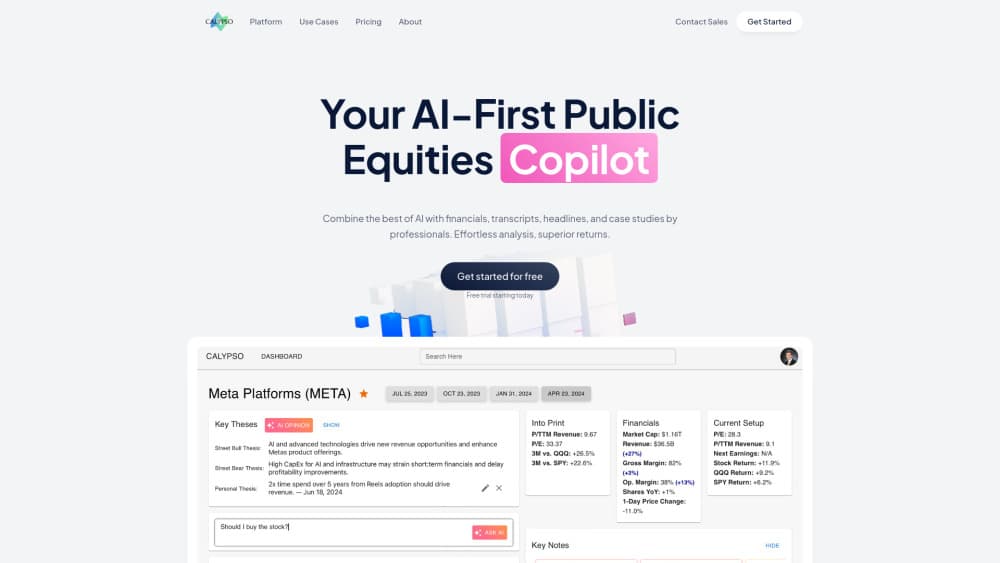
About Calypso Copilot
What Is Calypso Copilot
Calypso Copilot is an AI equity research workspace for people who study public companies and want the evidence attached. You pick a ticker and see the live tape, the earnings history, a bull case, a bear case, management's past promises, and reported fund positions in one place. Every claim links back to a transcript excerpt, a filing, or a financial data point.
The problem it targets is assembly time. Earnings analysis usually means jumping between a terminal, a transcript PDF, a spreadsheet, and a folder of screenshots. Calypso pulls those into a single company page and keeps the citation next to the sentence. It also tracks how a thesis changed between quarters, which is the part most research tools leave to memory.
Two limits matter. Coverage starts at more than 400 companies, so this is not a full-market screener. And the AI writes summaries and debates, not buy or sell calls. You still make the judgment. Form 13F ownership data also arrives late by regulation, so positioning views describe the past, not today.
Getting Started
- Open app.calypsocopilot.com and browse the live dashboard. No account is needed for the public pages, which cover the market tape, company pages, manager pages and 13F pages.
- Search for a ticker from the command bar, or start from the earnings calendar when a report is due. The company page loads price action, guidance, KPIs and cited Q&A together.
- Read the bull and bear theses side by side, then check what changed in the last quarter. Each delta points to the transcript passage behind it.
- Sign up for Professional when you want saved work and the full workflow. The plan costs $20 per month after a 14-day trial.
- Build a watchlist and return after each earnings call. The pick outcomes view keeps your original call next to the market move that followed.
Product Information
A quick look at Calypso Copilot's pricing, supported platforms, and performance.
Best for
The users, tasks, and scenarios where this tool fits best.
Users
- Individual investors who follow earnings closely
- Analysts at small funds without a terminal budget
- Portfolio managers who need a fast second opinion
- Finance students and writers
Tasks
- Earnings prep
- Thesis tracking
- Peer comparison
- Ownership checks
Scenarios
- The night before an earnings release
- A quarterly review with limited time
- Building a coverage list from scratch
Key features
Live Market Tape and Earnings Calendar
The tape records price action across your watchlist, including overnight moves, and ties each swing to the earnings event or cited news behind it. You see when a company reports, whether it lands before or after the close, and how the stock reacted. For anyone who trades around results, that removes the usual tab switching.
Source-Cited Company Research
Company pages combine guidance, KPIs, transcript excerpts and filing references. Answers link to the passage they came from, so you can check the wording yourself rather than trusting a summary. The reporting basis is dated and displayed, which matters when a figure gets restated.
Bull and Bear Thesis Tracking
Each company carries a bull thesis and a bear thesis, both broken into quarter-over-quarter changes. You see which claim accelerated, which stalled, and which piece of evidence moved. This is the closest thing in the product to a running argument, and it's more useful than a single verdict line.
Management History and Peer Read-Throughs
The management view puts prior commitments next to later results, so a promise from four quarters ago is easy to test. Cited commentary then links into relevant peers, which helps when one company's commentary says something about its suppliers or rivals.
Reported Positioning and Short Interest
A 13F view lists fund adds, cuts, exits and holder history for a security. Calypso states the reporting delay on the page, and short interest sits in its own section instead of being blended into the ownership numbers. Treat it as history, not a live position feed.
Pick Outcomes and Research Archive
Published earnings picks stay beside the original call and the market move that followed, so the record is visible rather than curated. The archive also holds earnings reports, sector roundups and guides, which is handy for checking how a thesis looked before the outcome was known.
Pros and cons
Pros
- Citations sit next to the claim, which cuts the time spent verifying a number or a quote.
- Thesis deltas by quarter make it obvious what changed after a report, a task most tools leave to spreadsheets.
- The free public dashboard covers the tape, company pages and 13F pages without an account.
- Professional costs $20 per month, well below terminal pricing, and includes a 14-day trial.
- Management history and peer read-throughs connect a single comment to a wider group of companies.
Cons
- Coverage of roughly 400 companies leaves out most small caps, so the tool can't be your only source for broad screening.
- Form 13F data is delayed by filing rules. The positioning view tells you what funds reported, not what they hold now.
- There is no public API or export path documented, which limits use inside an existing research stack.
- The product writes summaries and debates but gives no price targets or recommendations, so it won't replace your own valuation work.
Frequently asked questions
It covers live earnings and overnight price action, source-backed company research, management history, reported 13F positioning, short interest and published pick outcomes. Coverage runs to more than 400 companies, mostly larger names that report quarterly.
Related content
Explore related tools, skills, and articles for Calypso Copilot.
Calypso Copilot Alternatives

Knocket
Knocket (Tencent RTC team) · Productivity · Business · ChatbotKnocket is a free live chat and contact page tool that lets visitors message you from your website, app, or a shareable link, with every reply handled from Telegram or one inbox.

shippedit.me
Krawlup · Marketing · Businessshippedit.me now redirects to Krawlup, a web platform that audits SEO, AEO and page speed every week, then hands the fixes to AI coding agents over MCP.

Ayven
Alknoma · Productivity · BusinessAyven is an AI control centre by Alknoma that turns a plain-language goal into a dated plan, hands the work to your people and AI agents, and asks for your approval only when the call is yours.