

Camoleo
Camoleo · Coding
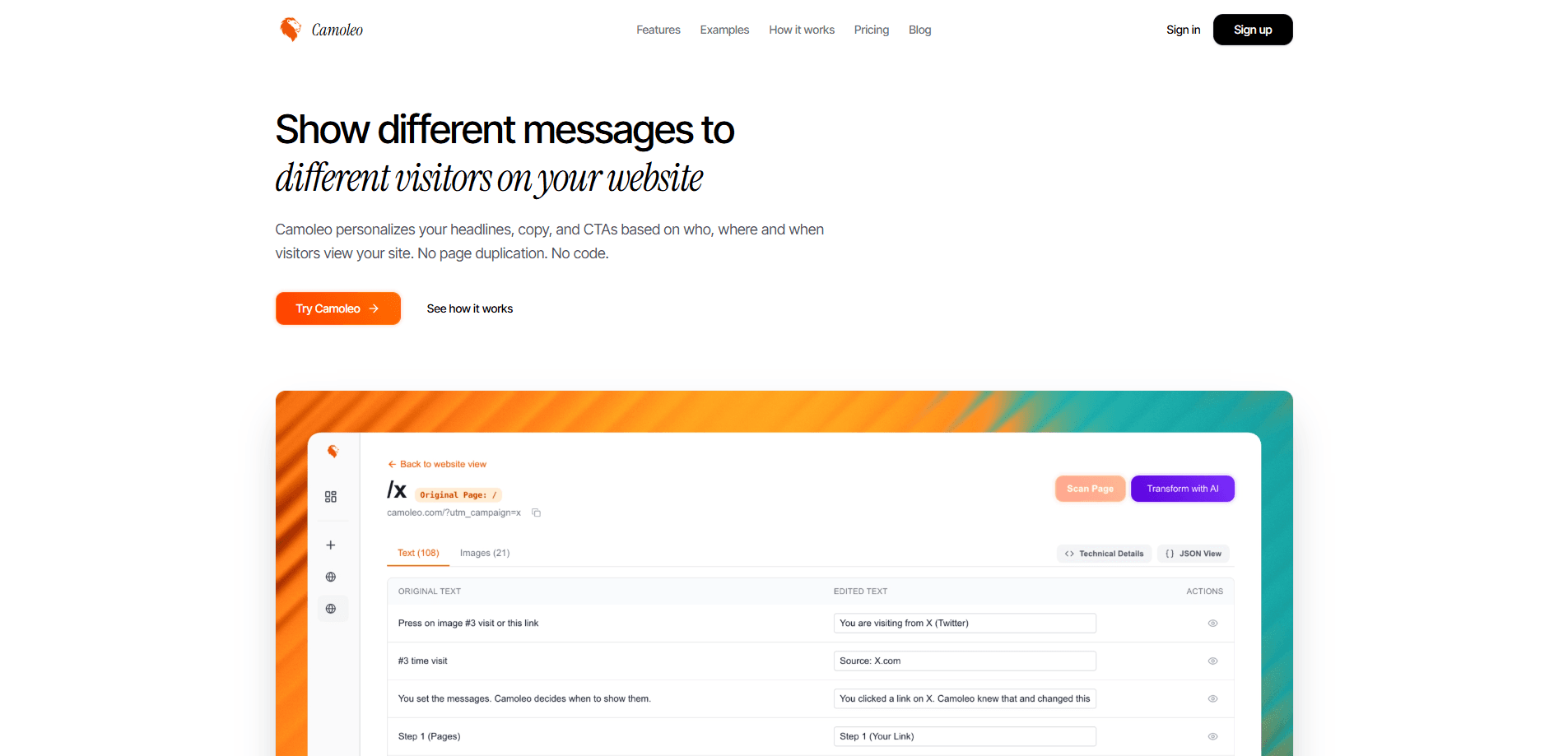
Camoleo is a website personalization platform that shows a different version of the same page to different visitors, based on where they came from. This is landing page personalization without the rebuild. Instead of building a separate page for every ad, campaign, or community, you write a few variations of your headline, body copy, and call to action, and Camoleo decides which one to display. It's no-code personalization for small teams that share one link in many places and keep watching the wrong audience bounce.
About Camoleo
What Is Camoleo
Camoleo is a web personalization platform for small marketing teams. The core promise is narrow and specific: same URL, different messages. A visitor arriving from a Reddit thread sees one headline, a visitor from a LinkedIn ad sees another, and a returning customer skips the intro altogether, all on the same page address.
Most small teams send every link to the same generic page. Your bio, your outreach email, and your ad all land on the homepage. The visitor expects one thing and gets another, so they leave. Camoleo targets that gap by matching the page to the context of the visit. It reads signals like UTM parameters, the referring site, and visit history, then swaps pieces of the page to fit. No redirects. No new URLs. No rebuild.
The obvious limit is depth. This isn't an enterprise experimentation suite with advanced statistics or complex audience segmentation. It's built for teams that want relevance without a developer in the loop. So who is it for? If your setup needs multi-variant testing with statistical significance or deep CRM integration, you'll likely bump into the ceiling fast. For a solo founder or a two-person growth team, that restraint is the point.
Getting Started
- Sign up for the free trial. No credit card is required, and the trial runs for 7 days.
- Point Camoleo at the page you want to personalize, or select it from your site.
- Open the visual editor and create variations. Change the heading, the call to action, or a paragraph of body text for each audience.
- Set the rules that decide when each variation shows. You can match on traffic source, campaign, or returning-visitor status.
- Publish and share your usual link. Camoleo picks the matching version and serves it automatically.
Product Information
A quick look at Camoleo's pricing, supported platforms, and performance.
Best for
The users, tasks, and scenarios where this tool fits best.
Users
- Small marketing teams
- Solo founders and indie makers
- Growth and demand-gen specialists
Tasks
- Matching landing page copy to an ad
- Skipping the intro for returning visitors
- Tailoring a single link for many communities
Scenarios
- Running a link-in-bio with several campaigns behind it
- Launching a new ad set without new pages
- Keeping SEO intact while personalizing
Key features
Same URL, No Redirects
Camoleo personalizes the page in place rather than pushing visitors to a different address. That means no new URLs to create, no redirect chains to maintain, and no disruption to the search rankings you've already earned. Your single shared link stays shareable while the content beneath it changes.
Source-Based Visitor Matching
The platform detects where a visitor came from and picks the right message for that context. It can key off UTM parameters, referrer data, or visit history, so someone from a specific campaign, community, or ad sees copy that matches how they arrived. That's visitor targeting without a developer. Matching the page to the source is what closes the gap between the ad and the thing it points at.
No-Code Visual Editor
You build and update variations in a visual editor rather than in code. Marketers edit headlines, paragraphs, and buttons directly, and the change goes live without a developer ticket. No engineering queue. For small teams without engineering slack, that's the difference between personalizing every campaign and personalizing none of them.
AI Copywriting
Camoleo can generate variations of your copy in seconds. If you need five versions of a call to action for five audiences, the built-in AI drafts them so you edit rather than start from a blank page. It's a speed feature first, not a replacement for judgment. You still decide what fits each audience. That part stays yours.
Returning Visitor Logic
Camoleo tracks visit history, so a page can treat a first-timer and a returning customer differently. Returning visitors can skip an introductory pitch and land on more direct content instead, which is one of the more practical uses here, since repeating the sales pitch to someone who already signed up wastes their time and yours.
Simple, Transparent Setup
Everything runs from a browser, and the free trial needs no credit card. There's no infrastructure to stand up and no code to embed beyond the initial page connection. The barrier to testing the idea on one page is a few minutes rather than a sprint.
Pros and cons
Pros
- Keeps a single URL and preserves SEO, so you personalize without creating redirects or duplicate pages.
- No-code visual editor means marketers ship changes without waiting on a developer.
- Source-based matching lines up your ad copy and landing page text automatically.
- Free 7-day trial with no credit card lowers the cost of finding out whether it fits.
- Returning-visitor logic lets you skip the intro for people who already know you.
Cons
- Pricing isn't published on the site, so you have to start a trial or contact the team to learn what a paid plan costs.
- It's built for small teams, so advanced experimentation features and deep analytics aren't the focus.
- There's no public API, which rules out programmatic workflows or custom integrations for now.
Frequently asked questions
Camoleo is a website personalization platform that shows different versions of the same page to different visitors. It swaps headlines, body copy, and calls to action based on where a visitor came from, without a developer touching the code.
Related content
Explore related tools, skills, and articles for Camoleo.
Camoleo Alternatives

Base Code
Base44 (Wix) · Coding · ProductivityBase Code is a shared cloud development environment from Base44. Teammates describe changes to an existing GitHub codebase in chat, preview them live and send them back as pull requests.

Google EmbeddingGemma 2
Google DeepMind · Writing · Image · CodingGoogle EmbeddingGemma 2 is a 740M-parameter open model that turns text, code, images, audio, and video frames into vectors in one 768-dimension space, running on phones and laptops.

GitGlow
GitGlow · Coding · ProductivityGitGlow is a local-first desktop Git client that lets independent developers review their own code and their AI agents' changes in one place before shipping.