

Canvass AI
Canvass AI · Other
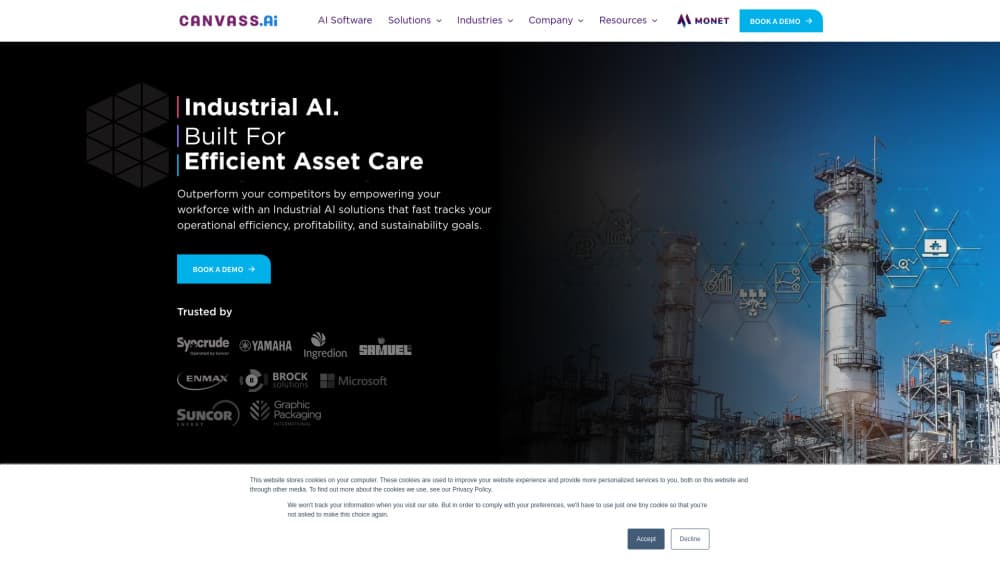
Canvass AI is a knowledge AI platform for industrial teams. It builds assistants that search engineering documents, specs, and compliance records, on-premise or in a private cloud.
About Canvass AI
What Is Canvass AI
Canvass AI turns the paperwork a plant or a hospital already owns into something people can ask questions about. Strip away the marketing and it's enterprise knowledge management with an industry filter on top. Engineering drawings, maintenance logs, supplier documents, SOPs, regulatory clauses: the platform indexes them, then serves answers through a chat assistant tuned for one industry at a time.
The pitch is narrower than a general chatbot. Manufacturing, healthcare, financial services, government, and oil and gas each get their own set of assistants, from a Maintenance Assistant to a Regulatory Clause Assistant. Those assistants read technical symbols, annotations, and spec tables that a generic model tends to mangle.
There's a catch worth stating early. Canvass AI sells to organizations, not individuals. There's no published price list, no self-serve signup, and no free trial you can start on your own. You book a demo and the rollout runs through your IT and security teams.
Getting Started
- Book a demo through the Canvass AI site and describe your document set, systems, and the roles that need answers.
- Pick a deployment model: on-premise, private data center, or a secure private cloud inside your own environment.
- Connect data sources, up to 100 or more enterprise tools, and let the platform build its index and knowledge graph.
- Choose the assistants that match your teams, then run a pilot with human review turned on.
- Expand to more departments once the answers hold up against your own subject matter experts.
Product Information
A quick look at Canvass AI's pricing, supported platforms, and performance.
Best for
The users, tasks, and scenarios where this tool fits best.
Users
- Industrial engineers and plant maintenance leads
- Compliance and quality managers in regulated sectors
- IT and security teams at large organizations
Tasks
- Engineering document search across drawings, P&IDs, and equipment manuals, including scanned pages and annotations.
- Maintenance troubleshooting that pulls the last three similar failures and their fixes from work orders and logbooks.
- Regulatory clause and SOP lookups where the assistant cites the paragraph instead of paraphrasing from memory.
- Supplier and RFP documentation review, matching submitted specs against internal requirements before a contract moves forward.
Scenarios
- A plant running twenty-year-old equipment where the knowledge sits in binders and the heads of two retiring engineers.
- An audit two weeks out and a quality team that needs every relevant clause and its supporting record in one place.
- A hospital or insurer that can't send patient or client records to a public model, so the AI has to live inside its own walls.
Key features
Industry-Tuned Assistants
Canvass ships separate sets of AI assistants for manufacturing, oil and gas, healthcare, financial services, and government. Each one is trained on the vocabulary and document shapes of its sector, including technical symbols and annotations on engineering drawings. You pick the set that matches your operation instead of prompt-engineering a generic chatbot into shape.
Knowledge Graph Plus Retrieval
Answers come from a combination of a knowledge graph and retrieval over your own documents. The platform keeps the full source document in context, not just a chunk, so an answer about a pressure rating can be checked against the page it came from. It also flags contradictions between systems, document types, and image versus text.
Human-in-the-Loop Validation
Canvass builds review into the loop. Subject matter experts approve or correct answers, and the platform tracks performance over time. The company says this is how it holds accuracy and keeps hallucinations out of production answers. In practice, your team carries some review load at the start.
Flexible Deployment
The same platform runs on-premise, in a private data center, or in a secure private cloud. Data stays under organizational control, and Canvass states that customer data isn't used to train language models without consent. For sectors where a public cloud is a non-starter, this is often the deciding feature.
Model-Agnostic Architecture
Underneath, the platform routes each task to whichever model fits, drawing on a catalog of more than 100 public and private language models. Fine-tuning on customer and domain data is supported. That means a document lookup and a reasoning-heavy query don't have to run on the same model.
Enterprise Data Integration
Canvass connects to 100 or more enterprise tools and data sources and handles structured and unstructured material: text, tables, images, video, and audio. Assistants can also take actions inside common business applications, with automatic execution or human approval set per agent. No onboarding sprint is promised, and real deployments still need data cleanup.
Pros and cons
Pros
- Deployment options cover on-premise and private cloud, which clears security review in sectors that ban public model access.
- Assistants are tuned per industry, so engineering symbols and spec tables are handled without custom prompt work.
- Answers cite full source documents and flag conflicting records, which makes them auditable rather than opaque.
- Model-agnostic routing across 100 or more language models keeps you from being locked to one vendor's model.
- Human review and performance tracking give quality teams a way to measure accuracy instead of trusting a demo.
Cons
- No public pricing and no self-serve tier, so a single engineer or a small shop can't evaluate it without a sales conversation.
- Rollouts lean on your IT and data teams for integration and cleanup, which pushes the first useful answer weeks out.
- Human-in-the-loop review is a strength and a cost: someone has to approve answers before the assistant is trusted.
- The published results, such as 30 to 50 percent faster turnaround, are vendor figures without a public methodology.
Frequently asked questions
It indexes an organization's technical and regulatory documents, then answers questions about them through assistants built for a specific industry. Typical use is finding a spec, a clause, or a past repair without opening a dozen files.
Related content
Explore related tools, skills, and articles for Canvass AI.
Canvass AI Alternatives
BinkBink
BinkBink · OtherBinkBink is a free online game platform and AI game maker that lets anyone turn a short text description into a playable browser game. You can jump into hundreds of community-made games. Or describe your own idea and play it in seconds, then share it with friends. Want to create your own game? You don't need to code. No engine setup, no download, no hassle.

Audiogen
Audiogen Inc. · OtherAudiogen is an AI music generator built by Audiogen Inc., a small research team that spent about 2.5 years training its own generative music model and designing a web interface around it. Instead of a plain text box, this AI music tool turns the timeline into a beginner-friendly Generative Audio Workstation, or GAW, where inpainting, extending, remixing and stem editing work more like painting on a canvas. The product is still in beta, so access runs through a waitlist or an invite. Paid plans aren't published yet.

Aiml API
AIMLAPI OÜ · OtherAiml API is a unified AI model API that puts more than 1000 models from OpenAI, Google, Anthropic, and others behind one endpoint and one bill. You write code against a single OpenAI-compatible schema, then switch between chat, image, video, and audio models by changing a model string. It suits developers and small teams who want multi-model access without juggling a dozen separate provider accounts, and it removes the usual billing headache that comes with testing several vendors. One key covers it all.