

Capacity
Capacity · Coding
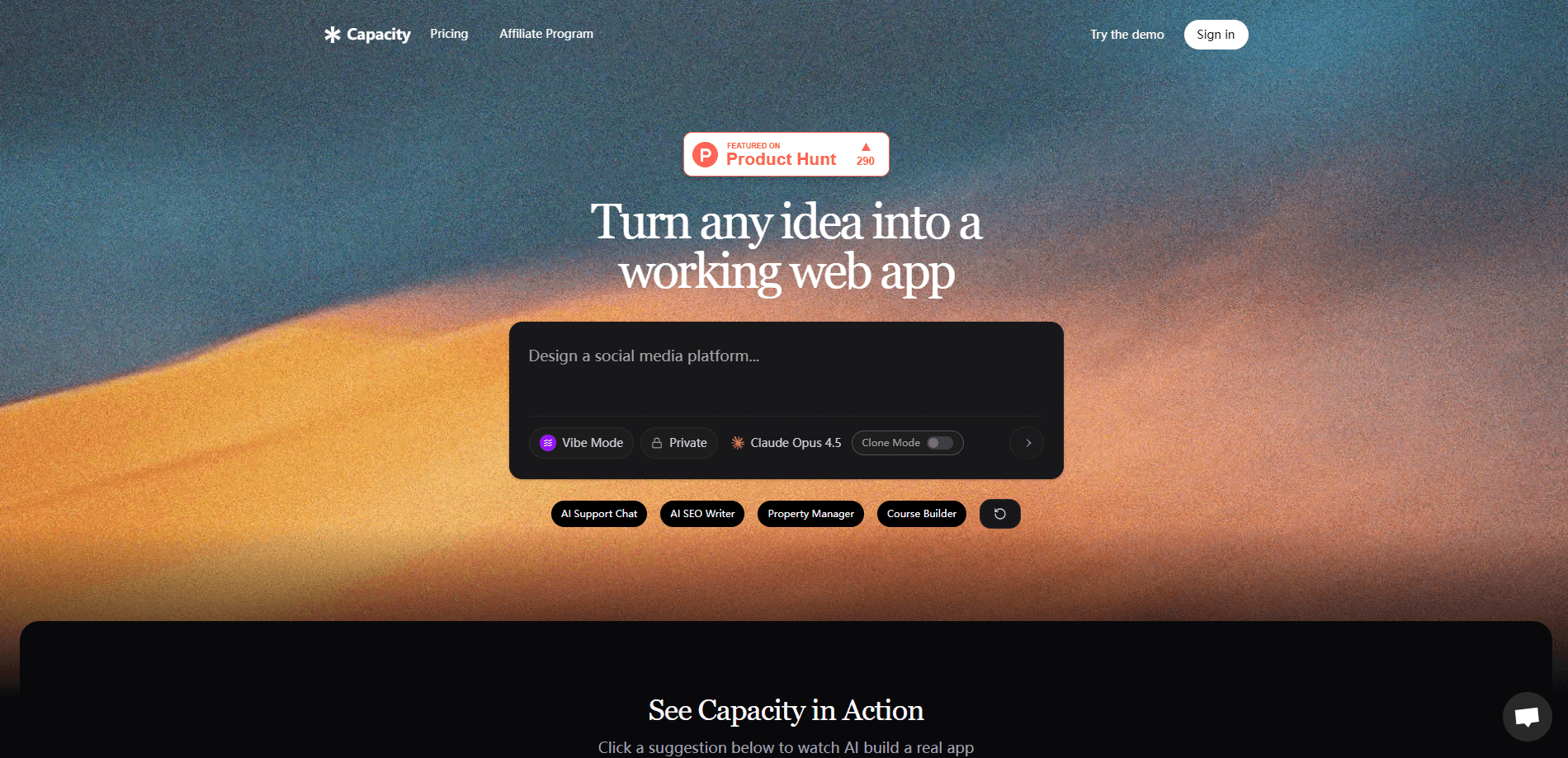
Capacity is an AI app builder that turns a plain-language description of your idea into a working full-stack web app. You explain what you want the way you'd explain it to a friend, the tool asks a few follow-up questions, and then it builds the app with real member accounts, logins, saved data, and payments. You never write or see code, and one click puts the finished app online with a shareable link.
About Capacity
What Is Capacity
Capacity is a no-code app builder built for people who have never written a line of code. The pitch is simple. If you can describe your idea, you can build it. Instead of dragging blocks around a canvas, you type a description and Capacity handles the technical side for you. For people who've only ever used prompt tools, this is closer to vibe coding without the guesswork, except it keeps a written plan behind every build.
The product leans on what its team calls a spec-first approach. This is spec-first development in practice. Rather than guessing what you meant, it asks a few smart questions about who'll use the app, what it's for, and how it should feel. Then it builds exactly what you agreed on. That extra step matters. Most prompt-based builders produce something close to your idea but not quite right.
The biggest limits are worth knowing up front. You build by spending credits, so heavy building or constant changes cost more. And while you own the code and can export it, the apps live on Capacity's hosting. You're not managing servers yourself. That's the trade.
Getting Started
- Sign up for a free account on capacity.so. No card is required to start.
- Describe your app idea in plain words, the way you'd explain it to a friend.
- Answer the follow-up questions about your audience, purpose, and the feel you want.
- Let Capacity build the app, then test it and tell it in normal language what to fix.
- Click publish to put your app online, and connect a custom domain if you want one.
Product Information
A quick look at Capacity's pricing, supported platforms, and performance.
Best for
The users, tasks, and scenarios where this tool fits best.
Users
- Founders without technical backgrounds
- Small businesses and solo operators
- Product managers and designers
Tasks
- Building a first MVP
- Creating apps with real logins and payments
- Fixing and editing existing apps
Scenarios
- Testing an idea before spending money on developers
- Building an internal tool for a small team
- Launching quickly on a deadline
Key features
Plain-Language Building
You describe your idea in your own words. No technical terms, no tutorials. Capacity turns that description into a real app you can see and try right away. The point is to remove the translation step where you usually have to explain your idea to a developer.
It Asks Before It Builds
Instead of guessing what you meant, Capacity asks a few smart questions first: what the app is for, who will use it, and how it should feel. Then it builds exactly what you agreed on. That spec-first habit is the main thing that sets it apart from builders that generate from a single prompt.
Real Apps, Not Demos
Your app can have member accounts, logins, saved information, and payments. That's everything a real product has. So you're not stuck with a pretty mockup that can't take a signup. The builds are meant to work as actual products from day one.
You Own What You Build
Your app, your data, and your members belong to you. Not to Capacity. Connect your own domain if you want one. And if you ever decide to leave, you can take everything with you, including the code a developer would need. The higher plan tiers add full codebase export, so there's no lock-in.
Fix Problems in Normal Language
When something breaks, you say what's wrong in plain words, like "the button doesn't work" or "this page looks off." Your AI collaborator finds the problem and fixes it, then explains what happened in normal language. It's available day and night, which helps when you're stuck outside working hours.
Design That Matches Your Brief
Clean, modern design comes standard, and your app works on phones, tablets, and computers. You can tell Capacity the style you're after, like "warm and friendly" or "serious and premium," and it matches it. If you don't like something, you say so. It changes.
Credit-Based Pricing
Paid plans use credits, and you spend them when you build or change things. Simple requests use fewer credits. Complex operations, like building features or debugging code, use more. Credits never expire, so you're not racing a monthly clock.
Pros and cons
Pros
- Lets non-coders build full-stack apps with real logins, data, and payments, not just landing pages.
- Asks clarifying questions before building, which cuts down on wrong guesses.
- You keep full ownership and can export the code, so there's no hard lock-in.
- One-click publishing and custom domain support make going live fast.
Cons
- Credit-based billing means heavy building or constant edits can add up quickly.
- Apps run on Capacity's hosting, so you don't control the servers yourself.
- The free tier is limited, and serious projects will need a paid plan.
Frequently asked questions
Capacity turns an idea into a working web app. You describe what you want in plain words, answer a few questions, and it builds the app and puts it online. You never write or see code.
Related content
Explore related tools, skills, and articles for Capacity.
Capacity Alternatives
Forefront
Forefront · CodingForefront is a web platform for building with open-source AI. It lets you fine-tune leading open-source language models on your own data, evaluate how they perform, and run them through an API or export them to host yourself. Developers who want the convenience of a closed-source platform but insist on owning their models and data are the target audience here.

Startkit
StartKit.AI · CodingStartkit is a boilerplate for building AI SaaS and AI wrapper products. Think of it as an AI startup boilerplate with the boring parts already wired up: authentication, Stripe and Lemon Squeezy payments, usage limits, transactional email, and an AI API starter that talks to OpenAI, Anthropic, Groq, or Llama. You clone the repo, set your price, and start on the part of your product that people actually pay for. It's Next.js under React and Tailwind, so most of the boilerplate code already feels familiar.
Testim
Tricentis · CodingTestim is an AI-powered test automation platform for building and running end-to-end tests across web, mobile, and Salesforce applications. It leans on machine learning to keep tests stable when an interface changes, so teams spend less time fixing broken selectors. Not bad for an automated testing tool you can start using today. You create tests by recording actions in a browser, then optionally add JavaScript when you need more control. It's a solid pick for busy QA teams.