

CapGo.AI
CAPGO PTE. LTD. · Coding · Productivity
CapGo.AI is an AI SEO and GEO platform. It turns a company's own data into thousands of indexable pages that rank on Google and get cited inside AI assistants like ChatGPT and Google AI.
About CapGo.AI
What Is CapGo.AI
CapGo.AI is a growth service and platform that helps AI and SaaS companies turn their own data into indexable web pages. Its core idea is coverage: instead of chasing a handful of keywords, it generates collection, comparison, and landing pages at scale so a product shows up across the full range of what buyers search for. The same pages are written to be quoted inside AI assistants, which is the work usually called GEO, short for generative engine optimization.
The company comes from CAPGO PTE. LTD., founded in Singapore in 2023 by Yichen Guo and Chen Yu. It raised about one million dollars from Iterative and Antler, and it serves clients across Asia-Pacific and the United States, including Baidu, SiliconFlow, MathGPT, BlueFocus, and FinalRound. CapGo describes results such as SiliconFlow growing Google traffic tenfold in six months.
The limits are worth knowing. Much of CapGo.AI is a managed service, not a self-serve tool, so onboarding involves a team. The spreadsheet product, CapGo Table, is the self-serve part, and it still assumes you have structured data to feed it. Results build over months rather than weeks, since indexing and AI citations take time.
Getting Started
- Book a demo through the CapGo.AI site and describe your product and the data you already hold.
- The team reviews your existing pages, your data sources, and the queries you want to cover.
- If you use the self-serve route, set up CapGo Table and connect your data, from the web or a database.
- Define a page template once, then let it generate collection, comparison, and landing pages at scale.
- Publish to your site through the supported connectors, then track indexing and AI citations over the following months.
Product Information
A quick look at CapGo.AI's pricing, supported platforms, and performance.
Best for
The users, tasks, and scenarios where this tool fits best.
Users
- Growth leads at AI and SaaS companies
- Marketing teams that already rank on Google but lose the answer inside AI assistants
- AI products with large volumes of user-generated output, such as images, videos, or songs
- Founders evaluating programmatic SEO
Tasks
- Building collection and comparison pages at scale
- Improving AI citations
- Auditing and fixing existing pages
- Turning user-generated content into pages
Scenarios
- A SaaS product with a large feature catalog
- An AI image or video tool with a growing library
- A team preparing for AI-driven search
Key features
Programmatic SEO at scale
The core capability generates thousands of unique pages from one template. You define a template once, connect a data source, and each row becomes a page, such as a collection, a comparison, or a landing page. CapGo markets this as the volume approach that category leaders use, and the point is coverage rather than a single high-ranking article.
GEO for AI assistants
GEO here means making a brand the answer inside ChatGPT, Google AI, and Bing, not only ranking on Google. CapGo.AI publishes original, citable first-party pages that AI models prefer to reference, then tracks the results through official search data. It sits alongside regular SEO rather than replacing it, since many buyers now start in an assistant, and AI search visibility is the metric buyers watch.
CapGo Table, the AI spreadsheet
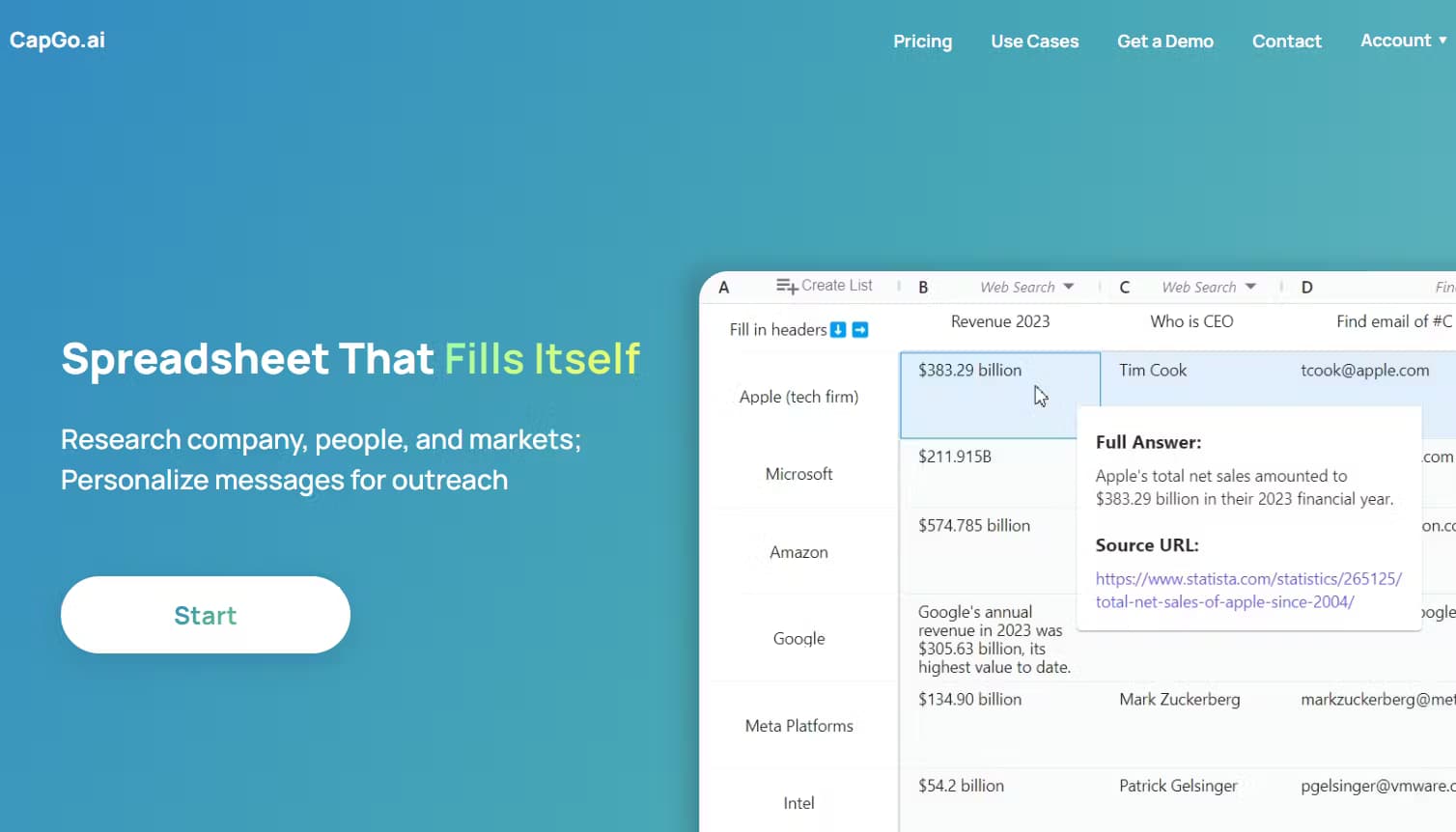
CapGo Table is the self-serve product. It works like a spreadsheet where every column is an action and every row scales, so a team can research, generate, refine, and publish pages from a familiar grid with no code. It can also pull live data from the web and from more than ten databases into the sheet before generating pages.
UGC SEO with LayerArc
LayerArc takes the AI images, videos, and other creations that a product's users generate and turns them into thousands of indexed pages. For AI products, this reuses content that already exists and gives it a second job as search and GEO material, which is a category many broad SEO tools do not address.
Publishing connectors
Generated pages need a home. CapGo.AI publishes to common site builders and CMS platforms, including Webflow, Framer, Shopify, and WordPress, so the output lands on your own domain rather than a third-party host. That keeps the SEO value with your brand.
Managed AI SEO service
Beyond the tool, CapGo.AI runs a managed service. A team uses AI to audit and improve existing pages, fixing structure, intent, and on-page signals at scale. CapGo positions itself as an SEO agency as much as a software vendor, and it suits companies that want the outcome without hiring and training an in-house SEO function.
Pros and cons
Pros
- Turns existing product data, reviews, and user content into indexed pages, so the work uses material a company already holds.
- Covers both Google ranking and AI citations in one service, which matters as more buyers start their research inside an assistant.
- CapGo Table lets a small team test programmatic SEO in a spreadsheet before paying for a managed engagement.
- Publishes to Webflow, Framer, Shopify, and WordPress, so pages live on your own domain and keep the SEO value.
Cons
- Core work is a managed service with a team involved, so it is not a quick self-serve setup for individual users.
- Custom pricing and no free plan mean you cannot judge the output on your own data without a sales conversation.
- Results build over months, since indexing and AI citations lag behind publication, so it is a poor fit for short campaigns.
- The value depends on having structured data to feed in, and a company with thin or messy data will get less from it.
Frequently asked questions
CapGo.AI turns a company's own data into indexable web pages that rank on Google and get cited by AI assistants. Companies use it for programmatic SEO, GEO, and for converting user-generated content into pages that drive traffic.
Related content
Explore related tools, skills, and articles for CapGo.AI.
CapGo.AI Alternatives

Base Code
Base44 (Wix) · Coding · ProductivityBase Code is a shared cloud development environment from Base44. Teammates describe changes to an existing GitHub codebase in chat, preview them live and send them back as pull requests.

Google EmbeddingGemma 2
Google DeepMind · Writing · Image · CodingGoogle EmbeddingGemma 2 is a 740M-parameter open model that turns text, code, images, audio, and video frames into vectors in one 768-dimension space, running on phones and laptops.

GitGlow
GitGlow · Coding · ProductivityGitGlow is a local-first desktop Git client that lets independent developers review their own code and their AI agents' changes in one place before shipping.