

CartAI
CartAI · Coding
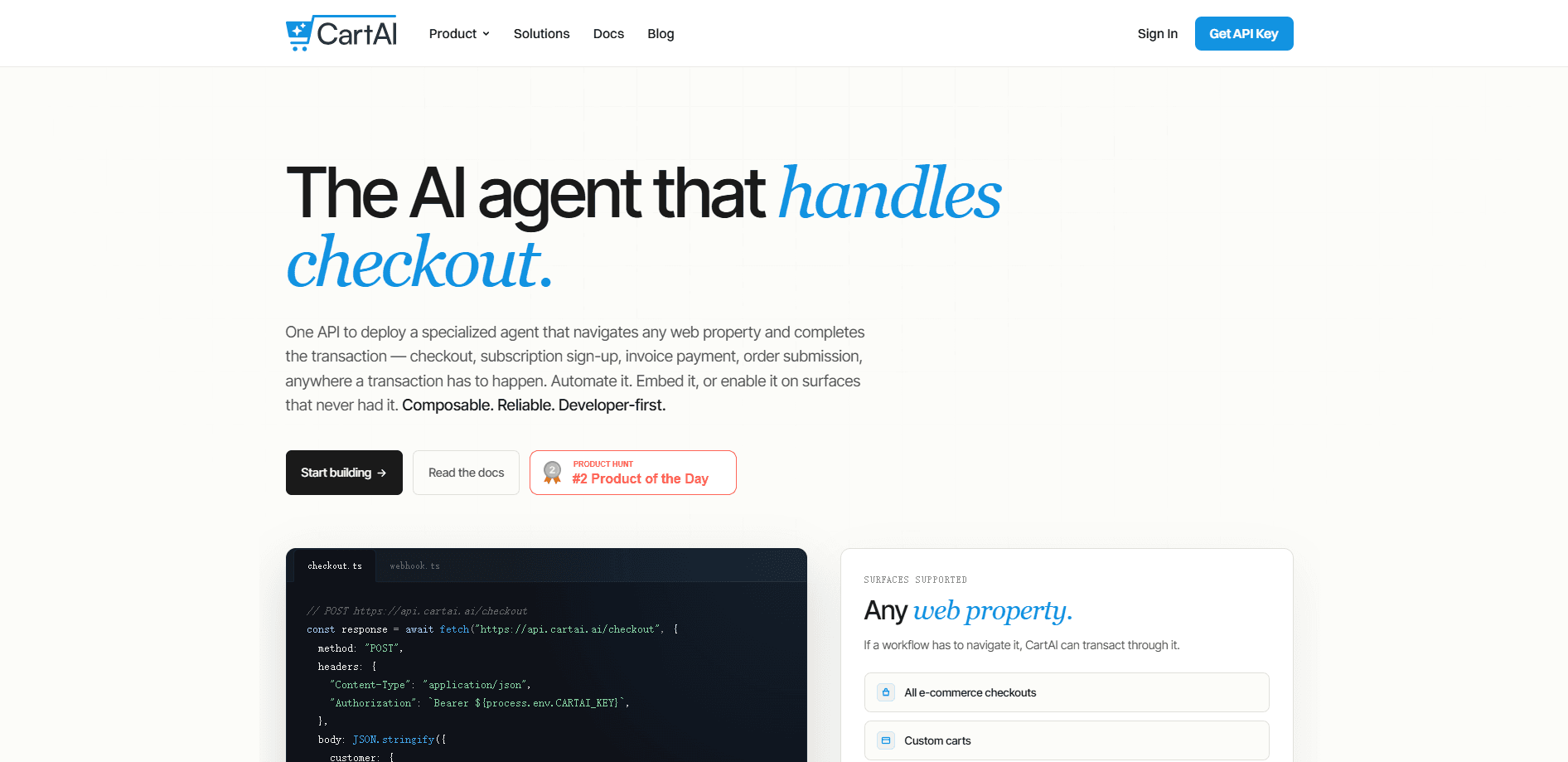
CartAI is a developer-first API that deploys a specialized agent to complete transactions on the web. You send it a target page and a task, and the agent navigates that page, fills the cart, and runs the checkout through a PCI-compliant payment stack. It handles e-commerce checkouts, subscription sign-ups, invoice payments, and order submissions wherever a transaction has to clear, whether that surface is a public store, a custom cart, or a login-gated vendor portal. Think of it as an AI agent for payments that also knows how to shop.
About CartAI
What Is CartAI
CartAI sits at the point where a browser automation API and agentic payments meet. Most web automation tools are built to roam the open web in general, and most payment rails are built to move money safely. Neither is built specifically for the workflow where a transaction has to actually go through, and that gap is what CartAI targets. According to the company, it fuses AI-driven browser execution with a payment stack into a single primitive, so you can program a checkout instead of manually clicking through one.
The product is aimed at developers. You call one endpoint, pass customer details, a target URL, and payment and shipping profiles, and the service runs the task asynchronously. You listen for a webhook when it finishes. That async design fits order pipelines, back-office tooling, and any system that needs to place a transaction without a human at the keyboard.
Its main limitation is scope by design. CartAI isn't a general-purpose agent for research, scraping, or form-filling. It's built for transactions, and it expects you to already know what you want bought and where. The company also describes cooperative bot-mitigation work, which matters because many checkout pages actively resist automated traffic. If a target site blocks bots hard, results can vary.
Getting Started
- Sign up at portal.cartai.ai and generate an API key, then store it as an environment variable such as CARTAI_KEY.
- Point requests at the checkout endpoint and pass your customer object with an email and name.
- Add a task with the target product URL, plus variant, shipping, and payment profiles for the purchase.
- Run in sandbox mode first to validate the flow without moving real money.
- Listen for the webhook callback to confirm the task completed and read back its status.
Product Information
A quick look at CartAI's pricing, supported platforms, and performance.
Best for
The users, tasks, and scenarios where this tool fits best.
Users
- Developers building checkout flows
- Teams automating back-office orders
- Product engineers adding agentic commerce
Tasks
- Completing an e-commerce checkout
- Signing up for a subscription
- Paying an invoice or submitting an order
Scenarios
- Placing routine reorders on a public store without a person clicking through
- Onboarding a customer into a paid plan as part of an app's flow
- Handling vendor or intranet purchase forms that are hidden behind a login
Key features
One API to Deploy a Checkout Agent
This is the core of what makes an AI checkout agent click. CartAI gives you a single endpoint that accepts customer details, a task list, and payment and shipping profiles. You describe what to buy, not how to click, and the service handles the navigation and the transaction. This keeps the integration small, so you spend time on your product rather than on brittle selectors.
Works Across Any Web Property
The agent is built to transact through public e-commerce checkouts, custom carts, intranet and vendor portals, and login-gated workflows. That breadth is the point. If a workflow has to navigate a page, CartAI is meant to handle the transaction through it. You aren't limited to stores it has a prebuilt connector for.
PCI-Compliant Payment Stack
Payments run through a compliant stack according to the vendor, which is the part most teams can't build in-house without real cost and risk. You supply payment profiles, and the stack handles the sensitive side of the exchange. For teams that need to touch money, this removes a heavy compliance burden.
Asynchronous Execution with Webhooks
Tasks queue and run in the background. The call returns a task ID and a status of queued, and your system listens on a webhook for completion. This suits order pipelines that shouldn't block on a slow checkout, and it maps cleanly onto event-driven back ends.
Sandbox Mode for Safe Testing
A sandbox flag lets you rehearse a full task without moving real money. You can build and test the whole flow, catch mistakes early, and only flip to live payments when you're confident. Any team touching payments will value that buffer.
Cooperative Bot-Mitigation
Checkout pages often fight automated traffic, which is where most naive checkout automation breaks. CartAI describes a cooperative approach to bot-mitigation, and that's what lets the agent get through pages that would otherwise block it. It's the difference between a demo that works once and a flow you can run on a schedule.
Pros and cons
Pros
- Solves a narrow problem well: transactions that have to clear, not generic browsing.
- Single-endpoint design keeps integration small and readable.
- Handles sensitive payment work through a compliant stack, cutting build cost.
- Works beyond standard stores, including custom carts and login-gated portals.
- Async execution with webhooks fits real order pipelines.
Cons
- No free plan, and pricing isn't published, so you have to contact the vendor before you can budget.
- Deliberately narrow scope means it's the wrong tool for scraping or research tasks.
- Because it automates live checkouts, performance depends on how aggressively target sites block bots.
Frequently asked questions
It deploys an AI agent that navigates a web page and completes a transaction, such as an order, a subscription sign-up, an invoice payment, or an order submission. You call one API, and it handles the browsing and the payment.
Related content
Explore related tools, skills, and articles for CartAI.
CartAI Alternatives
Forefront
Forefront · CodingForefront is a web platform for building with open-source AI. It lets you fine-tune leading open-source language models on your own data, evaluate how they perform, and run them through an API or export them to host yourself. Developers who want the convenience of a closed-source platform but insist on owning their models and data are the target audience here.

Startkit
StartKit.AI · CodingStartkit is a boilerplate for building AI SaaS and AI wrapper products. Think of it as an AI startup boilerplate with the boring parts already wired up: authentication, Stripe and Lemon Squeezy payments, usage limits, transactional email, and an AI API starter that talks to OpenAI, Anthropic, Groq, or Llama. You clone the repo, set your price, and start on the part of your product that people actually pay for. It's Next.js under React and Tailwind, so most of the boilerplate code already feels familiar.
Testim
Tricentis · CodingTestim is an AI-powered test automation platform for building and running end-to-end tests across web, mobile, and Salesforce applications. It leans on machine learning to keep tests stable when an interface changes, so teams spend less time fixing broken selectors. Not bad for an automated testing tool you can start using today. You create tests by recording actions in a browser, then optionally add JavaScript when you need more control. It's a solid pick for busy QA teams.