

Cencurity
Cencurity · Other
Cencurity is a security gateway that sits between your AI agents and the models they call. It acts as an LLM proxy, inspecting prompts and responses in real time, and it can mask, redact, or block sensitive data before it ever reaches a model or a user. This is AI data loss prevention aimed at the prompt layer, not just the network edge. The idea is simple. You keep building with any agent or IDE you already use, and Cencurity watches the pipe for secrets, personal data, and risky code patterns while keeping an audit trail you can hand to a security team.
About Cencurity
What Is Cencurity
Cencurity is an AI security gateway built for teams that ship with large language models but don't want their code, credentials, or customer data leaking through prompts. It works as a proxy layer. Your agents and IDE tools connect to it instead of talking to providers directly, and every request passes through detection rules that look for secrets, personally identifiable information, and unsafe output. The goal is prompt leakage protection without asking every developer to change how they work.
The product targets the gap most companies hit once AI moves out of a sandbox. Someone pastes an API key into a chat. An agent echoes back a customer record. A coding assistant suggests a snippet with a hardcoded token. Cencurity's pitch is that you catch those moments at the edge, in real time, rather than in a post-incident review weeks later.
Two limits are worth knowing up front. First, it's sold as an enterprise-grade gateway, so the site is oriented toward demos and rollouts rather than a self-serve free tier. Second, adding a proxy means one more hop in your AI traffic, so teams need to weigh latency and setup effort against the protection. You also need to route traffic through it, which is the whole point but does mean a change to how your tools connect.
Getting Started
- Request a demo through the official site to get access and discuss your rollout.
- Connect your existing agents, IDEs, and model providers to the Cencurity gateway. The company says one integration works across models, tools, and environments without rewriting your setup.
- Configure detection policies for secrets, PII, and risky output, and decide what should be masked, redacted, or blocked.
- Run in dry-run mode first to measure how many requests trip your policies before you enforce anything.
- Turn on enforcement, wire up webhook alerts to Slack or Jira, and review the dashboard and logs as traffic flows.
Product Information
A quick look at Cencurity's pricing, supported platforms, and performance.
Best for
The users, tasks, and scenarios where this tool fits best.
Users
- Security and platform engineers
- Engineering teams at companies
- Compliance and risk staff
Tasks
- Blocking secret leakage
- Redacting personal data
- Monitoring agent activity
Scenarios
- Rolling AI tools out across a company
- Investigating a suspected leak
- Preparing for an audit
Key features
LLM Proxy and Redaction
Cencurity proxies your LLM traffic and automatically redacts sensitive data as it passes through. That means the gateway sees every prompt and response, so sensitive data masking happens on the wire rather than relying on each app to scrub its own input. For teams, this removes the need to touch every codebase that talks to a model.
Real-Time Leak Prevention
The gateway detects and blocks secrets, PII, and risky output at the edge, before that content reaches users or models. If a coding assistant is about to emit a hardcoded credential, or an agent is about to echo customer data back, the block happens at the point of egress. This is the core promise. Stop leakage in the moment, not after the fact.
Centralized Security Dashboard
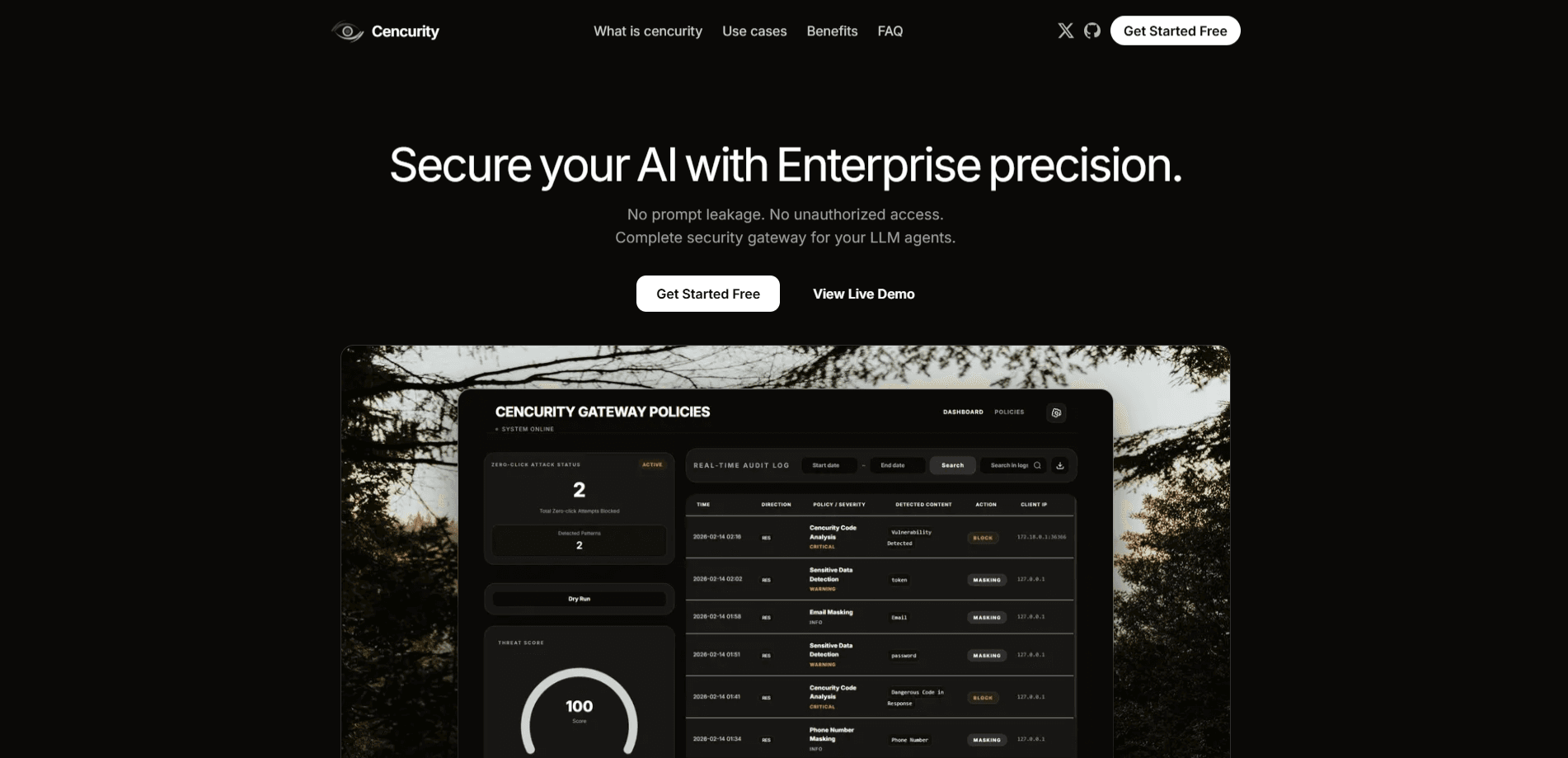
One dashboard shows every agent call: requests, responses, latency, policy hits, redactions, and blocks, all in real time. Instead of stitching together provider logs, you get a single view of what your AI estate is doing. That matters when something looks off and you need to see it fast. No more guessing.
Real-Time Log Analysis
Every interaction is traceable end to end. You can search, filter, and correlate requests, responses, and policy decisions to track down risk in seconds. Why does that matter? Triage speed. When an alert fires, you know which call triggered it and what the model was asked to do.
Policy-First Detection with Dry-Run Rollout
You define what counts as a violation, and the gateway prioritizes what matters. Dry-run mode lets you measure how many requests would trip a policy before you turn enforcement on, which is how you avoid breaking a working workflow on day one. Then you roll out enforcement without guesswork. That staged path is the whole point.
Webhook Notifications
Verified alerts can be pushed to Slack, Jira, and other tools you already use. Routing warnings into your existing channels means your team sees them where it already works, rather than in yet another console nobody checks.
Enterprise Rollout Support
The gateway comes with a rollout process around it, not just a login. Dry-run measurement, policy tuning, and webhook wiring are treated as part of deployment. It's a poor fit if you wanted to sign up and go in ten minutes. It's a decent fit if security review and staged enforcement are already how your org ships.
Pros and cons
Pros
- Works with agents and IDEs you already use, so setup doesn't require rebuilding your AI workflows.
- Detection and redaction happen in real time at the edge, catching leaks before they reach a model or a user.
- Dry-run mode lets a team measure policy impact before enforcing anything.
- Audit-ready logs give security and compliance teams concrete evidence instead of vague summaries.
Cons
- No public pricing or free plan, so you have to talk to sales before you can judge cost, which slows down evaluation.
- Routing traffic through a proxy adds a hop, and the impact on latency isn't something you can verify without a trial.
Frequently asked questions
It's a security gateway that proxies your LLM and agent traffic, inspects it for secrets, personal data, and risky output, and then masks, redacts, or blocks what breaks your rules. It also keeps logs of every request and response for audits.
Related content
Explore related tools, skills, and articles for Cencurity.
Cencurity Alternatives
BinkBink
BinkBink · OtherBinkBink is a free online game platform and AI game maker that lets anyone turn a short text description into a playable browser game. You can jump into hundreds of community-made games. Or describe your own idea and play it in seconds, then share it with friends. Want to create your own game? You don't need to code. No engine setup, no download, no hassle.

Audiogen
Audiogen Inc. · OtherAudiogen is an AI music generator built by Audiogen Inc., a small research team that spent about 2.5 years training its own generative music model and designing a web interface around it. Instead of a plain text box, this AI music tool turns the timeline into a beginner-friendly Generative Audio Workstation, or GAW, where inpainting, extending, remixing and stem editing work more like painting on a canvas. The product is still in beta, so access runs through a waitlist or an invite. Paid plans aren't published yet.

Aiml API
AIMLAPI OÜ · OtherAiml API is a unified AI model API that puts more than 1000 models from OpenAI, Google, Anthropic, and others behind one endpoint and one bill. You write code against a single OpenAI-compatible schema, then switch between chat, image, video, and audio models by changing a model string. It suits developers and small teams who want multi-model access without juggling a dozen separate provider accounts, and it removes the usual billing headache that comes with testing several vendors. One key covers it all.