
ChatBees
ChatBees · Marketing
ChatBees is a serverless platform for AI customer support that trains private AI on your knowledge base, then resolves support tickets, answers chat, and searches enterprise documents.
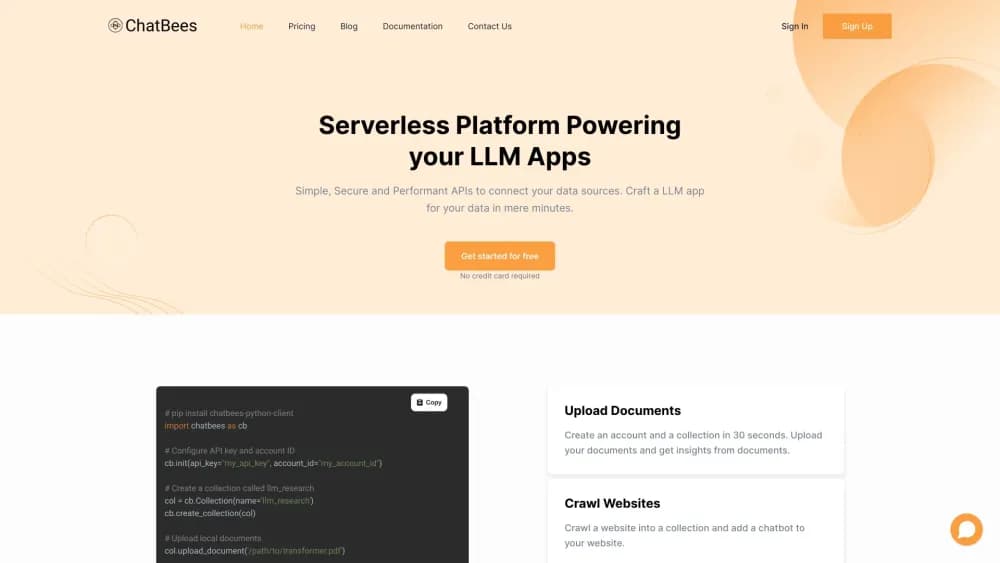
About ChatBees
What Is ChatBees
ChatBees is a web platform and API from the team behind chatbees.ai. It takes your company's own documents, help center pages, and historical support tickets, turns them into a private knowledge base, and lets that AI answer questions and draft resolutions. The target is support teams and developers who already have a pile of documents and want answers pulled from them without building a retrieval pipeline by hand.
The product runs as RAG as a service, and it also ships an AI chat for Confluence app. You pick a data source like Notion, Confluence, Google Drive, or a website, ChatBees crawls it, parses the files, builds a vector index, and keeps it current on a schedule you set. From there you get three main surfaces: a ticket agent that suggests resolutions inside HubSpot, chat bots for your website, Slack, and Discord, and an API that answers, summarizes, and searches the same collection.
The main limits are practical. The bot answers only as well as the source documents behind it, so messy or missing docs lead to thin answers. The HubSpot copilot was in early trial and required contacting the team to join, and enterprise features like SSO and role-based access sit behind the Enterprise tier.
Getting Started
- Sign up for a free trial, then create a collection, which is the container that holds one knowledge set.
- Upload files as PDF, Markdown, or CSV, or connect a data source like Confluence, Google Drive, or Notion and let ChatBees ingest it.
- Answer questions, chat, summarize, or run semantic search over the collection to check the answers before you publish.
- Publish the collection to a website chat bot, a Slack bot, or a Discord bot, or call the same collection from your own code.
- Connect HubSpot so the AI ticket agent drafts a suggested resolution whenever a new ticket arrives.
Product Information
A quick look at ChatBees's pricing, supported platforms, and performance.
Best for
The users, tasks, and scenarios where this tool fits best.
Users
- Support teams buried in tickets
- Customer experience managers
- Developers building LLM apps
Tasks
- Drafting ticket resolutions
- Answering employee questions privately
- Searching enterprise knowledge
Scenarios
- Cutting first-response time on a busy queue
- Standing up a support chat bot fast
- Prototyping an internal RAG app
Key features
AI Ticket Agent for HubSpot
This feature watches HubSpot and reacts the moment a new ticket arrives. It reads the ticket, draws on historical tickets and your knowledge base, and writes a suggested resolution for the agent. The agent can accept it, adjust it, or ask the copilot to expand on a tricky case. The point is speed and consistency: every rep starts from the same reference answer rather than a blank reply box.
Private AI Trained on Your Knowledge Base
ChatBees builds a private model from your own material, not the open web. You feed it PDFs and docs, a web help center, Notion, Confluence, or Google Drive, and it periodically re-ingests the sources to keep answers current. The company states that your data stays private and is never used to train a shared LLM, which is the reason many teams pick it over a general chatbot.
RAG as a Service API
This serverless platform exposes the whole retrieval pipeline through simple APIs. You create a collection, upload files or crawl a data source, then call ask, chat, summarize, or semantic search against it. A Python client and plain REST endpoints are both supported, so you can build a question-answering app in a few steps without managing a vector database or index yourself.
Website, Slack, and Discord Chat Bots
You can publish a collection as a chat bot on your website, in Slack, or in Discord with no coding. Each bot answers from the collection it is tied to, so an internal Slack bot speaks from internal docs while a public website bot uses customer-facing pages. A Slack bot can also answer an employee's question privately, which keeps routine questions out of group channels.
Enterprise Search Engine
The search engine runs across an organization's scattered knowledge: Confluence, Google Drive, Notion, and more. Instead of guessing which tool holds the answer, a user asks once and gets the matching page plus a short answer. For teams whose knowledge lives in many places, this replaces the usual tab-hopping with a single query box.
Security and Access Control
ChatBees handles crawling, parsing, indexing, and serving on your behalf, and it layers on end-to-end encryption, key management, and role-based access control. Enterprise accounts add single sign-on, multiple ticket pipelines, and an uptime SLA of 99.9%. For anyone shipping this to customers, these controls are often the deciding factor, not the retrieval quality alone.
Pros and cons
Pros
- Runs as RAG as a service, so you skip building and maintaining your own vector pipeline and index.
- Ingests from the tools teams already use, including Confluence, Google Drive, Notion, and web help centers, with periodic refresh.
- The HubSpot ticket agent and copilot plug into the support workflow agents already open all day, cutting first-response time.
- Ships website, Slack, and Discord bots with no coding, so non-developers can deploy a trained bot in clicks.
- The pay-as-you-go Flex plan plus $20 of included API usage keeps small trials cheap before any monthly commitment.
Cons
- Answer quality tracks the source documents, so thin or outdated knowledge bases produce thin, sometimes wrong replies that still need review.
- The HubSpot copilot was in early trial and required contacting the team, so the deepest workflow integration was not open to everyone at launch.
- Enterprise features like SSO, multiple ticket pipelines, and the uptime SLA are locked behind the Enterprise tier, which needs a custom quote.
Frequently asked questions
ChatBees trains private AI on your own data and uses it to resolve support tickets, answer customer chat, and search internal documents. It handles the retrieval pipeline for you, from crawling your data sources to serving answers through bots and APIs.
Related content
Explore related tools, skills, and articles for ChatBees.
ChatBees Alternatives

Emailwritr
Emailwritr · Writing · MarketingEmailwritr is an AI email copywriting tool built for affiliates, course creators, and online businesses that want more revenue from the list they already own. Instead of blank pages or generic chatbot prompts, this AI email writer generates welcome sequences, launch campaigns, cart recovery emails, and promo series from frameworks modeled on well-known direct-response copywriters. You connect your autoresponder, answer a few questions about your offer, and it writes the copy for you.

Prosp
Prosp · Writing · Voice & Language · MarketingProsp is an AI LinkedIn outreach tool built for agencies and sales teams, and it writes the message and the voice note in your own voice for each prospect so they actually reply. You connect your accounts, find leads, and let the AI draft and send personalized messages at scale, all from one inbox. It's built for people running outbound at volume. That's the whole pitch. Every touchpoint still has to feel human.

On Model
On Model · Image · MarketingOn Model is an AI fashion model tool that places your clothing on virtual models so online stores can get on-model product photos without booking a photoshoot. It runs as a Shopify app, letting you swap the model in an existing image, change backgrounds, and generate faces for cropped or headless shots. The goal is simple: match your product photos to your customers and stand out from competitors using the same supplier images.