

ChatterQuant
ChatterQuant, Inc. · Marketing · Business
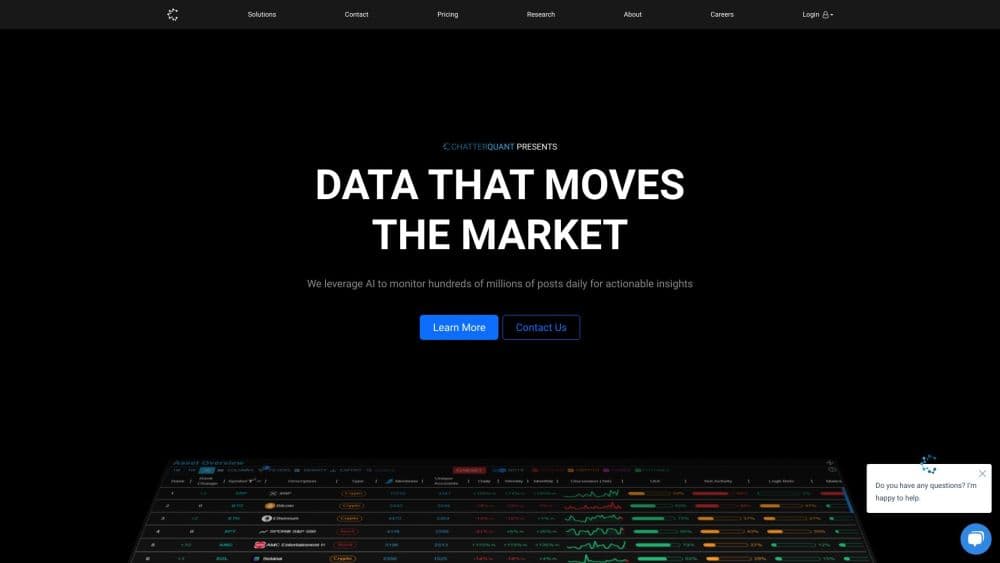
ChatterQuant turns stock and crypto chatter on Twitter and Reddit into mention and sentiment data for trading teams, delivered through dashboards and a REST API.
About ChatterQuant
What Is ChatterQuant
ChatterQuant is a social media tracking platform built for financial professionals. It monitors public posts about stocks and crypto tickers, counts how often each asset gets mentioned, scores the tone of those posts, and sorts the accounts behind them into human, low quality, and bot buckets. The output lands in an analytics dashboard or comes out through a REST API.
The problem it addresses is the gap between what retail traders say online and what a desk can actually measure. Scanning feeds by hand doesn't scale past a handful of tickers, and raw mention counts are easy to inflate. ChatterQuant separates authorized bots from malicious ones and from ordinary users, so a surge in chatter can be read as organic interest or as a coordinated push.
The limits are worth knowing before a call with sales. Public coverage centers on Twitter and Reddit, while TikTok, YouTube, and news outlet coverage are still listed as coming soon on the site. The company publishes no price list and no self-serve signup, so access runs through a sales conversation. The public site also carries a 2022 copyright and several features marked as arriving that year, which makes a direct check on current coverage the sensible first step.
Getting Started
- Contact the sales team through the site and describe the assets, sectors, or portfolios you need covered.
- Get account credentials and API keys for the environment you're granted.
- Build a portfolio list or watchlist inside the dashboard, then open the feeds for the tickers you care about.
- Pull the same data through the REST endpoints if your models or internal tools need it, using the documented read access for datasets and private read access for your account.
- Compare sentiment and mention counts against price action over a window that matters to your strategy, then decide whether the signal earns a place in your process.
Product Information
A quick look at ChatterQuant's pricing, supported platforms, and performance.
Best for
The users, tasks, and scenarios where this tool fits best.
Users
- Hedge fund and asset management analysts
- Quant researchers building alternative data signals
- Risk and compliance teams watching retail sentiment
Tasks
- Due diligence on a single ticker
- Monitoring short-squeeze risk across a portfolio
- Separating real interest from manufactured hype
- Feeding sentiment into an existing model
Scenarios
- Earnings season
- Meme-stock volatility
- Building a data product
Key features
Mention and Sentiment Tracking by Asset
Every tracked ticker carries a set of counts and scores: mentions from regular users, low quality accounts, authorized bots, and malicious bots, each with its own sentiment value. That split is the core of the product. A raw mention spike means little on its own, but a spike driven by malicious bot accounts reads very differently from one driven by ordinary users, and the data lets you tell them apart.
Bot Detection and Manipulation Signals
ChatterQuant classifies accounts and looks for coordinated behavior, including pump attempts and short-squeeze campaigns organized among retail traders. For a desk holding a position in a heavily discussed name, that's an early warning that the conversation is being steered. The site lists Twitter malicious and authorized bot activity tracking as part of the standard dashboard.
Portfolio Dashboards
The dashboard is built around a portfolio you define, with feeds and metrics scoped to those holdings rather than to a keyword list. Analysts can generate a view for a specific book and check sentiment, mention volume, and narrative changes across it. The stated purpose is alpha generation, risk management, and faster due diligence, and the layout follows that order.
Smart Twitter and Reddit Feeds
Custom feeds filter the firehose down to accounts and threads that matter for your coverage. Instead of reading a timeline, you get a stream tied to the assets you follow, with the account quality labels attached. Reddit coverage includes investing communities where retail coordination tends to start.
Keyword and Narrative Trends
A trends view surfaces the market moving topics of the day and shows how narratives around individual names and the wider market shift. That's useful when a stock moves without an obvious catalyst and you need to know which story traders are telling each other.
SEC Filings Monitor
Trending SEC filings sit alongside the social data, so a filing that starts drawing discussion shows up in the same place as the chatter about it. It shortens the loop between a document landing and the market reacting to it.
REST API and Embeds
Real time data products are available through REST endpoints, with read access to datasets and private read and write access to your account. A websocket API is listed as coming soon, which matters if you need streaming rather than polling. Embeds let a partner surface the data inside an existing interface.
Pros and cons
Pros
- Mention and sentiment counts split by account type, including malicious and authorized bots, which is more useful than a single aggregate score.
- Ships with both dashboards and a sentiment API, so analysts and engineers can work from the same dataset.
- Covers stocks and crypto in one place, which suits desks that trade both.
- SEC filing activity sits in the same view as social chatter, cutting a step out of event-driven research.
- Built for institutional workflows from the start: portfolios, due diligence, and risk framing rather than consumer trend hunting.
Cons
- No published pricing and no self-serve trial. You can't evaluate the data without a sales conversation, which slows down a small team's decision.
- Coverage centers on Twitter and Reddit. TikTok, YouTube, and news outlet tracking were still marked as coming soon on the public site, so budget for gaps if your thesis depends on video or news.
- The public site carries a 2022 copyright and unresolved launch notes, so current feature status needs confirming directly with the company.
- Streaming access isn't live yet. Teams that need real time pushes have to poll the REST API for now.
Frequently asked questions
It measures what people say about stocks and crypto on social media. You get mention counts, sentiment scores, and account quality labels per ticker, which trading firms use for idea generation, risk monitoring, and due diligence.
Related content
Explore related tools, skills, and articles for ChatterQuant.
ChatterQuant Alternatives

ngram 2.0
ngram · Video · Marketingngram 2.0 is an AI video generator for teams. It turns a prompt, a screen recording, or a product URL into a narrated explainer, product demo, or AI avatar video, and every scene stays editable.

shippedit.me
Krawlup · Marketing · Businessshippedit.me now redirects to Krawlup, a web platform that audits SEO, AEO and page speed every week, then hands the fixes to AI coding agents over MCP.

MePersona
MePersona, Inc. · Writing · Productivity · MarketingMePersona is an AI unified inbox for creators. It learns your voice, drafts replies to fan messages from 12 platforms, and sends only what you approve.