

Clarity AI
Clarity AI · Writing · Coding · Marketing
Clarity AI is an ESG data platform that scores companies, funds and sovereigns on sustainability risk, climate and impact, so banks and asset managers can report to regulators and invest with traceable evidence.
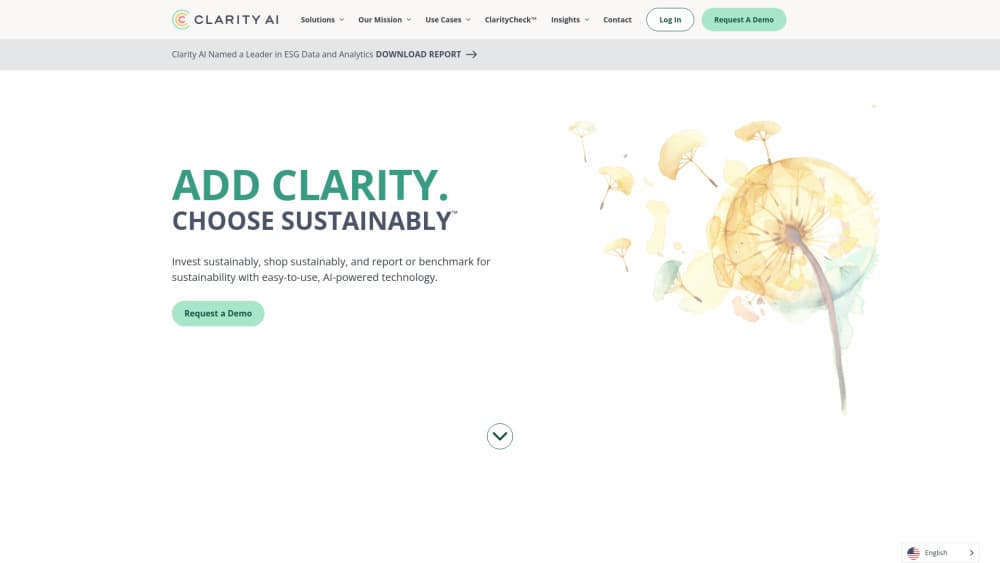
About Clarity AI
What Is Clarity AI
Clarity AI is a sustainability AI platform built for financial institutions. It turns company disclosures, news and satellite-level climate models into scores, exposures and reports that an analyst can defend in front of a client or a regulator.
The company started in 2017 in Madrid with one stated mission: bring societal impact to markets. It sells to asset managers, asset owners, banks, wealth managers, corporates and insurers, and its coverage reaches private companies and sovereigns, not just listed equities.
The limit is the same one that shapes every enterprise data vendor. There's no self-serve signup, no published price list, and no consumer app. You talk to sales, run a pilot, and license data or modules. Clarity AI also announced in September 2026 that it's combining with Glass Lewis, the proxy voting and governance firm, which will fold stewardship and voting data into the same platform over time.
Getting Started
- Book a call with the Clarity AI team and describe the workflow you need, such as a fund-level SFDR report or an ESG risk screen for a portfolio.
- Receive a sample dataset or a trial workspace built around your universe of companies and funds.
- Connect that universe through the data API, a flat file feed, or the web platform, depending on how your systems are set up.
- Build the first report or screen with support from Clarity AI's analysts, then hand the workflow to your own team.
- Review coverage gaps and methodology notes before you sign, since private company data and emerging market coverage carry more estimation than listed equity data.
Product Information
A quick look at Clarity AI's pricing, supported platforms, and performance.
Best for
The users, tasks, and scenarios where this tool fits best.
Users
- Sustainability analysts at asset managers
- Compliance teams at EU banks
- Portfolio managers who screen on climate
- Wealth and retail banking product owners
Tasks
- Producing SFDR periodic reports and principal adverse impact statements
- Screening a portfolio for controversies and ESG risk
- Checking a fund against EU Taxonomy alignment or ESMA fund naming rules
- Estimating financed emissions for a loan book or fund
Scenarios
- A bank preparing its first Pillar 3 ESG disclosure
- An asset manager answering a client questionnaire on a single holding
- A wealth platform adding a sustainability score to fund pages
Key features
ESG Scores Built From Source Data
Clarity AI computes ESG ratings from company reports, regulatory filings and news rather than reselling another vendor's scores. Each score keeps a path back to the document that produced it, which matters when a client or regulator asks why a company landed in a certain band. The company says its coverage reaches up to 42,000 companies, including private firms that never file a sustainability report.
Controversy and Exposure Screening
The platform tracks controversies and business exposures across holdings, so a portfolio review shows which names carry a governance failure, a labor dispute or a revenue link to a contested activity. Flags arrive with context instead of a bare number. For an ESG risk analysis, that context is usually the difference between a defensible exclusion and a guess.
Climate Analytics at Asset Level
Climate modules cover physical asset-level risk, scenario analysis, transition alignment, carbon footprint and nature and biodiversity. Asset-level modeling is the part that stands out. A utility's headline emissions say little about whether its plants sit in a flood zone or a water-stressed region. Scenario runs then show how those assets hold up under different warming paths.
Regulatory Reporting Modules
Reporting packs follow named rules: SFDR, EU Taxonomy, principal adverse impacts, MiFID II sustainability preferences, ESMA fund naming and Pillar 3 ESG. Each module ships with the field definitions the rule requires, which shortens the mapping work that usually eats a reporting cycle. Clarity AI is also moving toward authorisation under the EU ESG Ratings Regulation.
Fund Look-Through Across 360,000+ Funds
Fund coverage runs past 360,000 funds, with look-through to the underlying holdings and sovereign exposure. That turns a fund label into an actual portfolio view, so a "sustainable" fund's sector tilts and controversy load become visible. Sovereign coverage adds 198 national, 206 subnational and 50+ supranational entities for blended portfolios.
Delivery Through API, Feeds and Retail Channels
Data reaches clients through the ESG data API, scheduled file feeds or the web platform, so scores can sit inside an existing risk system instead of a separate tab. The retail banking solutions push the same scores into customer apps and advisor tools. Following the September 2026 combination with Glass Lewis, governance and proxy voting signals are being folded into the same delivery layer.
Pros and cons
Pros
- Coverage includes private companies and sovereigns, which most ESG data providers handle thinly or skip.
- Source-level traceability makes scores explainable to clients, auditors and regulators.
- Reporting modules map to specific EU rules, cutting the manual field mapping in an SFDR or Pillar 3 cycle.
- Physical asset-level climate risk adds a view that company-level totals can't provide.
- The Glass Lewis combination points to governance and voting data arriving in the same place.
Cons
- No free tier and no public pricing, so a small team can't test the data before a sales cycle.
- Costs scale with coverage and users, which makes budget approval slow for boutique firms.
- Private company scores rely on estimation and modeled data, so gap flags need a human check.
- Depth varies by region, and European regulation is clearly the strongest area.
Frequently asked questions
It's used to measure and report the sustainability profile of companies, funds and sovereigns. Banks and asset managers run ESG risk screens, climate exposure checks and regulatory reports such as SFDR disclosures on top of the same dataset.
Related content
Explore related tools, skills, and articles for Clarity AI.
Clarity AI Alternatives

Google EmbeddingGemma 2
Google DeepMind · Writing · Image · CodingGoogle EmbeddingGemma 2 is a 740M-parameter open model that turns text, code, images, audio, and video frames into vectors in one 768-dimension space, running on phones and laptops.

MePersona
MePersona, Inc. · Writing · Productivity · MarketingMePersona is an AI unified inbox for creators. It learns your voice, drafts replies to fan messages from 12 platforms, and sends only what you approve.

Fluence
Yay Software (Yannick Huchard) · Writing · Voice & Language · ProductivityFluence is an Android app that reads PDFs, EPUBs, Word files and web articles aloud, follows each sentence as it speaks, and answers questions about the text on the phone itself.