

Clarm - AI DevRel Engineer
Clarm · Coding · Marketing
Clarm is an AI coworker platform that helps operations teams turn the work they still do by hand into agents that run inside clear rails. It's built for governed, repeatable jobs. Built for complex, multi-system companies, Clarm Atlas lets IT and compliance approve reusable building blocks once, then lets non-technical operators assemble them into coworkers for order intake, client review, document control, and other recurring jobs. These are AI agents for operations. Not chat toys. Every answer carries a source receipt. Every action leaves an audit trail.
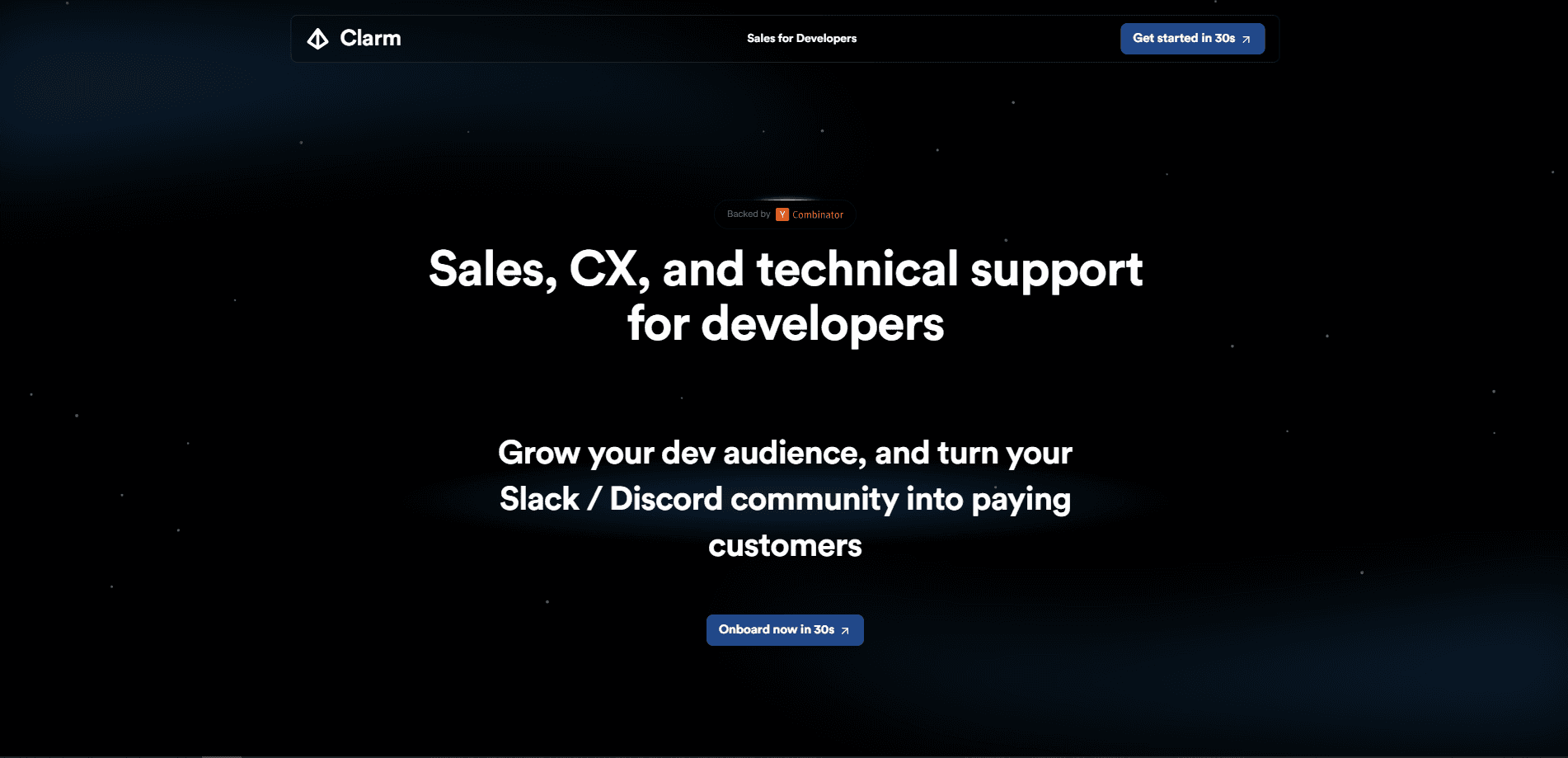
About Clarm - AI DevRel Engineer
What Is Clarm
Clarm is a platform for building AI coworkers that do recurring operational work rather than just answering prompts. The pitch is simple. A chatbot talks and then stops, while a Clarm agent carries a role, tools, and memory, builds from approved sources, and runs the job with receipts. Teams start with a workflow they already perform by hand, pick from a catalog of approved sources, rules, and guardrails, and ship the result straight into production. No rebuild needed.
The product is aimed at operations teams inside regulated or multi-system businesses where ungoverned agents are a non-starter. IT and compliance approve the building blocks once, so operators get freedom to deploy without asking for a fresh security review every time. That governance is the whole point of building governed AI agents this way. Clarm says it's backed by Y Combinator and reports enterprise pilots across healthcare, banking, and logistics.
The main limits are worth stating up front. It's an enterprise product, and the entry Team plan starts at $2,000 per month. Not cheap. That rules it out for small teams and solo users. Access is also gated. Team and Enterprise are being opened in waves through a waitlist, and there's no self-serve signup you can complete in ten minutes.
Getting Started
- Join the waitlist or book a pilot call from the Clarm site, since Team and Enterprise open in waves rather than instantly.
- Once your workspace is provisioned, connect the systems your team already uses, such as email, files, CRM, and internal policy documents.
- Have IT and compliance review the reusable building blocks, including sources, permissions, and guardrails, so they only need approval once.
- Pick one manual workflow, then drag approved sources and rules into a coworker and assign a named owner for sign-off.
- Run the job and review the audit trail and source receipts to confirm each action matched the rules you set.
Product Information
A quick look at Clarm - AI DevRel Engineer's pricing, supported platforms, and performance.
Best for
The users, tasks, and scenarios where this tool fits best.
Users
- Operations managers at multi-system companies who need the recurring work their team still does by hand to run without a fresh security review each time.
- Compliance and IT leads who want to approve a set of building blocks once and let operators reuse them, rather than gate every new agent.
- Client-facing teams in banking or professional services that need cited briefings and CRM-ready notes with a named owner signing off.
Tasks
- Turning email and file intake into a structured order or case, with missing facts flagged before the work moves on.
- Drafting cited account briefings from approved CRM notes, policy, and product context.
- Running customer checks against sanctions lists on a schedule. The coworker logs the trail and routes any match to a human owner.
- Producing weekly reports, allocation packs, and contract summaries from the systems the team already uses.
Scenarios
- A department that has one painful manual workflow and wants a single working coworker before expanding.
- A regulated rollout where every action needs a replayable audit trail and a source receipt.
- A global team that needs tenant isolation, SSO, or a self-hosted option before it can deploy anything.
Key features
Worker Builder From Approved Blocks
Clarm Atlas lets operators assemble agents by dragging reusable building blocks that IT and compliance have already approved, rather than writing prompts from scratch. Each coworker starts with a trigger, pulls from approved sources, runs a defined set of checks, and produces a named output. The blocks are pre-cleared. That means a new agent doesn't need a fresh security review every time someone builds one.
Source-Grounded Answers With Receipts
Every answer the coworker produces comes with a source receipt, so you can trace a claim back to the document or record it came from. That matters most in workflows where a wrong fact has real consequences, like client briefings or policy lookups. When a required fact is missing, the coworker flags it instead of guessing. Big difference.
Named-Owner Checkpoints
Before a sensitive output reaches a customer or a downstream system, Clarm routes it to a named human owner for sign-off. The coworker does the drafting and the research. A person owns the final call. This keeps the automation useful without handing final judgment to the model.
Audit Trail on Every Action
Clarm records an audit trail that a compliance team can replay, so you can reconstruct what an agent did and why. It's the feature that turns enterprise AI agent deployment from a board-level risk into something closer to routine. Regulated teams can show exactly which sources, rules, and approvals were in play. No guesswork.
Any Model, No Separate Subscription
Clarm runs on top of whichever model you prefer, including Anthropic's Claude, Azure OpenAI, AWS Bedrock, GCP Vertex AI, Together AI, or self-hosted inference. Model choice is a configuration change rather than a rebuild. No separate model subscription to buy. No API key to bring. Swapping models doesn't mean rebuilding the coworker.
Enterprise Isolation and Compliance
The Enterprise tier adds tenant-isolated retrieval and storage, single sign-on through SSO and SAML, and a self-hosted deployment option for teams with strict data rules. Clarm lists SOC 2 Type II, HIPAA, Swiss FADP, and GDPR among the standards it supports, which is what lets a global or regulated rollout clear procurement without a long back-and-forth. Dedicated support and custom pilot terms come with the same tier.
Pros and cons
Pros
- Governing blocks once at the IT level saves operators from a security review for every new agent.
- Source receipts and a replayable audit trail make the output far easier to defend in a regulated setting.
- Named-owner checkpoints keep a human in control of sensitive work before it leaves the system.
- Any model is included with no separate subscription, so you aren't locked to a single provider.
Cons
- The Team plan starts at $2,000 per month, which rules it out for small teams and solo users.
- Access is waitlisted and opened in waves, so you can't just sign up and start today.
- There's no free tier, so evaluating it properly means a paid pilot or a call rather than a quick trial.
Frequently asked questions
Clarm is a platform for building AI coworkers that complete recurring operational work instead of only answering questions. A coworker carries a role, tools, and memory, runs the job from approved sources, and returns output with citations and an audit trail. Teams use it for order intake, client review, document control, and similar repeated tasks.
Related content
Explore related tools, skills, and articles for Clarm - AI DevRel Engineer.
Clarm - AI DevRel Engineer Alternatives
Forefront
Forefront · CodingForefront is a web platform for building with open-source AI. It lets you fine-tune leading open-source language models on your own data, evaluate how they perform, and run them through an API or export them to host yourself. Developers who want the convenience of a closed-source platform but insist on owning their models and data are the target audience here.

Startkit
StartKit.AI · CodingStartkit is a boilerplate for building AI SaaS and AI wrapper products. Think of it as an AI startup boilerplate with the boring parts already wired up: authentication, Stripe and Lemon Squeezy payments, usage limits, transactional email, and an AI API starter that talks to OpenAI, Anthropic, Groq, or Llama. You clone the repo, set your price, and start on the part of your product that people actually pay for. It's Next.js under React and Tailwind, so most of the boilerplate code already feels familiar.
Testim
Tricentis · CodingTestim is an AI-powered test automation platform for building and running end-to-end tests across web, mobile, and Salesforce applications. It leans on machine learning to keep tests stable when an interface changes, so teams spend less time fixing broken selectors. Not bad for an automated testing tool you can start using today. You create tests by recording actions in a browser, then optionally add JavaScript when you need more control. It's a solid pick for busy QA teams.