

Clarum
Clarum · Business
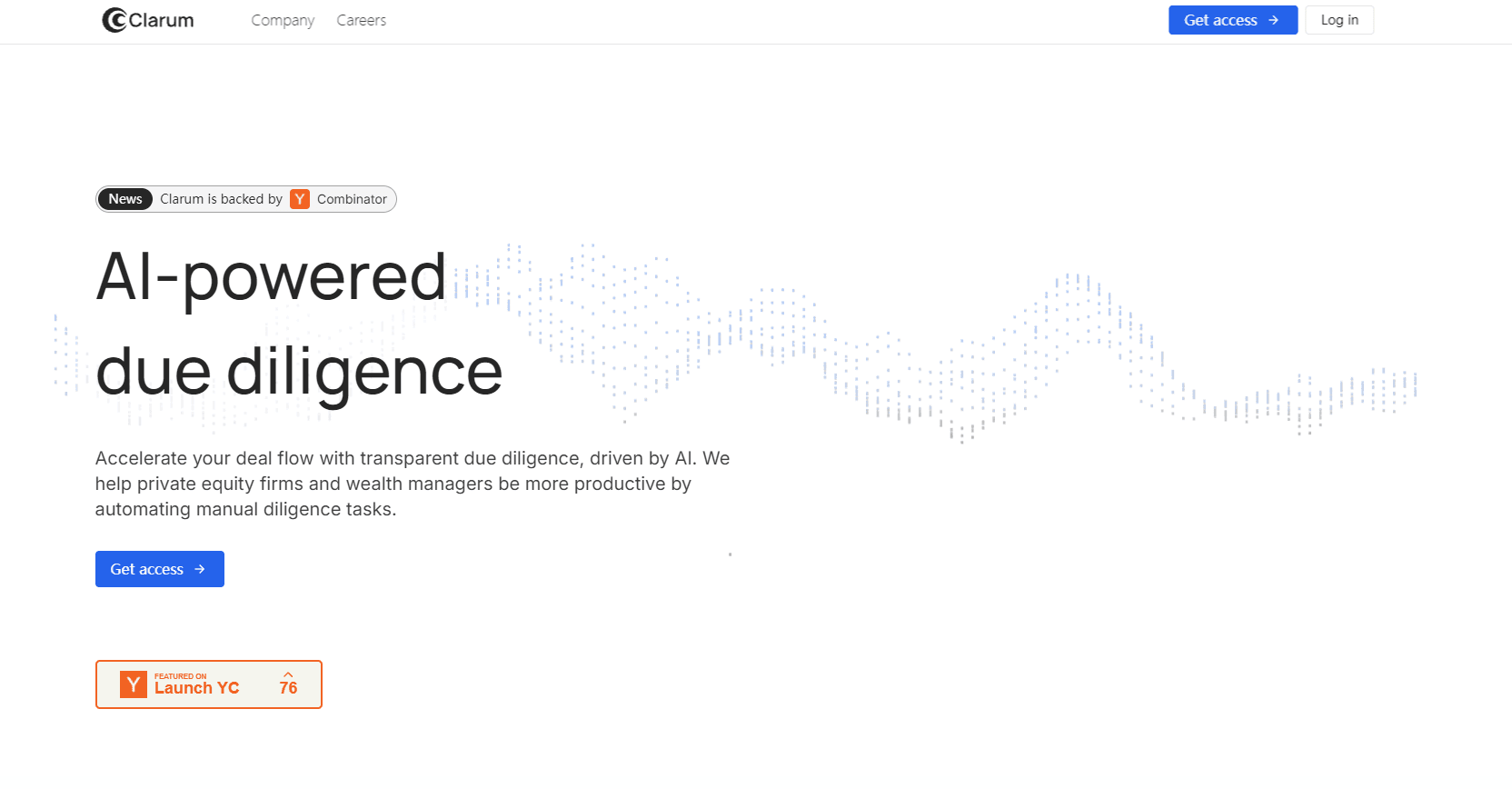
Clarum is an AI agent platform for private markets. It learns how a firm runs diligence, monitoring, and reporting, then automates those workflows end to end.
About Clarum
What Is Clarum
Clarum is due diligence software built for people who read fund documents for a living. Private equity firms, venture capital teams, family offices, and fund-of-funds use it to turn a data room into structured data, analytics, and finished deliverables. The company describes the product as AI agents for private equity diligence rather than a chat window: you hand over files, it returns answers, tables, and drafts.
The problem it targets is old and unglamorous. Every firm runs a slightly different process, with its own checklists, criteria, and house format, so off-the-shelf tools never quite fit. Clarum's agents observe how a specific firm works and copy that process. Diligence, portfolio monitoring, and reporting all run inside the same system. That's the difference between real deal diligence automation and a pile of disconnected tools.
Two limits are worth knowing up front. The platform is sold through a demo, and pricing isn't published, so budgeting takes a conversation. And the output is only as good as the documents you feed it. Messy scans and partial data rooms still need a human pass.
Getting Started
- Book a demo and walk the team through your current diligence and reporting process.
- Connect or upload the documents you normally work from, such as data room files, fund reports, and portfolio updates.
- Configure the criteria, checklists, and output format your firm already uses.
- Run a live deal or reporting cycle and review what the agents produce against your own work.
- Expand the agents to monitoring and recurring reporting once the first workflow checks out.
Product Information
A quick look at Clarum's pricing, supported platforms, and performance.
Best for
The users, tasks, and scenarios where this tool fits best.
Users
- Private equity associates who spend deal weeks in a data room, since the agents answer diligence questions from the files directly.
- Venture and growth investors screening many companies at once, because the same workflow can run across a pipeline without a new setup each time.
- Family offices and fund-of-funds teams that evaluate managers and funds, where document review is steady work rather than a one-off project.
- Wealth managers and advisors who need a defensible read on private market allocations without adding headcount.
Tasks
- Data room analysis
- Deal diligence documentation
- Portfolio monitoring
- Fund reporting
Scenarios
- A live deal with a few hundred pages and an investment committee meeting in ten days.
- Quarterly reporting season, when the same report has to be rebuilt for several funds.
- Ongoing monitoring across a portfolio of a dozen companies where nobody has time to read every update.
- A first review of a new fund or co-investment where outside counsel isn't in the budget yet.
Key features
Agents That Learn Your Firm's Process
Clarum's core claim is that its agents pick up how a specific firm works instead of forcing a fixed template. You show them your checklists, criteria, and preferred output, and they apply that pattern to new deals. That's investment workflow automation in the literal sense, not a dashboard with AI bolted on. It matters in private markets, where two funds can look alike from the outside and still run completely different reviews.
Data Room Import and Structured Extraction
You upload fund documents and the platform returns structured data instead of a wall of text. Financials, contract terms, and company details land in tables and fields you can filter. According to Clarum's Y Combinator launch page, firms can import data room files and get answers to hundreds of questions in minutes.
Diligence Question Answering
The agents answer diligence questions against the source documents, which cuts the back-and-forth of hunting through PDFs. Answers trace back to the files they came from, so an associate can check the reasoning before it reaches a partner. This is the feature that decides most buying conversations, because it replaces the slowest part of the job.
Portfolio Monitoring
Once a deal closes, the same agents keep reading. Portfolio company updates, management reports, and financial packages flow in and get compared against prior periods. You see what moved, what stalled, and which covenant or KPI needs attention, without an analyst rebuilding the model by hand.
Reporting and Deliverables
Clarum produces the deliverables themselves, not just the analysis behind them. Reports come out in your format, using your criteria, ready for an investment committee or an LP letter. Firms that generate the same report for several funds get the most from fund reporting automation, since the second and third versions cost almost nothing extra.
Enterprise Security Controls
Security is sold as a first-class feature rather than an add-on. Clarum is SOC 2 Type II certified and GDPR compliant, with AES-256 encryption at rest, TLS 1.3 in transit, role-based access, SSO through SAML 2.0 and OIDC, enforced MFA, and configurable data residency. The company states that customer data is never used to train AI models.
Pros and cons
Pros
- Learns each firm's diligence and reporting process instead of forcing a single template, which is rare among due diligence software.
- Covers sourcing, diligence, monitoring, and reporting in one system, so teams stop moving files between tools.
- Turns data room documents into structured data and finished deliverables, not just chat answers.
- Serious compliance posture for the category, with SOC 2 Type II, GDPR, SSO, MFA, and data residency options.
- Named customers in private markets, including Stone Garden Group, Blue Ocean Capital Advisors, JB46, and Mosaic Advisors.
Cons
- No published pricing and no self-serve signup, so you can't test the product before a sales call.
- There's no mobile app, which is a problem for partners who review deals on a phone.
- No public API documentation, so teams that want to wire Clarum into their own systems can't plan for it yet.
- Results depend on document quality. Scanned or incomplete data rooms still need manual cleanup before the agents are useful.
Frequently asked questions
Clarum automates the document-heavy work of private markets investing: diligence, portfolio monitoring, and fund reporting. Teams upload data room files and get structured data, analysis, and drafted deliverables back.
Related content
Explore related tools, skills, and articles for Clarum.
Clarum Alternatives

Knocket
Knocket (Tencent RTC team) · Productivity · Business · ChatbotKnocket is a free live chat and contact page tool that lets visitors message you from your website, app, or a shareable link, with every reply handled from Telegram or one inbox.

shippedit.me
Krawlup · Marketing · Businessshippedit.me now redirects to Krawlup, a web platform that audits SEO, AEO and page speed every week, then hands the fixes to AI coding agents over MCP.

Ayven
Alknoma · Productivity · BusinessAyven is an AI control centre by Alknoma that turns a plain-language goal into a dated plan, hands the work to your people and AI agents, and asks for your approval only when the call is yours.