

Clay
Clay · Coding · Marketing
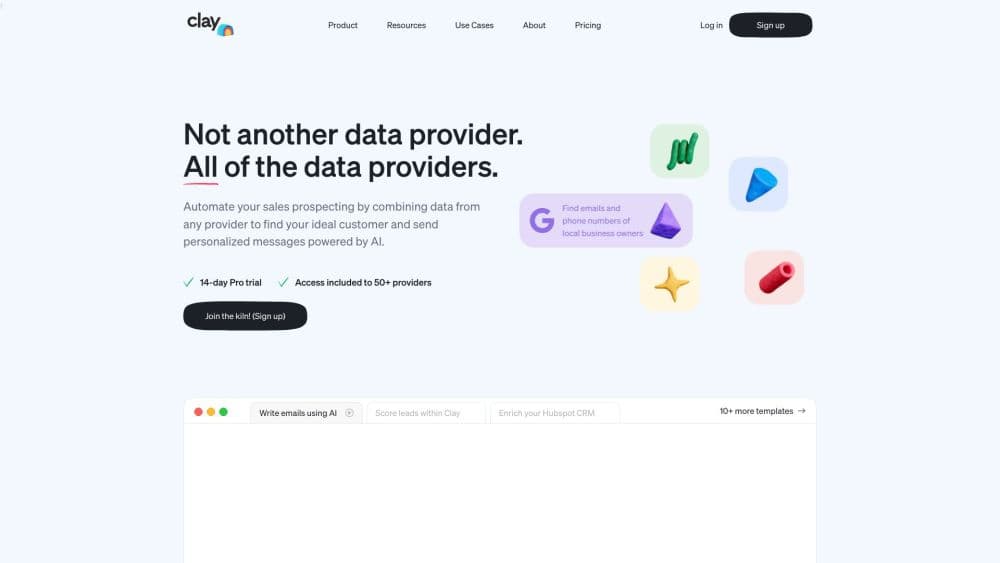
Clay is an AI go-to-market platform that pulls data from 150+ providers, tracks buying signals, and runs automated sales and outreach workflows in one workspace.
About Clay
What Is Clay
Clay is a go-to-market platform that sales, marketing, and growth teams use to find prospects, enrich their data, and act on it without hopping between a dozen tools. You point it at a list of companies or people, and it fills in the blanks: contact details, job titles, funding history, tech stack, and more. The pitch is simple enough. One workspace replaces the spreadsheet, the enrichment vendor, and the sequence tool that used to live apart.
What sets Clay apart is how it gets that data. Instead of buying one provider's database, it runs a waterfall: it asks provider A, and if the answer comes back empty, it moves to provider B, then C. That matters for coverage. No single vendor has accurate emails for everyone, so falling through several databases beats trusting one.
The product's centerpiece is Claygent, an AI agent that browses the web to answer custom questions you would otherwise pay an analyst to research. Ask it to summarize a company's latest press release or find whether a prospect posted about a competitor, and it returns an answer in the same table.
The catch is the learning curve and the cost. Clay is built for people who think in spreadsheets and workflows, and the pricing runs on credits that real prospecting at scale burns through quickly. A solo founder testing an idea can start free. A team running outbound every day is looking at a four-figure monthly commitment.
Getting Started
- Sign up at clay.com. The free plan needs no credit card and gives you a small monthly credit allowance to try the core enrichment.
- Import your starting list. Pull companies or people from a CSV, a CRM, or Clay's own search, and they land in a table.
- Add enrichment columns. Choose the data points you want, such as work email, headcount, or funding, and Clay runs its provider waterfall to fill them in.
- Bring in Claygent for the open-ended questions. Describe what you want found in plain language, and the agent researches each row.
- Turn enriched rows into action. Push qualified records to your CRM, drop them into a sequence, or trigger a webhook when a signal fires.
Product Information
A quick look at Clay's pricing, supported platforms, and performance.
Best for
The users, tasks, and scenarios where this tool fits best.
Users
- Sales development teams
- Marketing and growth teams
- RevOps and GTM engineers
- Founders doing their own outbound
Tasks
- Finding verified work emails and phone numbers
- Researching accounts at scale
- Enriching an existing CRM
- Personalizing cold outreach
Scenarios
- Building a target account list from scratch
- Reacting to a buying signal the same day
- Cleaning up a messy database
- Testing a new market
Key features
Multi-Provider Data Waterfall
Clay does not rely on a single data vendor. It asks one provider for an email or a phone number, and if the field comes back empty, it tries the next, then the next, until something hits. With more than 150 providers wired in, coverage tends to beat any one database on its own. That is the core reason teams replace a standalone enrichment tool with Clay.
Claygent AI Research Agent
Claygent is Clay's AI agent. It reads the web to answer questions you write in plain language, and it does this row by row across a whole table. Use it to summarize a company's latest news, check whether a prospect mentioned a competitor, or pull a detail no database stores. It turns research that used to be a human task into a column of output.
Signals and Buying Triggers
Clay watches for moments that suggest a company is ready to buy: a job change, a promotion, a new hire, a funding round, or a social post. When a signal fires, you can trigger a workflow automatically. This is what separates a live target list from a static one that goes stale the week after you build it.
CRM and Warehouse Sync
Growth plans connect Clay to your CRM and data warehouse, so records move both ways. Enrich a table, push updates back to Salesforce or HubSpot, and keep product data from Snowflake or BigQuery in the same view. For teams that already run on these systems, the sync is what makes Clay a layer rather than another silo.
HTTP API and Webhook Automation
Clay connects to anything with an HTTP API, and webhooks let any signal start a process. That opens the door to custom tools, internal services, and niche platforms that have no prebuilt integration. It is the feature that keeps Clay from being boxed into a fixed set of supported apps.
Clay Sequencer and Email Sending
Growth and Launch plans can send outreach without leaving Clay, and you can buy domains and mailboxes for the built-in sequencer. That closes the loop from enriched data to a sent email in one tool. Teams that already pay for a separate sequencing platform may not need this, but it does remove a handoff.
Audience Building and Import
Clay can run unlimited searches and import large audiences on higher plans, which is how you go from a broad filter to a ready list. Note the row limits on the cheaper tiers. A free table tops out at a couple hundred rows, so anything beyond a small test needs a paid plan.
Pros and cons
Pros
- The provider waterfall improves email and phone coverage, which raises deliverability and cuts bounce rates on outbound.
- Claygent handles open-ended research in plain language, replacing work that otherwise lands on an analyst's desk.
- Signals turn a static list into a live one, so reps reach out when timing is right instead of weeks late.
- Deep CRM, warehouse, and HTTP API integrations let Clay sit between existing tools rather than replace them.
- The free plan and modular credits let a small team test the workflow before spending real money.
Cons
- Pricing runs on credits, and at scale the cost climbs fast, so a busy outbound team can burn through a plan sooner than expected.
- The learning curve is real. Clay thinks in tables, formulas, and workflows, and new users spend time learning the model before they get value.
- Data accuracy depends on the third-party providers behind the waterfall, so a hard-to-find contact may still come back blank or wrong.
- The lower tiers cap rows and searches, which means heavier prospecting pushes you into a higher plan quickly.
Frequently asked questions
Clay is a go-to-market platform. Sales, marketing, and growth teams use it to find prospects, enrich their contact and company data from many sources, track buying signals, and automate outreach. It replaces the separate tools that used to handle researching, cleaning, and contacting leads.
Related content
Explore related tools, skills, and articles for Clay.
Clay Alternatives

Base Code
Base44 (Wix) · Coding · ProductivityBase Code is a shared cloud development environment from Base44. Teammates describe changes to an existing GitHub codebase in chat, preview them live and send them back as pull requests.

Google EmbeddingGemma 2
Google DeepMind · Writing · Image · CodingGoogle EmbeddingGemma 2 is a 740M-parameter open model that turns text, code, images, audio, and video frames into vectors in one 768-dimension space, running on phones and laptops.

GitGlow
GitGlow · Coding · ProductivityGitGlow is a local-first desktop Git client that lets independent developers review their own code and their AI agents' changes in one place before shipping.