

Cleanlist AI
Cleanlist · Coding · Marketing
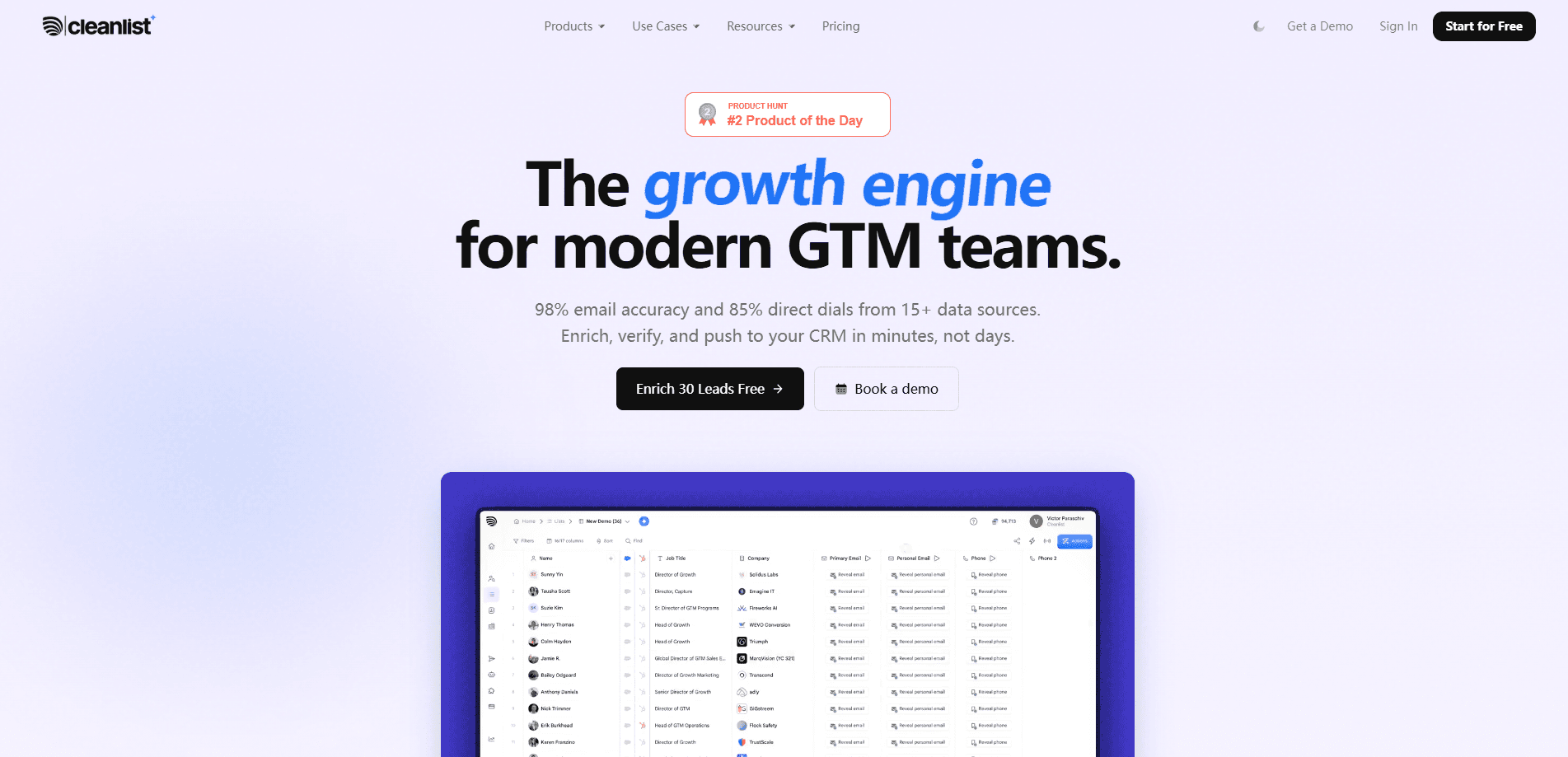
Cleanlist AI is a B2B data enrichment platform that turns a name, email, domain, LinkedIn URL, or CRM record into verified contact data. It runs every lookup through a 25+ provider waterfall, returns 98% verified emails and 85% direct-dial coverage, and pushes the enriched records back to your CRM in real time. If your sales team works from stale lists, this targets the gap between what a database holds and what's actually true today.
About Cleanlist AI
What Is Cleanlist AI
Cleanlist AI is the orchestration layer for B2B go-to-market workflows. The pitch is simple: take whatever you already have, whether that's a raw CSV, a LinkedIn URL, or a half-empty CRM record, and send it through a waterfall of 25+ data providers instead of trusting one static database.
The reason that matters is data decay. B2B contact data ages at roughly 22.5% per year, according to Cognism, so a list built last summer is already bleeding accuracy. A single-source database serves you a cached snapshot. The waterfall pulls live data on each lookup and cascades to the next provider when the first one comes up empty. That's why coverage isn't capped by any one vendor.
It's built for sales, marketing, and revenue operations teams who care about deliverability and want to stop paying for phone numbers that ring into the void. The tradeoff is credits. Heavy enrichment runs on them, so high-volume teams need to watch usage against their monthly cap. Miss the cap and enrichment stalls.
Getting Started
- Create a free workspace, no credit card needed. It opens on Scale for 14 days with 250 credits and 3 seats, then settles onto the Free plan at 30 credits a month.
- Bring your input: upload a CSV, import a Sales Navigator export, type a LinkedIn URL, or connect a CRM.
- Pick your columns. Choose verified email, phone, or a full contact, and add AI columns if you want the data transformed, not just appended.
- Run the waterfall and review the verification results before anything syncs.
- Push enriched records to your CRM, or export CSV if you'd rather keep it manual for now.
Product Information
A quick look at Cleanlist AI's pricing, supported platforms, and performance.
Best for
The users, tasks, and scenarios where this tool fits best.
Users
- Sales development reps
- Revenue operations teams
- Founders running early outbound
Tasks
- Email verification
- Contact discovery
- CRM data hygiene
- List building at scale
Scenarios
- Cleaning a bought or inherited list before a campaign so you don't burn your sending domain on bounces.
- Filling gaps in a Sales Navigator export when you need contact details the platform doesn't expose.
- Running weekly enrichment on active accounts to catch job changes and new roles before a rep reaches out.
Key features
Waterfall enrichment across 25+ providers
Rather than relying on one database, Cleanlist AI queries multiple premium providers in sequence. When one provider has no record for a contact, the request cascades to the next, so coverage isn't limited by any single source. In the company's own 500-lead benchmark, the waterfall returned 98% verified email coverage and 85% direct-dial coverage, against 70-80% and 30-60% for single-source databases on identical input.
Real-time SMTP email validation
Every email lookup runs a live check that covers syntax, DNS and MX records, and a mailbox handshake. An address only counts as verified if it's deliverable and not a risky catch-all, which is the difference between a number that looks good in a spreadsheet and one that survives a real send.
AI research agents and AI columns
This is where Cleanlist AI separates itself from a plain contact database. AI columns let you transform and enrich data on top of the waterfall. AI agents handle research tasks, so raw records come out structured and scored rather than dumped as-is. For teams that already have data but need it shaped, that's the part worth paying attention to.
Native CRM sync
Enriched records push straight into your CRM instead of landing in a CSV you have to import by hand. Native sync is available from the Pro tier up, which keeps your pipeline current without a manual data entry step every week.
Chrome extension and credit-based plans
The Chrome extension pulls enrichment into your browser. Work from LinkedIn or a prospect's site without switching tabs. Pricing runs on credits: 1 credit equals a verified email, 10 credits equal a phone number, and 11 credits cover a full contact. Extra seats run $20 a month on paid plans, and annual billing trims 25% off.
Pros and cons
Pros
- High verified coverage from the waterfall: 98% email and 85% direct-dial accuracy in the company's benchmark, well above single-source tools on the same leads.
- Free plan with 30 credits a month and no credit card, plus a 14-day Scale trial with 250 credits for real testing.
- AI columns and research agents add a transform layer that static databases don't offer.
- Native CRM sync from Pro up removes the manual import step for teams running weekly enrichment.
Cons
- Credit-based pricing means heavy enrichment scales with cost fast; Starter's 1,500 credits a month covers roughly 1,500 emails or just 150 phone numbers, so phone-heavy teams hit the cap quickly.
- The lowest-value features like CSV upload and Salesforce Navigator import only appear at Starter, so the Free tier is really just a trial.
- Native CRM sync and API access sit behind the Pro tier at $229/mo, which prices out solo founders who need those integrations most.
Frequently asked questions
It enriches and verifies B2B contact data. Feed it a name, email, domain, LinkedIn URL, or CRM record. It then queries 25+ data providers to return verified emails, phone numbers, or full contacts, and syncs the results to your CRM.
Related content
Explore related tools, skills, and articles for Cleanlist AI.
Cleanlist AI Alternatives
Forefront
Forefront · CodingForefront is a web platform for building with open-source AI. It lets you fine-tune leading open-source language models on your own data, evaluate how they perform, and run them through an API or export them to host yourself. Developers who want the convenience of a closed-source platform but insist on owning their models and data are the target audience here.

Startkit
StartKit.AI · CodingStartkit is a boilerplate for building AI SaaS and AI wrapper products. Think of it as an AI startup boilerplate with the boring parts already wired up: authentication, Stripe and Lemon Squeezy payments, usage limits, transactional email, and an AI API starter that talks to OpenAI, Anthropic, Groq, or Llama. You clone the repo, set your price, and start on the part of your product that people actually pay for. It's Next.js under React and Tailwind, so most of the boilerplate code already feels familiar.
Testim
Tricentis · CodingTestim is an AI-powered test automation platform for building and running end-to-end tests across web, mobile, and Salesforce applications. It leans on machine learning to keep tests stable when an interface changes, so teams spend less time fixing broken selectors. Not bad for an automated testing tool you can start using today. You create tests by recording actions in a browser, then optionally add JavaScript when you need more control. It's a solid pick for busy QA teams.